
26 · Vernacular, Gardens & Engineering WondersNo. 22 in era
Neuschwanstein Castle
A stage-set that learned to stand up. Neuschwanstein is the most famous castle never meant to defend anything — a theatrical evocation of the Middle Ages, first drawn by an opera scene-painter, that turned out to be one of the most technologically modern buildings of its age.
1. A picture before a building
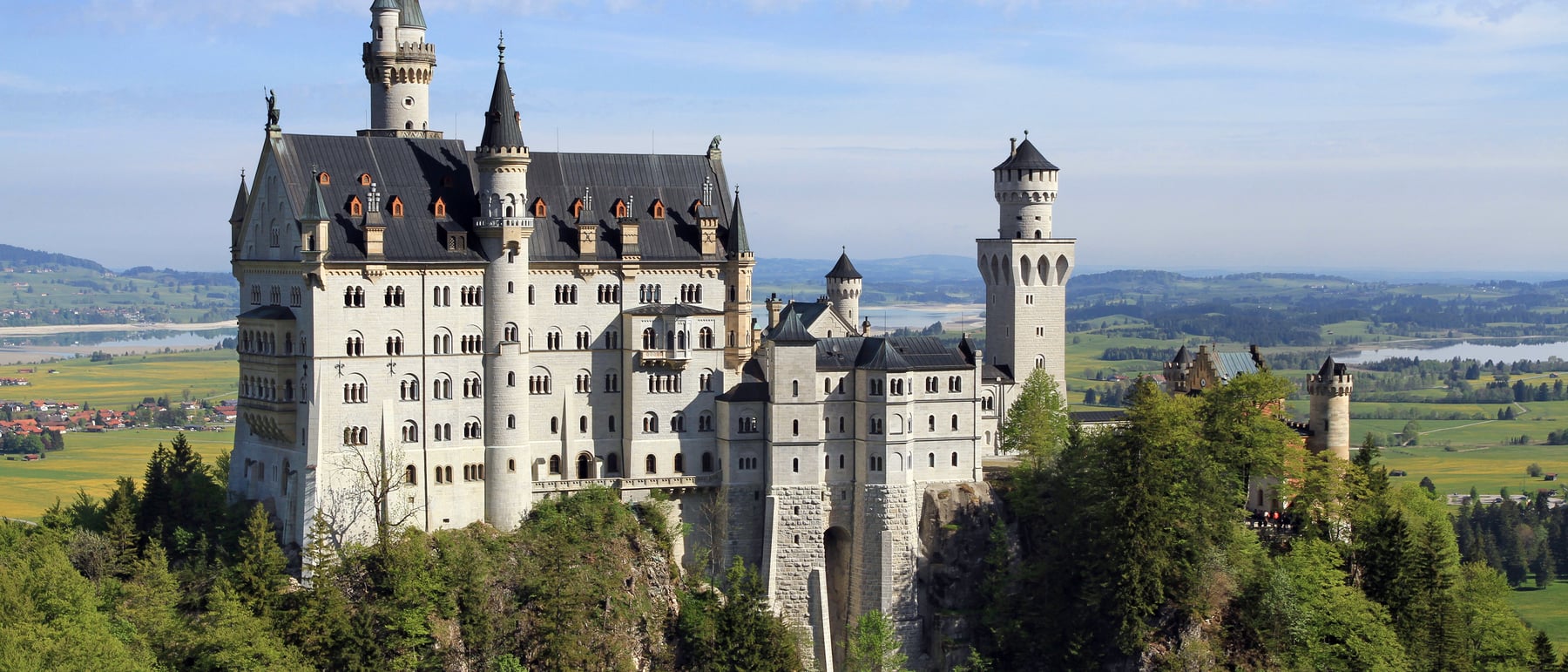
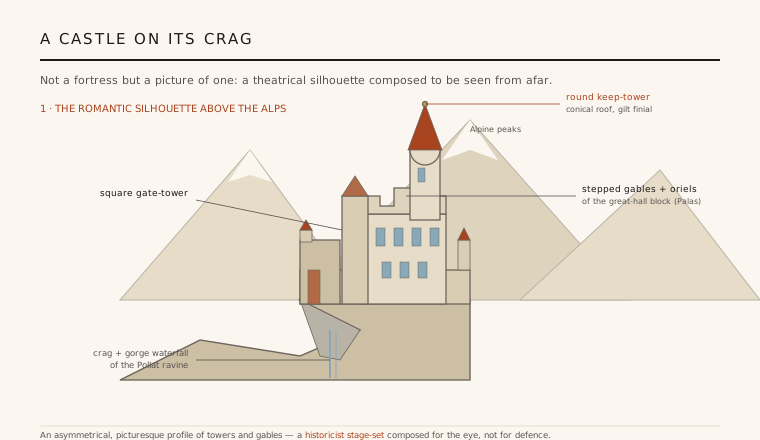
Neuschwanstein began not with an architect's plan but with a painting. King Ludwig II handed the first designs to Christian Jank, a theatrical scene-painter, whose watercolours composed an idealised knight's castle for the eye — an asymmetrical pile of towers, stepped gables and turrets crowning a crag above the Pollat gorge. Only afterwards were court architects Eduard Riedel and Georg von Dollmann tasked with turning these stage-flats into something that could actually be built, quarried and drained.
The result is architecture as image. The silhouette is calculated for the distant, picturesque view rather than for defence, circulation or economy: there is no real bailey to hold, no arrow-slits that matter, no siege logic. It is a Romanesque-Revival composition — round-arched windows, a slender keep-tower, a great-hall block (the Palas) — assembled from a scrapbook of the medieval past, closer in spirit to opera scenery than to a genuine fortress.
2. A shrine to Wagner
The plan is organised less around living than around Richard Wagner's operas. Ludwig, the reclusive "Swan King," built the interiors as a sequence of stage-sets drawn from Wagner's music-dramas. The vast Singers' Hall on the top floor recreates a medieval minstrels' hall from Tannhäuser; the Throne Room is a gilded Byzantine apse — a hall for a sacral kingship that Ludwig imagined more than he ever ruled.
Motifs of Lohengrin, the Swan Knight, saturate the building — in murals, textiles, carved swans and the very name Neuschwanstein, "New Swan Stone." The rooms are programmatic, narrative spaces: you move through the castle as through the acts of an opera. It is one of the purest built expressions of nineteenth-century Gesamtkunstwerk, the total work of art in which architecture, painting and music are meant to fuse into a single dream.
3. The Middle Ages on the outside, the 1880s within
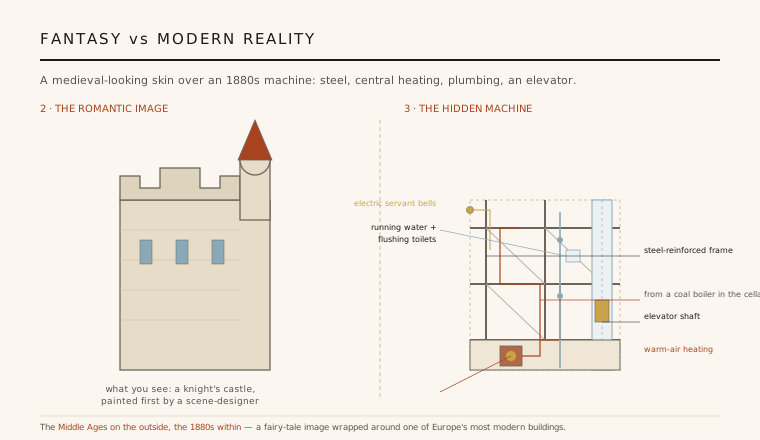
The great paradox of Neuschwanstein is that behind the medieval skin sits one of the most modern buildings of its era. The masonry is a brick core dressed in pale limestone, but it is stiffened with iron and steel members, and the tall Throne Room was carried on a hidden steel-framed structure — a frankly industrial technology masked entirely by hand-cut stone and painted plaster.
The services were startlingly advanced. A coal-fired central heating plant in the cellar drove warm air through ducts; running water reached every floor, with flushing toilets and automatic flushing for the privies. There was hot water for the kitchen, an elevator, telephone lines, and battery-powered electric bells to summon servants. The romantic exterior is, in effect, a costume worn by a thoroughly nineteenth-century machine.
4. Built to ruin a king
Neuschwanstein was ruinously expensive, and it was Ludwig's private obsession rather than a state project. Costs ballooned as the king revised, enlarged and gilded; the great gatehouse was completed first so he could live on-site and supervise, and only about a third of the rooms were ever finished. To keep building, Ludwig ran up enormous personal debts and pressed his court for ever more credit.
The spending became the pretext for his downfall. In 1886 a commission declared Ludwig insane — on medical evidence gathered without examining him — and deposed him; days later he died mysteriously in the shallows of Lake Starnberg, the castle still a building site. What was conceived as a solitary refuge from the modern world had, through its cost, entangled its maker fatally in the politics of that world.
5. The castle that became an image of "castle"
Within weeks of Ludwig's death the castle he built to hide in was opened to the public, and it has since become one of the most visited castles on earth. Its power is precisely that it was designed as a picture: it photographs as the idea of a castle, uncluttered by the messy pragmatism of real medieval building. That legibility made it the acknowledged model for Disney's fairy-tale castle, and through Disney the template for the castle in the popular imagination worldwide.
For architecture, Neuschwanstein is a hinge between eras. It is the culmination of nineteenth-century historicism — the borrowing of past styles as ready-made language — and, in its steel and services, an unwitting rehearsal of the modern building as a serviced, engineered shell wearing an applied skin. It reminds the discipline that the most influential buildings are sometimes not the most authentic but the most convincing as images.
Neuschwanstein is the ancestor of every themed resort, casino and Disney park where a steel-and-services building hides behind a scenographic historical skin — architecture as image first, structure second.
References & further reading
- 01Petzet, Michael (1995). König Ludwig II. und die Kunst. Hirmer / Bayerische Schlösserverwaltung, Munich.
- 02Bayerische Verwaltung der staatlichen Schlösser, Gärten und Seen (2023). Neuschwanstein Castle: Official Guide and History. Bavarian Palace Department, schloesser.bayern.de. https://www.neuschwanstein.de/englisch/idea/index.htm
- 03King, Greg (1996). The Mad King: A Biography of Ludwig II of Bavaria. Aurum Press, London.
- 04Blackbourn, David (1998). The Long Nineteenth Century: A History of Germany, 1780–1918. Oxford University Press, New York.
- 05UNESCO World Heritage Centre (2025). The Palaces of King Ludwig II: Neuschwanstein, Linderhof, Herrenchiemsee, Schachen. UNESCO World Heritage List, inscribed 2025. https://whc.unesco.org/en/list/1683/
Last verified 2026-07-11. Ancient and vernacular works often have no single architect or firm date; dates are given as widely accepted approximations and the builder-culture is named where no individual designer is known.