
24 · Brasília & the Modern CityNo. 03 in era
National Congress of Brazil
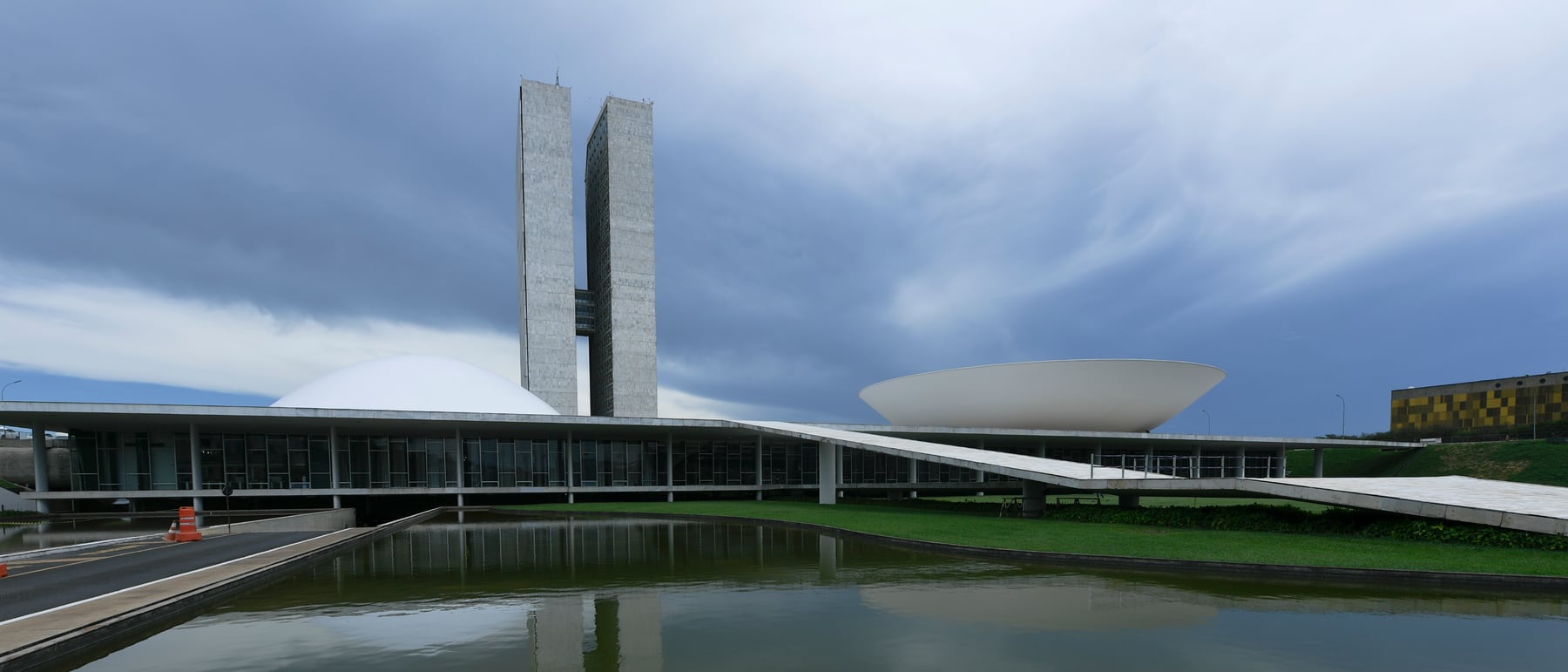
A dome, a bowl and twin towers. At the far end of Brasília's Monumental Axis, Oscar Niemeyer reduced an entire national legislature to a handful of primary shapes on a long white platform — and turned the business of government into abstract sculpture, legible from a kilometre away.
1. Government reduced to primary shapes
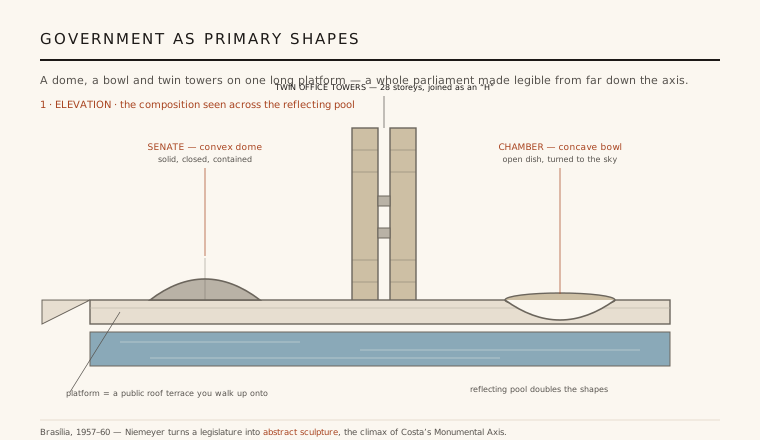
The National Congress is the visual climax of Lúcio Costa's Plano Piloto — the point where the long Monumental Axis runs into the Three Powers Plaza. Niemeyer answered that ceremonial approach not with a grand façade but with a diagram legible from far down the axis: a low horizontal platform carrying two shallow half-shells, with a pair of tall office slabs rising behind. Everything is stripped to elemental geometry — plane, dome, bowl and vertical.
The two shells are the debating chambers. A solid convex dome houses the Senate; an open concave bowl, or dish, houses the Chamber of Deputies. Between and behind them stand twin 28-storey towers, joined by walkways so that from a distance they read as a single letter H. It is one of the rare buildings whose entire composition can be grasped in a single silhouette.
2. The platform as public terrace
Niemeyer's boldest move is the great flat roof. The two chambers do not sit on the ground; they emerge from the top of a broad concrete slab that reads, from the plaza, as a horizontal esplanade. A long ramp climbs the slope beside it, so the public can walk up onto the platform and out among the shells — the roof of the parliament becomes an accessible open terrace rather than a barrier.
This inverts the usual monumental grammar, in which a parliament is raised on an inaccessible podium and reached by a flight of ceremonial steps. Here the podium is the destination. The reflecting pool laid in front of the platform doubles the whole composition, so that dome, bowl and towers appear twice — once in concrete and once in water — reinforcing the sense of a few pure forms floating on a level plane.
3. Two chambers, two opposite curves
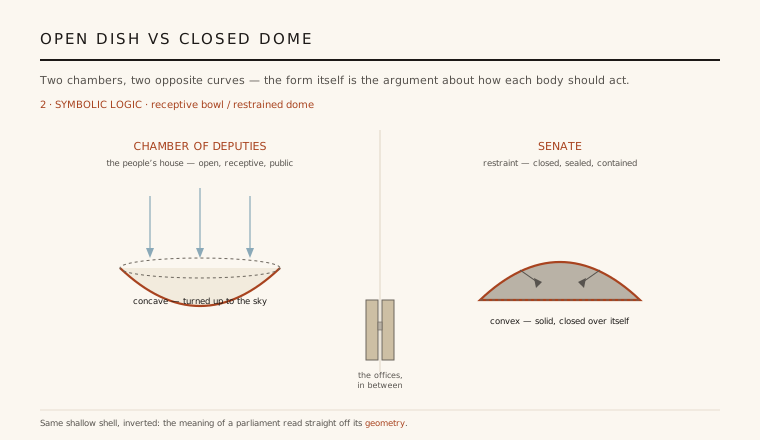
The symbolic logic is carried entirely by geometry. The Chamber of Deputies — the larger, popularly elected house — sits under the concave dish, a bowl opened upward to the sky: receptive, public, turned toward the people. The Senate sits under the convex dome, a shell closed over itself: an image of restraint, deliberation and containment. Same shallow shell, simply inverted, so that the meaning of each body can be read straight off its curve.
Whether or not the symbolism was fully intended from the first sketch, Niemeyer and later commentators embraced it, and it has become the building's standard reading. What matters architecturally is the economy: a single structural idea — a thin concrete shell — is used twice in mirror image, and that one gesture is enough to distinguish the two houses of a bicameral legislature at a glance.
4. Concrete plasticity and the free form
The Congress is a manifesto for Niemeyer's lifelong conviction that reinforced concrete had freed architecture from the straight line. Where his contemporaries in the International Style prized the rectilinear grid, he pursued curves — domes, shells and sweeping surfaces — arguing that concrete's plasticity invited exactly the forms that steel-frame orthodoxy forbade. The thin shells of the two chambers, engineered with Joaquim Cardozo, demonstrate how far a monolithic material can be pushed toward pure sculptural surface.
Against those low curves, the twin office towers supply the only strong verticals on the entire Monumental Axis. The contrast is deliberate: two slender slabs holding the sky above a field of horizontals and shells. The result is closer to an abstract composition — solid against void, curve against line, horizontal against vertical — than to any conventional idea of a government building.
5. Anchoring the capital
Brasília was built in under four years on an empty plateau to move Brazil's capital inland, and the Congress is the keystone of that gamble. It closes Costa's monumental spine and fronts the Three Powers Plaza, where it faces the Planalto Palace (the executive) and the Supreme Federal Court (the judiciary) — the three branches given three distinct Niemeyer forms around one civic space. The whole ensemble was inscribed as a UNESCO World Heritage Site in 1987, unusually early for a twentieth-century work.
Its influence runs in two directions. It confirmed that a modern legislature could be a work of abstract art rather than a revived classical temple, and it made Niemeyer's white-concrete curves an international emblem of Brazilian modernism. It also drew the standard critique of Brasília: a city and a parliament conceived as a sculptural image, monumental and photogenic, sometimes at the expense of the messier life of the street.
Every parliament or civic centre that tries to make democratic ideals legible in pure form — from Kahn's Dhaka assembly to countless competition-winning glass domes 'open to the people' — is still working in the shadow of Niemeyer's dish and dome.
References & further reading
- 01Underwood, D. (1994). Oscar Niemeyer and the Architecture of Brazil. New York: Rizzoli.
- 02Niemeyer, O. (2000). The Curves of Time: The Memoirs of Oscar Niemeyer. London: Phaidon.
- 03Holston, J. (1989). The Modernist City: An Anthropological Critique of Brasília. Chicago: University of Chicago Press.
- 04UNESCO World Heritage Centre (1987). Brasilia (inscription, criteria i, iv). World Heritage List no. 445. https://whc.unesco.org/en/list/445
- 05Deckker, Z. Q. (2001). Brazil Built: The Architecture of the Modern Movement in Brazil. London: Spon Press.
Last verified 2026-07-10. Ancient and vernacular works often have no single architect or firm date; dates are given as widely accepted approximations and the builder-culture is named where no individual designer is known.