
26 · Vernacular, Gardens & Engineering WondersNo. 16 in era
Machu Picchu terraces & drainage
The reason Machu Picchu is still standing after five centuries of earthquakes and torrential Andean rain is almost entirely invisible. What holds the royal estate to its knife-edge ridge is not its famous walls but its engineering — the layered terraces, deep foundations and gravity-fed water system buried beneath the view.
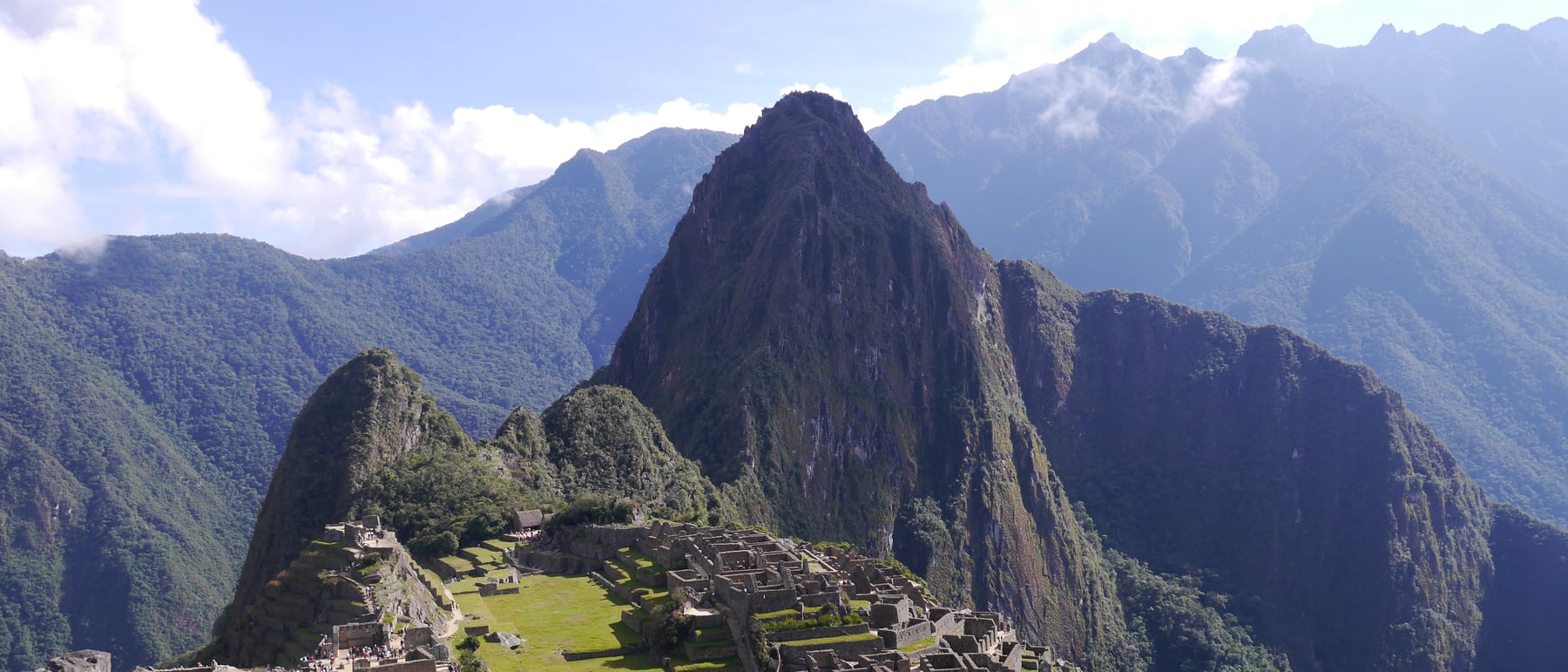
1. The terrace is a machine, not just a field
The stepped andenes that wrap Machu Picchu's slopes read as farmland, and they were — but growing crops was almost the least of their work. Each terrace is a piece of civil engineering that does three jobs at once: it creates a flat, workable surface on a slope too steep to farm; it retains the mountain, holding thousands of tonnes of earth against the pull of gravity and landslide; and it manages water, letting the constant rain move through the ground instead of tearing it apart.
The genius is that all three jobs are solved by the same object. A terrace is not a wall with soil dumped behind it. It is a carefully graded, layered fill — and it is that hidden section, rather than the neat masonry face, that keeps the ridge intact. On a mountain that receives roughly two metres of rain a year, controlling water is the whole problem, and the terrace is the answer.
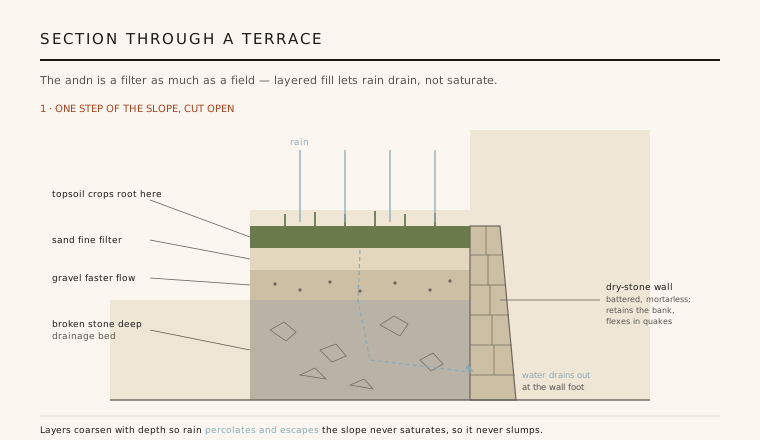
2. Reading the layered fill
Excavations behind the terrace walls reveal a deliberate stratigraphy. At the surface sits a layer of fertile topsoil, deep enough for roots — much of it carried up from the valley floor. Beneath it comes sand, then gravel, and at the bottom a thick bed of broken stone, often the rubble left over from quarrying and dressing the site's granite. The layers coarsen with depth, and that ordering is the entire point.
When rain falls, it drains through the fine topsoil, then meets progressively coarser material that carries it away faster and faster, until it reaches the broken-stone base and escapes through the joints of the dry-laid wall. Because water never pools, the fill never becomes saturated; because it never saturates, it never turns heavy and slumps. The terrace de-waters itself. This is why the andenes survive downpours that would liquefy an ordinary earth bank and send it sliding into the gorge.
3. A designed water supply
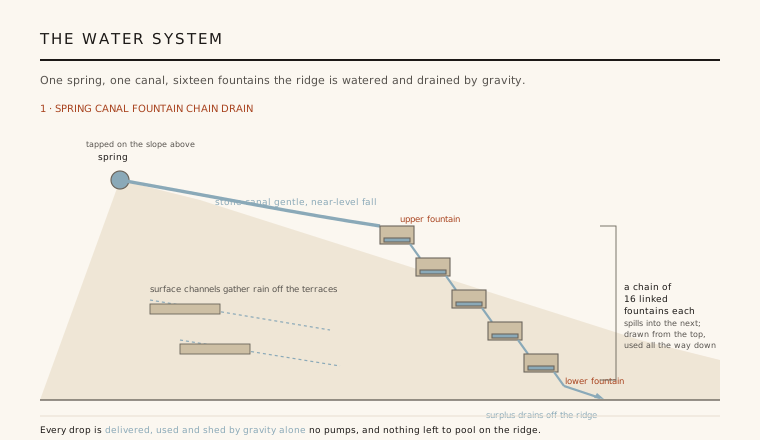
Machu Picchu also had to be lived in, and that meant clean water on a ridge with no river at the top. The Inca solved it by tapping a spring on the slopes of Machu Picchu mountain above the city and leading it along a finely graded stone canal — a channel cut to a gentle, near-constant fall so the flow stays steady and does not scour. The canal delivers the water to the heart of the settlement.
There it feeds a descending chain of sixteen linked stone fountains (the Inca paccha), each a small carved basin that spills into the one below as the water steps down through the town. The uppermost fountain, nearest the source, gave the cleanest water; those below served the rest. It is a complete hydraulic sequence — capture, convey, distribute, and finally discharge — driven entirely by gravity, with no pumps and no waste allowed to stand.
4. Most of the work is underground
The tourist sees dressed walls and green terraces; what the tourist cannot see is where most of the labour went. Studies of the site by engineers, notably Kenneth Wright, estimate that a large share of the total construction effort at Machu Picchu is buried — in deep foundations, in the graded terrace fill, and in a network of surface channels and subsurface drains that thread beneath the visible masonry to keep groundwater moving. The famous stonework is, in effect, the last and thinnest layer.
This inversion is the deep lesson of the site. The Inca built for a wet, seismic mountain by putting their intelligence below grade, where it does the structural work, and finishing with masonry above. It is architecture in which the invisible system — drainage, retention, foundation — is the primary building, and the walls are the visible reward for getting the hidden part right.
5. Building with the mountain
The Inca did not fight the ridge; they built with it. They quarried granite on the spot, so the stone never had to be hauled far and the quarry debris became terrace fill. They followed the natural contours and outcrops, letting the geology set the plan. And they laid their finest walls as dry-stone (mortarless) ashlar, blocks cut so precisely that they lock by friction and gravity alone — a technique that lets the masonry shift slightly and settle back during the frequent Andean earthquakes instead of cracking.
Taken together, the terraces, the drainage and the flexible walls form a single strategy for permanence in a hostile place: shed the water, retain the slope, and let the structure move. That is why a 15th-century estate on a rain-soaked, earthquake-prone ridge is still there to be visited. The engineering, not the view, is the achievement.
The terrace's coarsening-fill logic is exactly the graded, free-draining sub-base engineers now specify behind modern retaining walls and green roofs — the Inca were doing SuDS drainage design five centuries early.
References & further reading
- 01Wright, K. R. & Valencia Zegarra, A. (2000). Machu Picchu: A Civil Engineering Marvel. ASCE Press, Reston, Virginia.
- 02Wright, K. R., Witt, G. D. & Valencia Zegarra, A. (1997). Hydrogeology and Paleohydrology of Ancient Machu Picchu. Ground Water 35(4), pp. 660-666.
- 03Burger, R. L. & Salazar, L. C. (eds.) (2004). Machu Picchu: Unveiling the Mystery of the Incas. Yale University Press, New Haven.
- 04Wright, K. R., Kelly, J. M. & Valencia Zegarra, A. (1997). Machu Picchu: Ancient Hydraulic Engineering. Journal of Hydraulic Engineering 123(10), pp. 838-843.
- 05UNESCO World Heritage Centre (1983). Historic Sanctuary of Machu Picchu (Ref. 274). UNESCO World Heritage List. https://whc.unesco.org/en/list/274
Last verified 2026-07-11. Ancient and vernacular works often have no single architect or firm date; dates are given as widely accepted approximations and the builder-culture is named where no individual designer is known.