
25 · Late Modern, Postmodern & the Road to NowNo. 15 in era
Louvre Pyramid
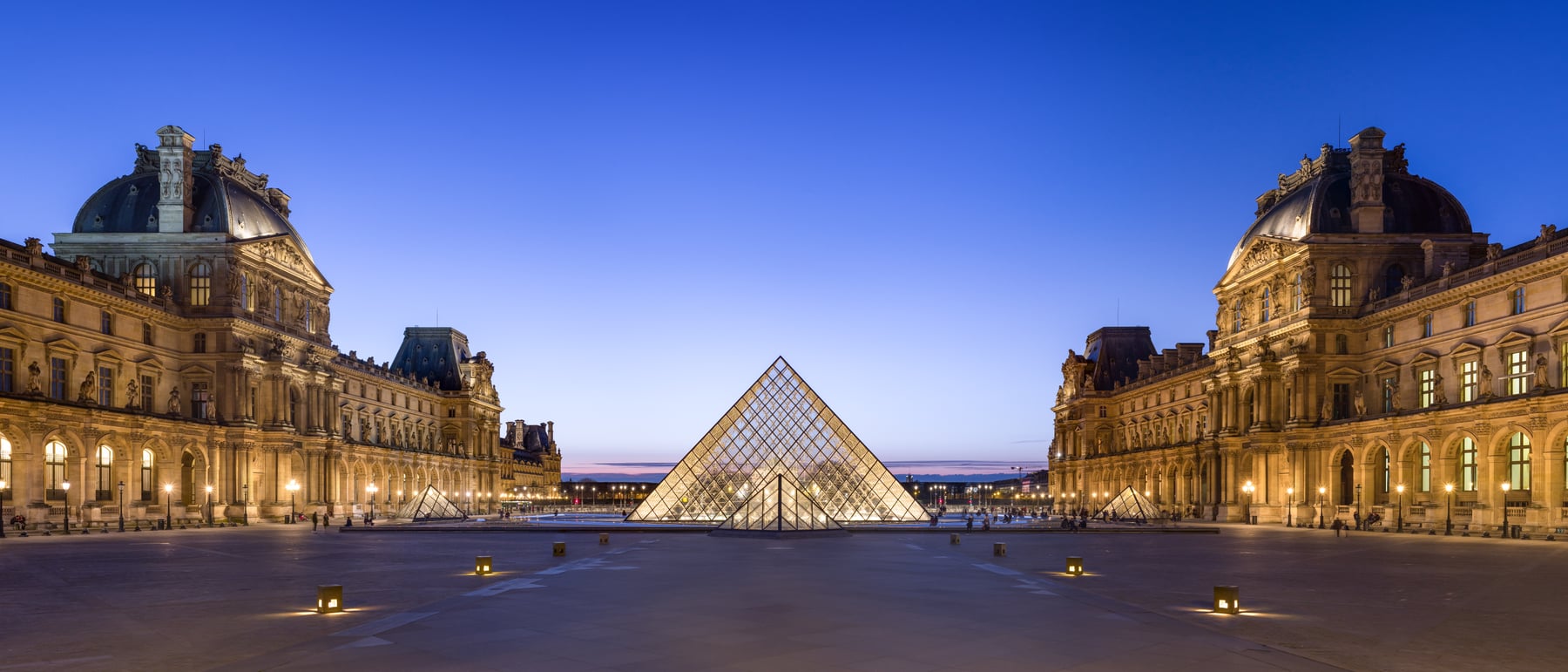
A glass pyramid in the courtyard of a palace — the most improbable and most successful act of mediation between old and new in modern architecture. Commissioned by President François Mitterrand as the flagship of his Grands Projets, I.M. Pei chose not to imitate the Louvre but to answer it with pure geometry and transparency.
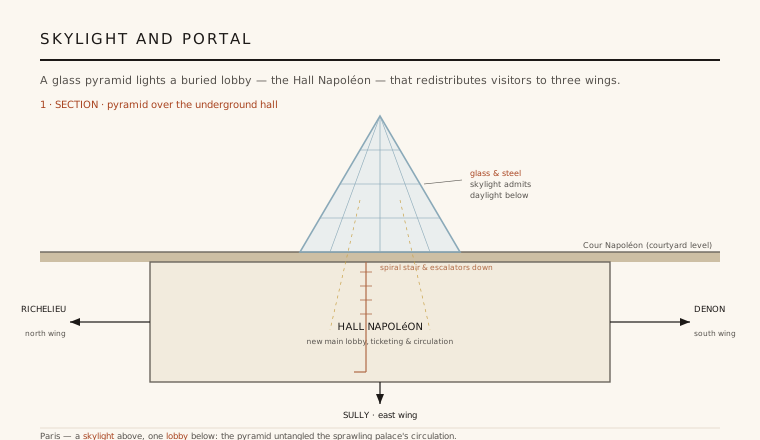
1. A skylight and a portal
The pyramid's first job is not to be looked at but to work. The sprawling Louvre had no single entrance and a circulation plan that defeated visitors; Pei's move was to excavate the Cour Napoléon and insert a vast new underground lobby, the Hall Napoléon, capped by the glass pyramid. The pyramid is therefore a skylight and a portal at once — a daylit lantern over a buried room.
From that one hall, escalators and a spiral stair carry visitors down and then out to the museum's three wings — Richelieu to the north, Sully to the east, Denon to the south. A monument that had grown for eight centuries by accretion was finally given a legible centre. The most photographed part of the design is the least important; the real intervention is the invisible reorganisation of the plan beneath the ground.
2. Contrast, not imitation
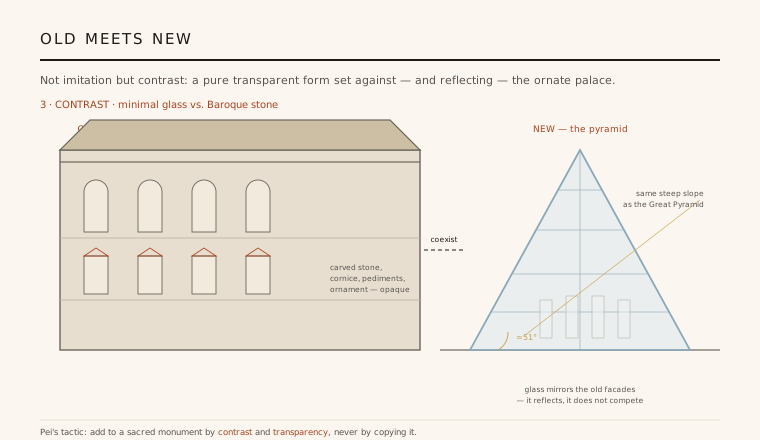
Adding to a hyper-sensitive historic monument is one of architecture's hardest problems, and the conventional answer is deference — match the cornice lines, echo the stone, disappear. Pei rejected that. A pastiche of the Baroque palace would have been a lie and would have looked like one. Instead he set against the ornate, opaque, carved facades their exact opposite: a single pure, minimal, transparent form with no ornament whatsoever.
The strategy is mediation by opposition. Because the pyramid shares nothing with the palace — not material, not scale of detail, not weight — the two never compete on the same terms; each makes the other legible. The old reads as old precisely because the new is so uncompromisingly new. It is an argument that respect for a monument can be shown by frank contrast rather than by camouflage.
3. Transparency as tact
Transparency is what makes the contrast bearable. Pei and his engineers specified a custom low-iron, ultra-clear glass, free of the greenish tint of ordinary float glass, so that the pyramid would read as pure crystal rather than as a solid green mass. In daylight the faces dissolve; in the right light they mirror the palace behind them. The new object literally reflects the old rather than blocking it.
The pure form is also loaded with reference. Its steep faces — close to the ≈51° slope of the Great Pyramid at Giza — reach back past the Baroque to the oldest monumental geometry humans built, so a self-consciously modern object also feels ancient and settled. A pyramid is, moreover, the one solid that resolves cleanly to a point against the sky, minimally interrupting the courtyard's grand axes.
4. Making it disappear: the cable-net structure
For the glass to seem to vanish, the structure holding it had to nearly vanish too. Working with the engineer Peter Rice and RFR, Pei's team built the faces as a lattice of slender steel struts pretensioned by thin rods and cables — a stressed net rather than a heavy frame. Borrowing rigging logic from yacht and greenhouse engineering, the members are kept as fine as structurally possible so the eye reads glass, not scaffolding.
The result was a genuine feat of late-1980s engineering: roughly six hundred rhomboid and triangular panes carried on a spidery web that looks too delicate to stand. The lesson the profession absorbed was that lightness is designed, not given — that a minimal appearance is the hardest and most deliberate kind of structure to achieve, and that engineering can be the true medium of an architectural idea.
5. From scandal to icon
The unveiling met fury. Critics called it a "scandal," "pharaonic," a gash and a scar on the face of historic Paris; the intrusion of a modern glass object — and an Egyptian form, and by a Chinese-American architect — into the heart of the French national palace was, for many, an outrage. Few buildings of the century were so loudly rejected on arrival.
That reaction has been almost completely reversed. Flanked by three small pyramids and later joined underground by the inverted pyramid, the Louvre Pyramid is now an unquestioned icon and one of the world's most recognised buildings — proof that additions to sacred monuments can be radical rather than deferential and still, in time, be loved. It remains the reference case for every architect asked to build the new beside the revered old.
Every glass-and-steel insertion into a historic fabric since — from the British Museum's Great Court to countless museum atria — argues Pei's case: that the honest way to add to the old is a transparent, frankly modern form that reflects it rather than mimics it.
References & further reading
- 01Jodidio, P. & Strong, J. A. (2008). I.M. Pei: Complete Works. Rizzoli, New York.
- 02von Boehm, G. (2000). Conversations with I.M. Pei: Light Is the Key. Prestel, Munich & New York.
- 03Rice, P. (1994). An Engineer Imagines. Ellipsis / Artemis, London.
- 04Musée du Louvre (2019). The Pyramid: History of the Louvre and its Architecture. Musée du Louvre official records, Paris.
- 05Wiseman, C. (2001). I.M. Pei: A Profile in American Architecture. Harry N. Abrams, New York.
Last verified 2026-07-11. Ancient and vernacular works often have no single architect or firm date; dates are given as widely accepted approximations and the builder-culture is named where no individual designer is known.