
1 · First Foundations (Prehistory & the Ancient Near East)No. 08 in era · ▸ India
Lothal dockyard
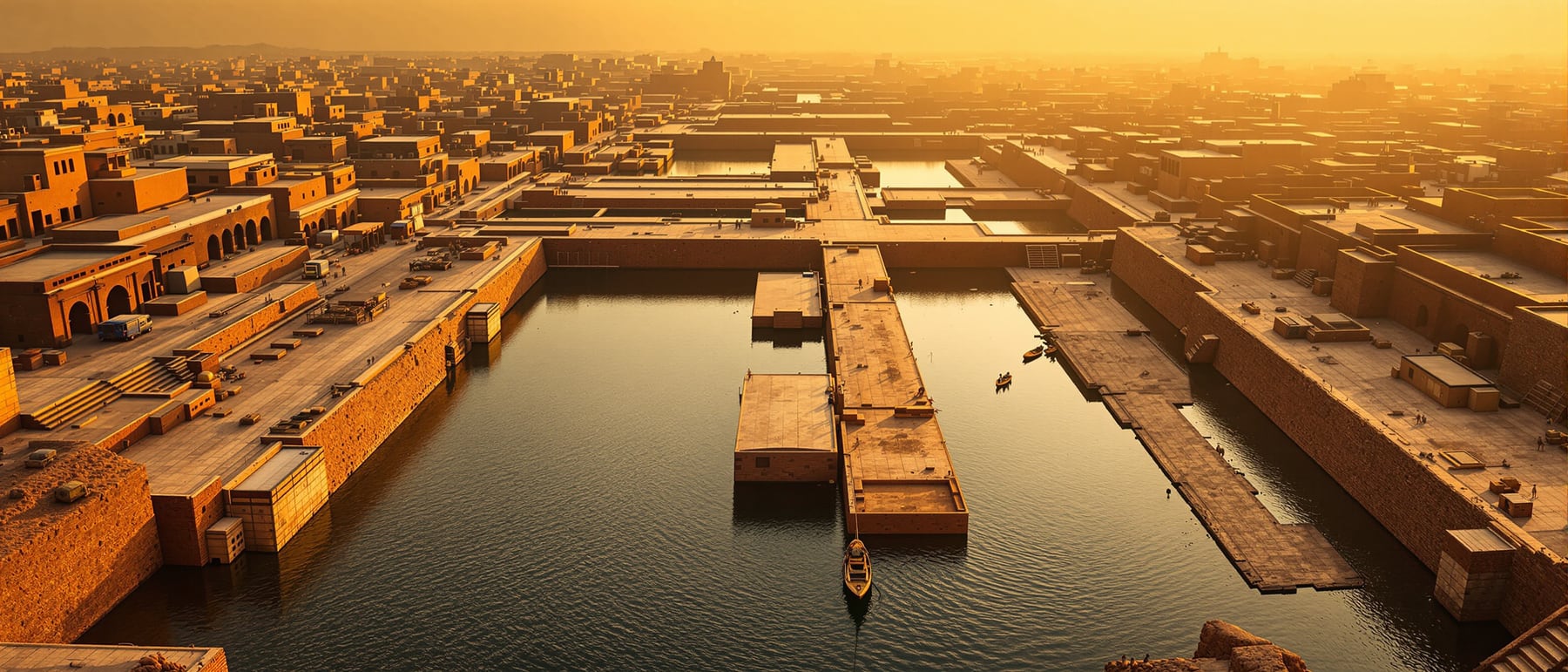
On a tidal flat in Gujarat, the Harappans laid a 217-metre brick basin against the estuary and let the sea flood in and out on command. Lothal is infrastructure raised to architecture — one of the earliest structures we can plausibly call a dock, and one of the most productively argued-over ruins in South Asia.
1. Infrastructure as architecture
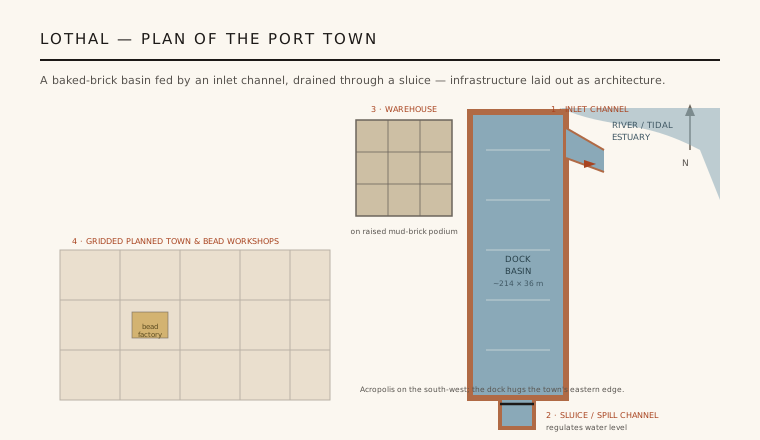
Most of the buildings we canonise are objects you stand inside — a hall, a tomb, a temple. Lothal is the opposite case: a piece of civic infrastructure so deliberately conceived that it reads as architecture in its own right. Founded around 2400 BCE at the north-eastern edge of the Harappan world, it was a small, intensely planned town wrapped around a single dominating feature — a vast rectangular basin of baked brick set hard against a tidal creek of the Sabarmati system, draining toward the Gulf of Khambhat.
That move — organising an entire settlement around a work of hydraulic engineering — is what earns Lothal a place in a canon of buildings. The dock, the warehouse, the workshops and the gridded streets were laid out as one system: bring goods in by water, store them on high ground, work them in the town, ship them out again. Ports, reservoirs and drains rarely make the architectural histories, yet here the water-work is the primary designed act, and everything else is arranged to serve it.
2. A basin built entirely in fired brick
The basin itself is an astonishing feat of Bronze Age construction. Its walls — roughly 214 metres on the long axis and 36 across, and preserved in places to about four metres — were built almost wholly in kiln-baked brick, laid in English-bond courses and set in a mud mortar, with fired brick chosen precisely because it resists water where the sun-dried mud brick of ordinary Harappan walls would slump and dissolve. Choosing the more expensive, fuel-hungry material for a structure that would sit permanently in water is an engineering decision, not a decorative one.
The walls batter slightly inward and were backed by earth to resist the outward push of an impounded body of water — the earliest hint in the subcontinent of a designer reasoning about hydrostatic load. Whatever the basin ultimately held, its makers understood that holding water in brick is a structural problem, and they solved it with the standardised, modular Harappan brick (in the civilisation's near-universal 1:2:4 proportion) deployed at civic scale.
3. Tide, inlet and sluice — and the great debate
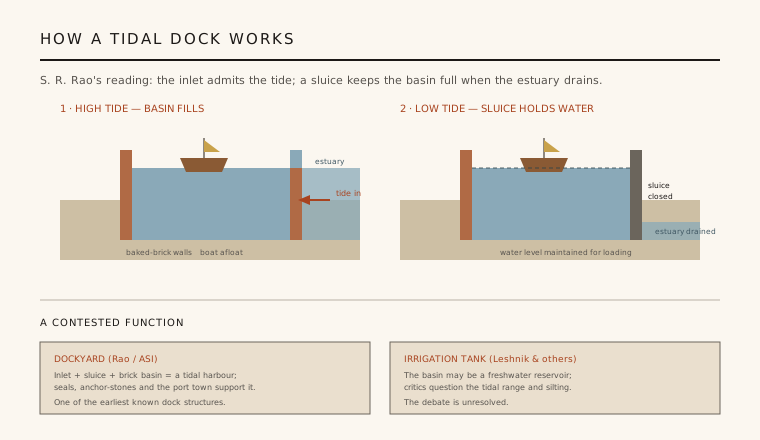
The basin's excavator, S. R. Rao, read it as a tidal dockyard. In his reconstruction an inlet channel roughly 12 metres wide, cut through the northern wall, admitted the incoming tide from the creek; a narrower spill channel with a sluice in the southern wall let surplus water out. By closing the sluice as the estuary drained, the harbour-masters could keep the basin brimming at low tide, so that flat-bottomed river boats stayed afloat and could be loaded and unloaded against the wharf — exactly the trick a modern lock or wet dock performs.
This interpretation is genuinely contested. Lawrence Leshnik and others argued the basin is more plausibly an irrigation tank or freshwater reservoir, questioning whether the tidal range reached Lothal, how boats could have entered a silting creek, and why a working port would sit so far inland. The evidence is honestly ambiguous: the seals, weights, a possible anchor-stone and the warehouse point to trade and storage, while the hydrology points both ways. The safest reading is that Lothal was a planned centre of maritime trade whose great basin may be the earliest known dock — a claim still worth arguing sixty years on.
4. The warehouse and the bead workshops
Beside the basin, on the town's raised acropolis, stood a warehouse built on a podium of mud-brick blocks — a grid of solid square plinths separated by narrow ventilation passages, lifting the goods clear of flood and damp. Many of the terracotta sealings found in and around it still carry the impressions of the cords and packing they once secured, so we can read the platform as a customs-and-storage house: cargo landed at the dock, stamped, and stacked on high, dry ground. Raising a floor on a ventilated plinth to beat monsoon flooding is a device Indian building would use for millennia afterward.
The town was also a manufactory. Lothal's craftsmen ran a celebrated bead industry, working carnelian, agate and steatite into micro-beads drilled with astonishing precision, alongside shell, ivory and copper work. A dedicated workshop quarter with kilns and a bead-drill assembly shows production organised by trade and zoned within the plan — architecture shaped around industrial process, not just dwelling.
5. A planned town, and why it still matters
For all the argument over the dock, Lothal's town is unmistakably Harappan and planned: a division into a higher acropolis and a lower town, streets on a rough grid, houses of standardised brick, and the civilisation's signature obsession with water — private baths, and covered brick drains running under the streets to carry waste away. It is a compact, legible demonstration of the Indus idea that a settlement is a designed object, sanitation and circulation included, laid down before the houses go up.
Lothal matters because it enlarges what we mean by early architecture. Long before temples and palaces dominate the record, here is a society investing its finest, most durable material and its best planning in shared infrastructure — a harbour, a warehouse, a drainage network. Whether the great basin proves to be a dock or a reservoir, it stands for the same civic proposition: that the works which move water and goods are worth building as carefully, and as monumentally, as anything we live inside.
Every contemporary port, lock and flood barrier engineered as civic architecture — from Rotterdam's Maeslant surge gate to the reborn dockland waterfronts of Kochi and London — continues Lothal's oldest argument: that infrastructure which commands the water deserves to be designed, not merely dug.
References & further reading
- 01Rao, S. R. (1979). Lothal: A Harappan Port Town (1955–62), Vols. I–II. Memoirs of the Archaeological Survey of India No. 78, New Delhi.
- 02Rao, S. R. (1973). Lothal and the Indus Civilization. Asia Publishing House, London.
- 03Leshnik, L. S. (1968). The Harappan "Port" at Lothal: Another View. American Anthropologist 70(5), 911–922. https://doi.org/10.1525/aa.1968.70.5.02a00050
- 04Possehl, G. L. (2002). The Indus Civilization: A Contemporary Perspective. AltaMira Press, Walnut Creek.
- 05Kenoyer, J. M. (1998). Ancient Cities of the Indus Valley Civilization. Oxford University Press, Karachi.
Last verified 2026-07-06. Ancient and vernacular works often have no single architect or firm date; dates are given as widely accepted approximations and the builder-culture is named where no individual designer is known.