
9 · Medieval India — Temple Cities & SultanatesNo. 03 in era · ▸ India
Konark Sun Temple
On the Odishan coast a king had his masons build the impossible: not a temple to the sun-god but the sun-god's own chariot, a colossus of carved stone riding on twenty-four wheels and dragged toward the dawn by seven straining horses.
1. A temple built as the god's chariot
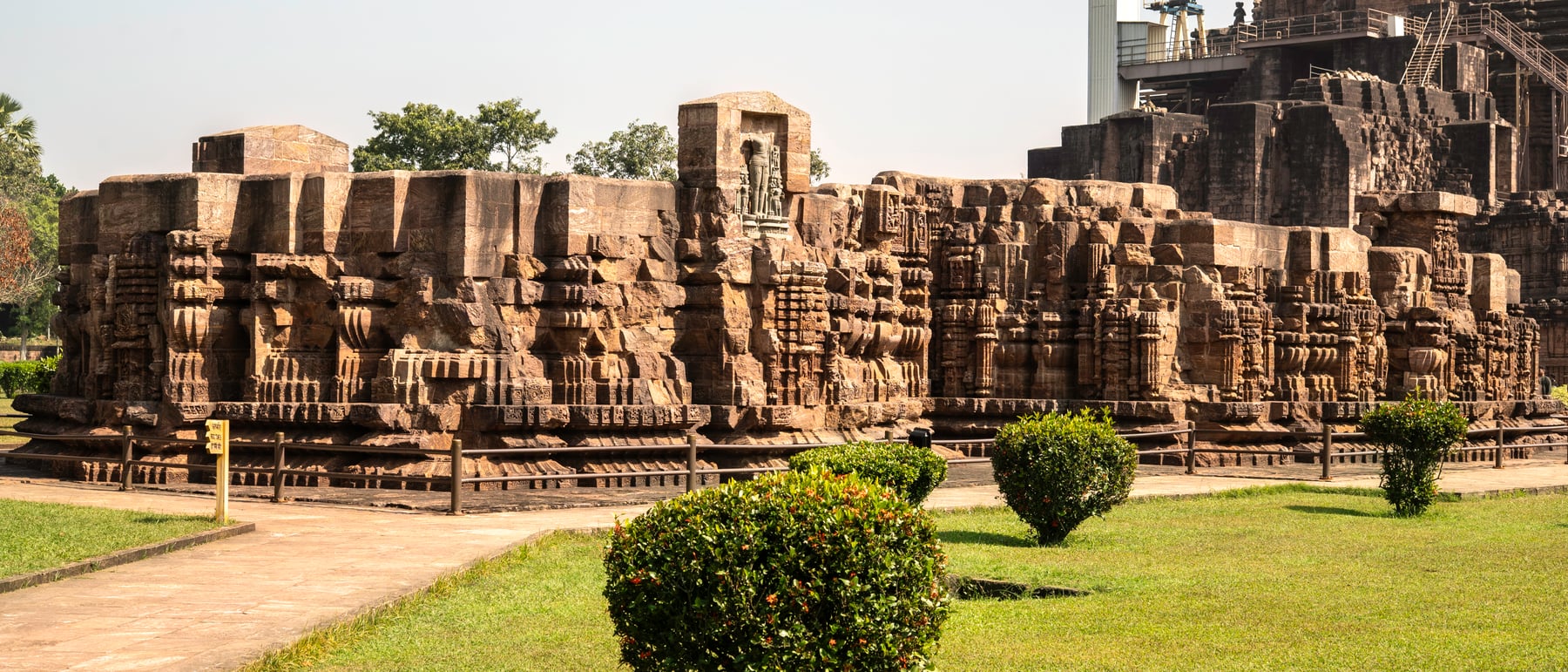
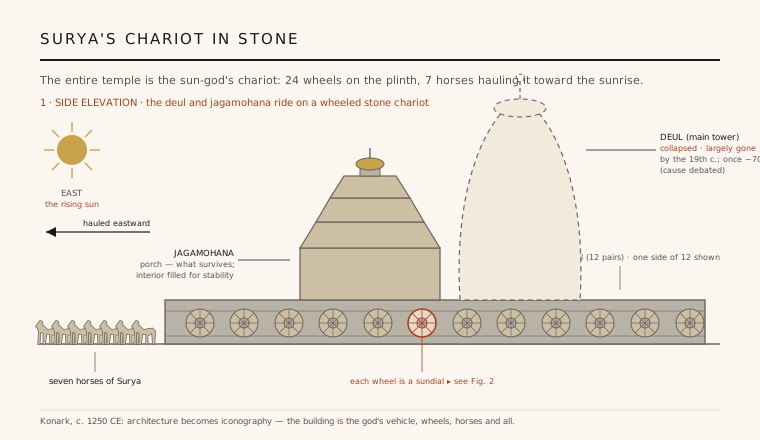
Most temples house a deity; Konark becomes the deity's vehicle. The whole complex was conceived as the ratha — the war-chariot — of Surya, the sun-god, imagined at the moment it is hauled across the heavens. Twenty-four monumental wheels, carved in twelve pairs along the terraced plinth, appear to carry the building forward, and a team of seven rearing horses is set at the eastern end to pull it toward the rising sun the temple faces. It is one of the most audacious literalisms in world architecture: the metaphor is not painted on the walls, it is the walls.
The conceit is not merely picturesque. Aligning the entire mass eastward turns the building into an instrument of the dawn, so that the first light strikes the sanctuary along the axis of travel. Later readings pile meaning on meaning — the 24 wheels as the hours, the 7 horses as the days of the week, the 12 pairs as the months — and while such numerology is partly retrospective, the governing idea is unambiguous in the stone: architecture here is pure iconography made structural.
2. The Kalinga Nagara plan: tower and porch
Beneath the sculpture Konark is a textbook of the Kalinga (Odishan) branch of Nagara temple building, the tradition that also raised the great shrines of Bhubaneswar and Puri. The type pairs two masses on a single east–west axis: a tall deul — the rekha sanctuary tower with its steep, gently in-curving profile — preceded by a jagamohana, the assembly porch roofed as a pidha deul, a stepped pyramid of receding horizontal tiers. In front of these once stood a detached dancing hall (nata-mandira) and a hall of offerings.
The distinction between the curvilinear tower and the pyramidal porch is the signature of the school, and Konark pushed both to a colossal scale. Tradition and 19th-century estimates put the vanished deul at perhaps as much as 70 metres — which, if true, would have made it the tallest temple tower in India. That figure is uncertain and probably idealised, but even the surviving porch, rising some 30 metres, conveys the ambition of a design meant to be seen from far out at sea.
3. Wheels that tell the time
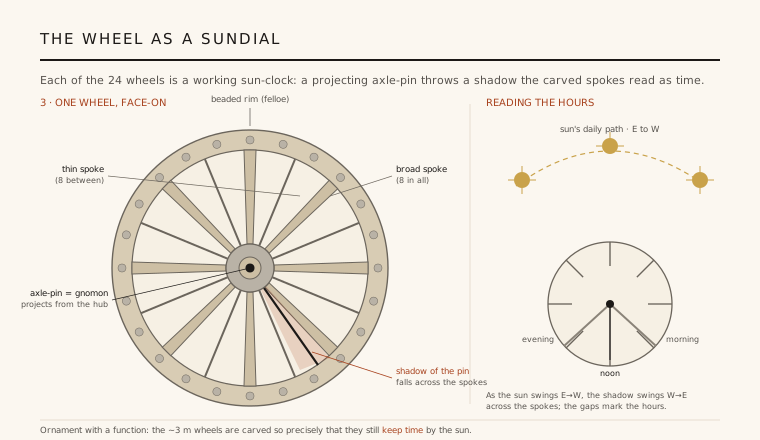
Each of the twenty-four wheels — roughly three metres across — is carved with a hub, a beaded outer rim (the felloe), and a rhythm of eight broad spokes alternating with eight thinner ones, plus a projecting axle-pin. It is widely held, and still demonstrated by local guides, that several wheels work as sundials: the axle-pin acts as a gnomon, and the shadow it throws across the spokes and rim-beads marks the time of day as the sun crosses the sky.
The geometry supports the claim. The eight broad spokes divide the wheel-face into the eight praharas, the three-hour watches of the Indian day, while the beads between them subdivide those intervals more finely, so a reading to within a few minutes is possible. Whether every wheel was intended as a working clock or whether some are purely emblematic is debated — but the precision of the carving shows that here, exceptionally, ornament and instrument were designed as one thing.
4. Stone, iron and the sea
Konark is built in three stones brought together with care: a core and platform of coarse laterite, the main fabric of grey-buff khondalite (a local gneiss), and the finest figures cut in dark, close-grained chlorite that takes a near-polished edge. To span its wide porch and bind courses that masonry alone could not hold, the builders used wrought-iron beams — some several metres long — one of the most ambitious uses of structural iron in the pre-modern world, and a reminder that this was an engineering project as much as a devotional one.
Its setting was equally deliberate. Raised near the shore of the Bay of Bengal, the tower was a landmark for mariners, who called it the Black Pagoda against the whitewashed "White Pagoda" of Puri inland. That coastal ground, however — soft, saline and shifting — is central to the temple's later misfortunes, and to keep the surviving jagamohana standing, its interior was deliberately packed solid with sand and stone during conservation work under the Archaeological Survey of India in the early 20th century.
5. The great loss, and why it still matters
The honest heart of Konark's story is that its masterpiece is gone. The towering deul had largely collapsed by the 19th century, and what visitors admire today is chiefly the jagamohana and the wheeled plinth. Why the tower fell is genuinely unsettled: candidates include structural failure on unstable marine foundations, the possibility that the immense spire was never fully completed, the loss of a binding keystone or lodestone (a persistent legend), and centuries of storm damage, quarrying and neglect. The prudent verdict is that several of these acted together, and that certainty is no longer recoverable.
Yet the fragment remains one of the summits of Indian architecture, inscribed by UNESCO in 1984 as "a monumental representation of the sun-god Surya's chariot." Its lesson is a large one: that a building can be conceived whole as a single vast symbol, and that even in ruin such a conception keeps its power. Konark is a caution about hubris and soft ground, and at the same time proof that the boldest architectural ideas outlast the stone that carried them.
Konark anticipates every building that is designed as an image before it is a shelter — from Utzon's sail-shell Sydney Opera House to Gehry's Guggenheim Bilbao — structures whose whole form is the message, and whose ambition flirts, as Konark's did, with the limits of what the ground can bear.
References & further reading
- 01Mitra, Debala (1968). Konarak. Archaeological Survey of India, New Delhi.
- 02Boner, A., Rath Sarma, S., Das, R. P. (1972). New Light on the Sun Temple of Konarka. Chowkhamba Sanskrit Series, Varanasi.
- 03Donaldson, T. E. (2005). Konark (Monumental Legacy series). Oxford University Press, New Delhi.
- 04Behera, K. S. (2005). Konark: The Heritage of Mankind. Aryan Books International, New Delhi.
- 05UNESCO World Heritage Centre (1984). Sun Temple, Konarak (inscribed 1984). UNESCO World Heritage List, no. 246. https://whc.unesco.org/en/list/246
Last verified 2026-07-06. Ancient and vernacular works often have no single architect or firm date; dates are given as widely accepted approximations and the builder-culture is named where no individual designer is known.