
26 · Vernacular, Gardens & Engineering WondersNo. 20 in era
Iron Bridge, Coalbrookdale
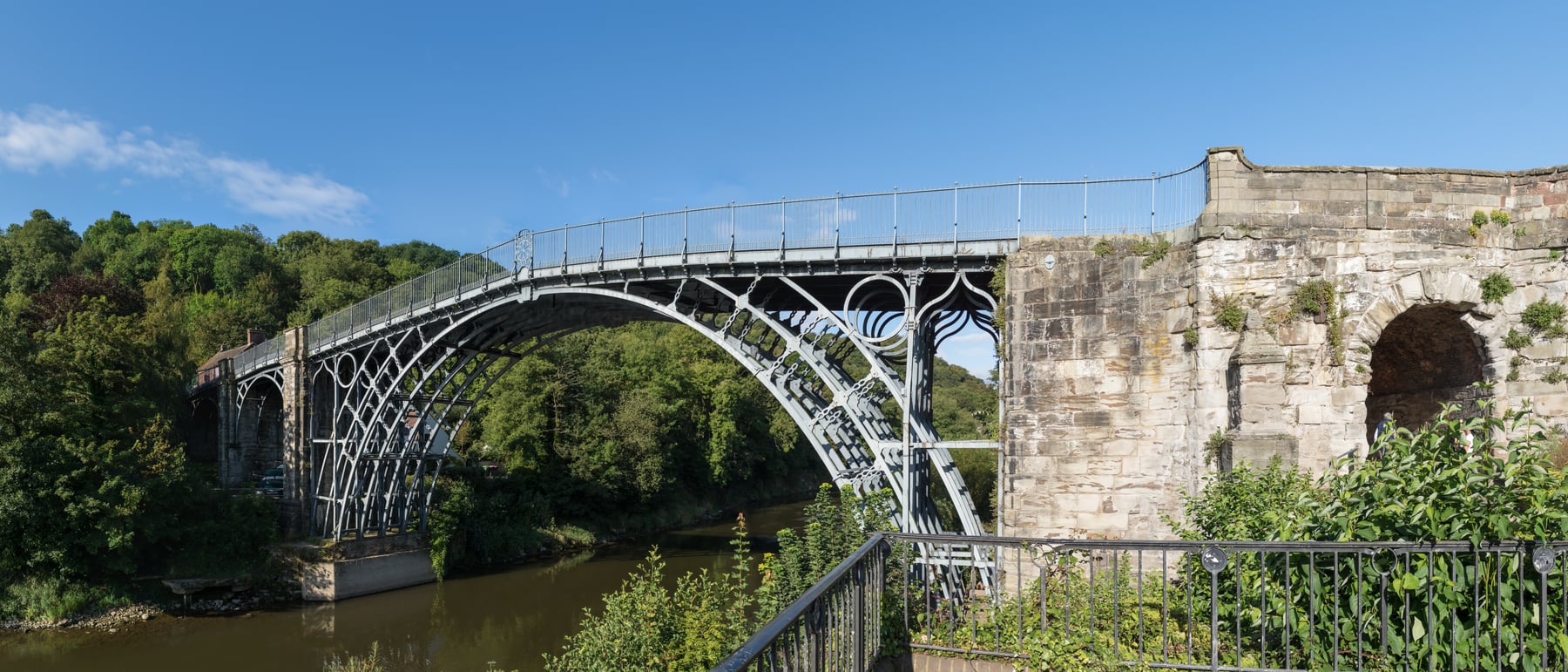
The world's first major bridge cast in iron — a single half-circle of metal thrown across the Severn Gorge, in the very valley where iron had first been smelted with coke. It is the moment a new structural material announced itself, still speaking, touchingly, in the grammar of wood.
1. One arch, cast whole
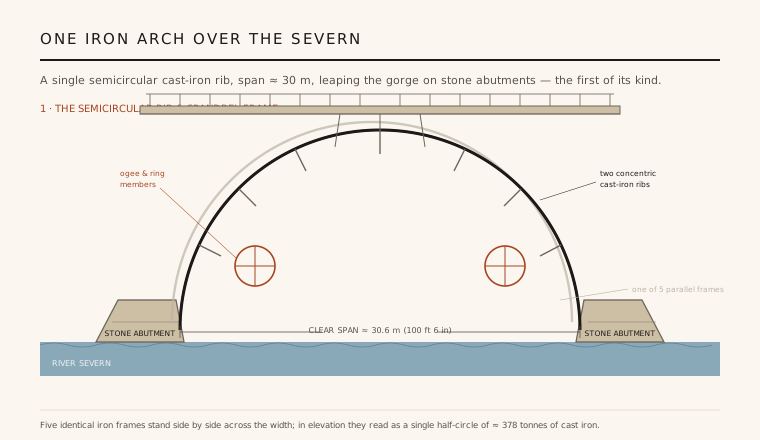
The Iron Bridge crosses the Severn in a single leap: one semicircular arch of about 30.6 metres, springing from stone abutments cut into the steep sides of the gorge. Across the width of the deck stand five identical iron frames set side by side, so that in elevation the eye reads a single clean half-circle. Each frame is built from two concentric ribs — a large outer arc and a smaller inner one — tied together by radiating struts and filled, near the springings, with circular and ogee-shaped ring members that carry the roadway down onto the abutments.
The scale of the individual pieces was unprecedented. The main ribs were cast in halves, each roughly 21 metres long, among the largest single castings any foundry had yet attempted. There was no theory of iron structures to lean on; the semicircle was chosen partly because it was a form masons and carpenters already trusted, and partly because a full arch throws its load cleanly down onto the rock walls of the gorge. The result is a structure that looks, and is, astonishingly light for its span.
2. The breakthrough that made it possible
The bridge did not appear out of nowhere. It stands a short walk from the furnace where, in 1709, Abraham Darby I first succeeded in smelting iron with coke instead of charcoal. Charcoal depended on dwindling forests and kept iron scarce and dear; coke, made from abundant local coal, broke that ceiling. Over three generations the Darbys turned Coalbrookdale into a place where iron was suddenly cheap, plentiful and cast to ever larger sizes.
That is the real precondition for the bridge. By the 1770s the Coalbrookdale works could pour enough iron, reliably enough, to contemplate a structure weighing hundreds of tonnes. The bridge was in this sense an advertisement — a very public demonstration, at a busy river crossing, of what the valley's iron industry could now do. Material abundance came first; the daring architecture followed.
3. Iron detailed as if it were timber
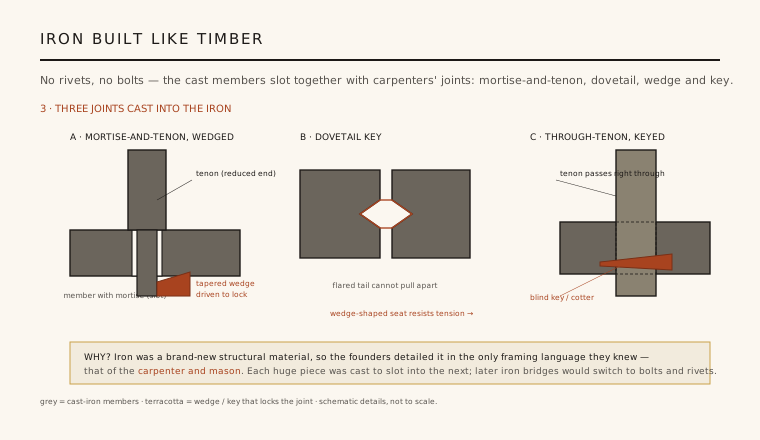
The most revealing thing about the Iron Bridge is how its parts are joined. There are no rivets and no bolts in the main structure. Instead the members lock together with joints lifted straight from carpentry and masonry: mortise-and-tenon, where the reduced end of one member passes through a slot cut in another; dovetails, whose splayed shape cannot pull apart; and wedges, blind keys and cotters tapped in to draw the joint tight. Each massive component was cast with these features already formed, so the pieces could be slotted and pegged together on site like an enormous wooden frame.
This is the signature of a first attempt. Iron was a brand-new structural material, and its makers detailed it in the only framing language they fully understood — that of the carpenter and the mason. The choice is slightly wasteful of metal and betrays an uncertainty about how iron really behaves, but it is precisely what makes the bridge so eloquent: you can watch an old craft tradition reaching to describe a new one. Within a generation, engineers would abandon these joints for bolts and rivets, and the timber grammar would vanish.
4. Attribution and dates
The design is usually credited to the Shrewsbury architect Thomas Farnolls Pritchard, who proposed an iron bridge here and prepared drawings, and the casting and financing to Abraham Darby III, master of the Coalbrookdale works. But the record is not tidy. Pritchard died in December 1777, before the ribs were cast, so how much of the executed design is his — and how much was worked out by Darby and his foundry men in the act of building — remains genuinely uncertain, and honest accounts say so.
The chronology is firmer. The great ribs were cast at Coalbrookdale over 1777–79 and raised across the river in the summer of 1779; the bridge opened to traffic on New Year's Day 1781. Darby carried much of the cost overrun himself and was, by some accounts, left in debt by the effort — the price of building the first of anything.
5. Why it matters
The Iron Bridge is a genuine first: the first major bridge, anywhere, to be built of cast iron, and the object that gave both a village and an idea their name. It proved that iron could span serious distances in the open air, and it did so with a lightness and slenderness that stone could never match. Everything that followed — the great iron and then steel arches, the train sheds, the exhibition halls, the skeletal frame itself — descends from the confidence this small bridge established.
It also marks a threshold in how architecture is made. Here, for the first time at scale, structure is prefabricated in a foundry and assembled on site, the building reduced to a kit of repeated, interchangeable metal parts. The surrounding Ironbridge Gorge, cradle of so much of this, was inscribed as a UNESCO World Heritage Site in 1986. The bridge still stands, restored, carrying pedestrians across the Severn — a monument that is also, quietly, the ancestor of the modern building industry.
Every prefabricated steel arch and bolted-together structural frame — from railway sheds to today's modular towers craned into place as ready-made components — traces its lineage to this one iron half-circle over the Severn.
References & further reading
- 01Cossons, N., & Trinder, B. (2002). The Iron Bridge: Symbol of the Industrial Revolution. Phillimore, Chichester (2nd ed.).
- 02Raistrick, A. (1989). Dynasty of Iron Founders: The Darbys and Coalbrookdale. Ironbridge Gorge Museum Trust / Sessions (orig. 1953).
- 03Trinder, B. (2016). The Industrial Revolution in Shropshire. Phillimore / The History Press (3rd ed.).
- 04UNESCO World Heritage Centre (1986). Ironbridge Gorge — World Heritage List, ref. 371. UNESCO, Paris. https://whc.unesco.org/en/list/371
- 05Historic England (2018). The Iron Bridge (Scheduled Monument & Grade I listing), Ironbridge, Shropshire. National Heritage List for England.
Last verified 2026-07-11. Ancient and vernacular works often have no single architect or firm date; dates are given as widely accepted approximations and the builder-culture is named where no individual designer is known.