
16 · The Industrial Revolution — Iron, Glass & the New ProgramNo. 10 in era · ▸ India
Howrah Bridge / colonial civic works
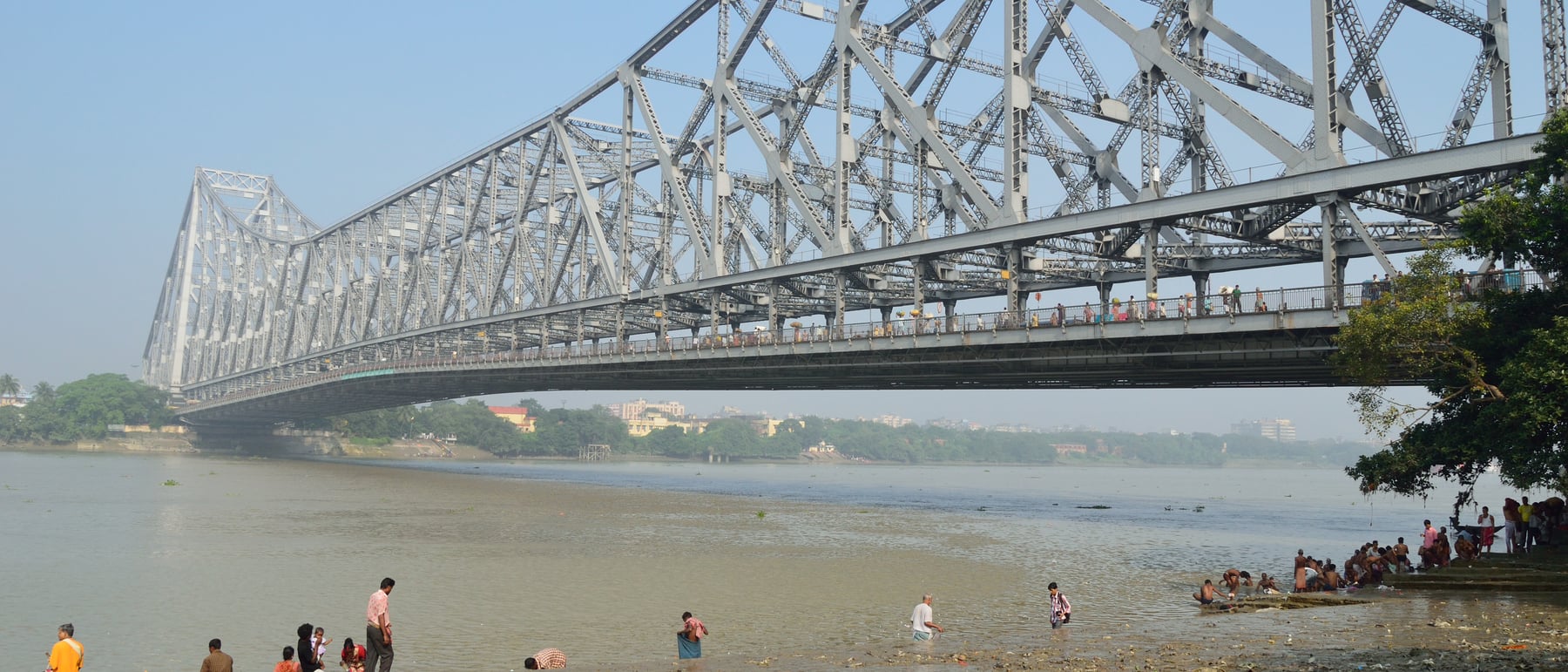
A cantilever of riveted steel strides 457 metres across the Hooghly without setting a single pier in the water — over 26,000 tonnes of it, much rolled from Indian Tata steel and driven together rivet by rivet. Built for empire in the shadow of a world war, the Howrah Bridge became, and remains, the beloved civic emblem of Kolkata.
1. A span that never touches the river
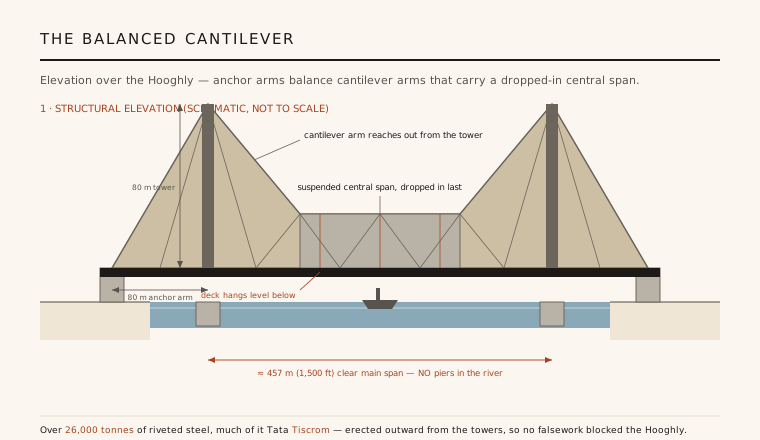
The Howrah Bridge answers one hard question: how do you throw a road and tramway across a wide, busy tidal river without ever obstructing it? Its answer is the balanced cantilever. Two great steel towers, each about 80 metres tall, rise from deep caissons sunk near either bank. From each tower the structure is balanced like a pair of scales — a landward anchor arm, roughly 80 metres long, holds down a cantilever arm that reaches out over the water toward mid-river.
Where the two reaching arms stop, short of meeting, a suspended central span is hung between their tips. The result is a clear main span of about 457 metres (1,500 feet) with no piers in the navigable channel at all. The roadway deck hangs level below the trusses, so traffic runs straight while the steelwork soars into diamond-shaped silhouettes overhead. Nothing about the crossing interrupts the river beneath it.
2. Why cantilever, not arch or suspension
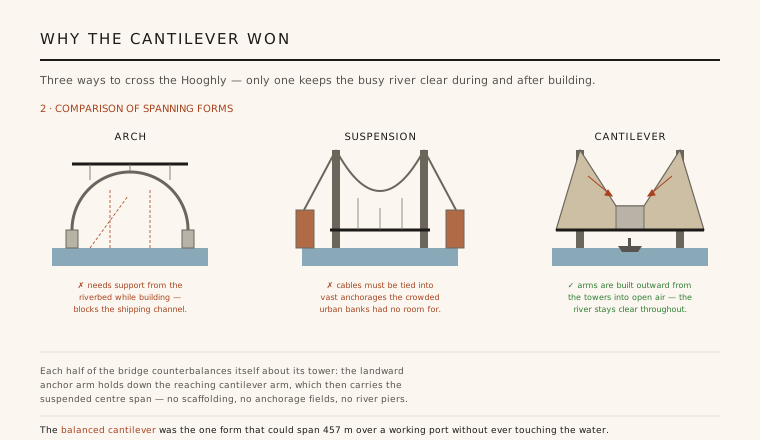
The Hooghly is a working port, and during the late 1930s a war made its shipping lane untouchable. That single constraint eliminated the obvious alternatives. A great arch would have needed temporary falsework built up from the riverbed to support it during construction, blocking the channel for years. A suspension bridge would have demanded enormous masonry anchorages to tie down its cables — and the dense, built-up banks of Howrah and Calcutta simply had no room to spare for them.
The cantilever alone could be erected outward from the towers into open air, each arm self-balancing about its tower as it grew, with the central span floated out and dropped in last. No scaffolding stood in the water; no anchorage fields devoured the shore. It was less an aesthetic choice than a logistical one — the one form that could span the river without ever depending on the river, and the reason the bridge could rise at all in wartime.
3. Riveted steel and Indian iron
Howrah is a monument to the rivet, driven home at the very moment welding was beginning to replace it elsewhere. Its trusses are assembled from built-up steel members — angles, plates and lattice — locked together by hundreds of thousands of red-hot rivets hammered flat, not by bolts or welds. In all the structure carries some 26,000 tonnes of steel, and a large share of it was Indian: high-tensile "Tiscrom" steel rolled by the Tata Iron and Steel Company, alongside imported British stock.
That detail matters to the thesis. This was an imperial commission — designed in London by Rendel, Palmer & Tritton and fabricated by Braithwaite, Burn & Jessop — yet it was raised from metal smelted in India and joined by Indian hands. The bridge is thus a hybrid object: the engineering language of the industrial West executed with the emerging industrial capacity of the colonised country, its every riveted node a small record of who actually built modern India.
4. The bones of the colonial city
Howrah Bridge is the spectacular apex of a much larger programme. The same century of industrial engineering that produced it also laced India with railways and their cathedral-like terminals, sank docks along its rivers, threw up jute and cotton mills by the hundred, and piped waterworks into the growing cities. This was the new program of the Industrial Revolution — iron, steel and glass marshalled not for temples or palaces but for movement, commerce and public utility.
It must be said plainly that this infrastructure was built to serve empire and extraction — to move raw materials to ports and troops to frontiers, and to profit those who ruled. Yet its physical form outlasted its purpose. The railways, docks, bridges and waterworks became the durable bones of the independent nation's cities, carrying a traffic their builders never imagined. The engineering of empire quietly turned into the public inheritance of the republic.
5. Rabindra Setu — an imperial object, nationally cherished
Today the bridge carries an astonishing daily load — hundreds of thousands of vehicles and, famously, even greater rivers of pedestrians — above the ghats, ferries and crowds of the Hooghly. It has never been merely useful. Its riveted towers are among the most photographed silhouettes in India, a fixture of Kolkata's cinema, painting and self-image, and in 1965 it was renamed Rabindra Setu in honour of the poet Rabindranath Tagore.
There is an honest tension in that affection. A structure conceived by a colonial administration, designed in London and named at first for the river it crossed, has been fully claimed as a civic emblem of a free city — cherished not despite its imperial origin but almost in spite of it. Howrah Bridge stands, in the end, for the whole paradox of colonial industrial works: engineering imposed from outside that a nation has since made unmistakably, and proudly, its own.
Every contemporary infrastructure landmark that a city adopts as its portrait — a signature river crossing or transit hall loved far beyond its function — inherits Howrah's lesson that hard engineering can become collective identity.
References & further reading
- 01Roy, Rammohun (ed.) / Government of West Bengal (1946). The Howrah Bridge: Its Construction and Engineering. Calcutta Port Commissioners / official record.
- 02Kerr, Ian J. (2007). Engines of Change: The Railroads that Made India. Praeger, Westport.
- 03Metcalf, Thomas R. (1989). An Imperial Vision: Indian Architecture and Britain's Raj. University of California Press, Berkeley.
- 04Institution of Civil Engineers (1946). The New Howrah Bridge, Calcutta. Proceedings / Journal of the ICE, papers on the Hooghly cantilever bridge.
- 05Mann, Michael (2015). South Asia's Modern History: Thematic Perspectives. Routledge, London (infrastructure and colonial modernity).
Last verified 2026-07-08. Ancient and vernacular works often have no single architect or firm date; dates are given as widely accepted approximations and the builder-culture is named where no individual designer is known.