
10 · East & Southeast AsiaNo. 11 in era
Great Wall of China
It is the largest thing humans have ever built, and it is not a building — it is a border made solid. The Great Wall of China is architecture at the scale of a nation's frontier: a defensive system thousands of kilometres long, drawn along the mountain crests to separate the settled empire from the northern steppe. And it is not one wall, but many walls, built and rebuilt by rival dynasties over some two thousand years.
1. A line drawn across geography
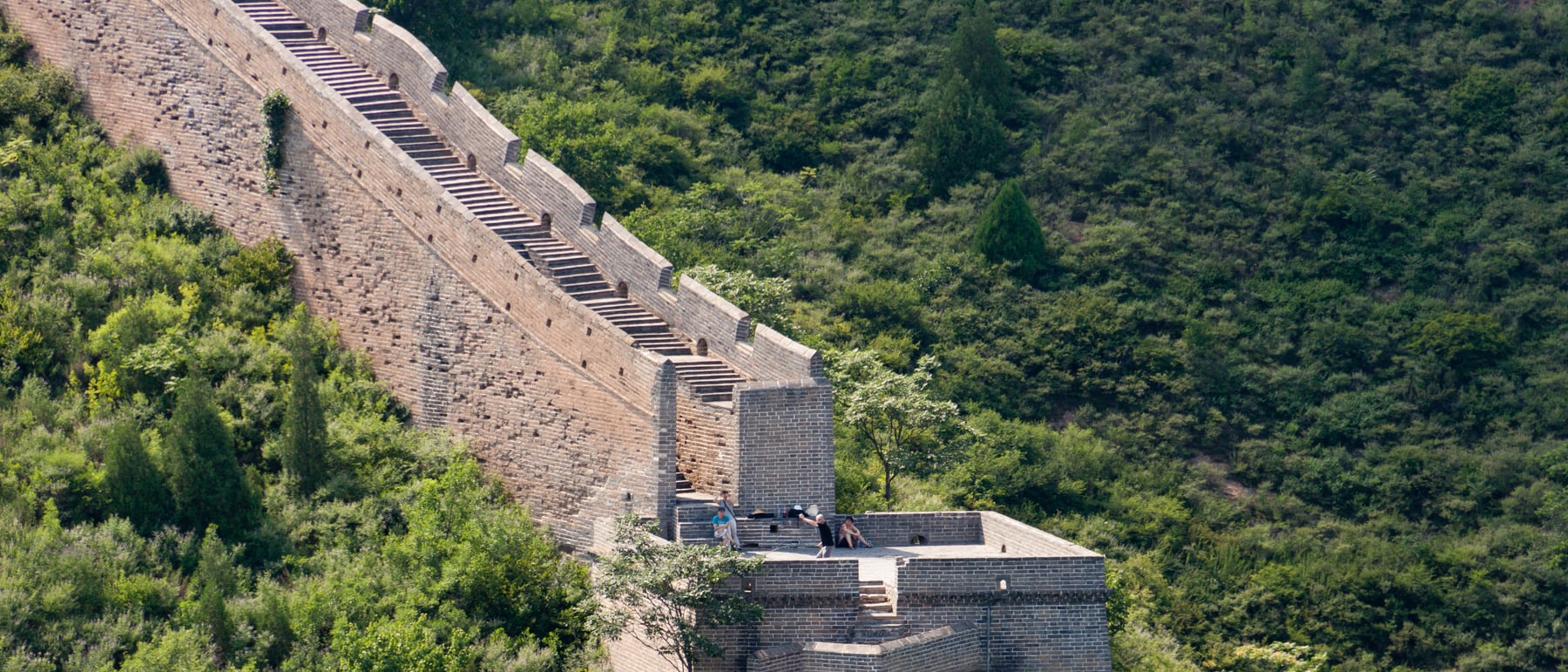
Most of the buildings in any canon can be walked around in an afternoon. The Great Wall cannot be seen whole from any single point on the ground: it is linear infrastructure, a piece of architecture whose defining dimension is not height or span but length, measured in thousands of kilometres. Its purpose was territorial — to draw a hard, defensible edge between the agrarian empire to the south and the mobile cavalry cultures of the steppe to the north, and to hold that edge as a continuous line.
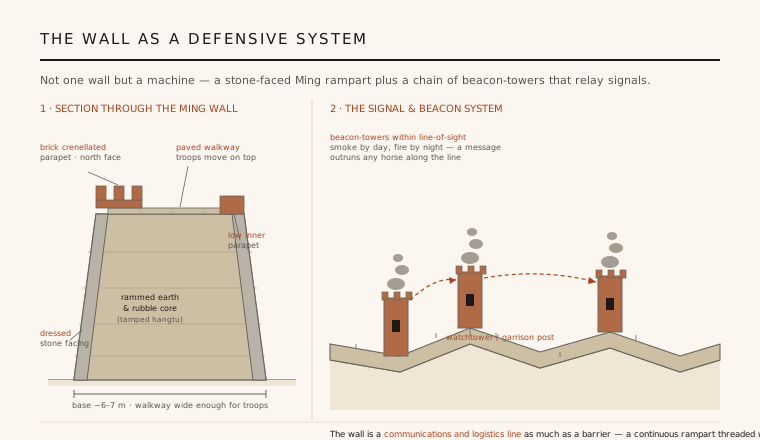
Seen this way the wall is less a barrier than a system. A continuous rampart is only its most visible element; threaded along it are regularly spaced watchtowers, signal-and-beacon towers, garrison fortresses and fortified mountain passes with gates. It was designed to slow an incursion rather than make one impossible, to force raiders toward defended crossings, and above all to carry warning and troops quickly along its own length. It is as much a communications and logistics network as a wall.
2. Not one wall, but many
There is no single Great Wall, and honesty about this makes the structure more interesting, not less. What we call the wall is the accumulated residue of walls built and rebuilt by competing powers across roughly two millennia. Rival states of the Warring States period were already raising defensive walls by the 7th–3rd centuries BCE; when Qin Shi Huang unified China around the 220s BCE, his general Meng Tian is said to have joined and extended existing northern walls into one frontier. The Han then pushed lines far west to guard the Silk Road, and centuries of later dynasties added, abandoned and re-routed sections.
These successive walls do not follow one line. They were built by different states for different threats along different frontiers, so the "wall" on a map is really a braid of overlapping, often discontinuous works from many centuries. The iconic stone-faced rampart that tourists photograph near Beijing is overwhelmingly the product of one late campaign — the Ming rebuild of the 14th to 17th centuries — laid over and beside far older, humbler earthworks.
3. Building with the terrain
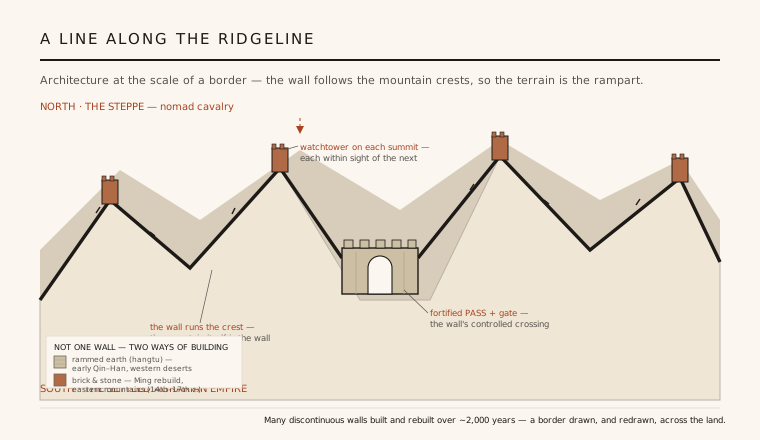
The wall's genius is that it does not fight the landscape; it uses it. Wherever possible the line was routed along ridgelines and cliff-tops, so that the mountain itself becomes the lower part of the defence and the masonry need only crown an already formidable slope. The architecture is therefore inseparable from its site — it climbs, banks and switches back with the crest, and in the steepest places the wall is almost vertical. It does not sit on the terrain so much as become it: the terrain, fortified.
Along that line sit the working parts of the system. Watchtowers rise at regular intervals, set within sight of one another; from them, beacon-towers relayed messages by smoke by day and fire by night, passing a warning down the frontier far faster than any rider could carry it. Larger garrison fortresses housed the troops, and passes — gated fortresses set in the saddles between mountains — controlled the few places where roads and armies could actually cross. The wall's strength lay in this integration of geography, sightlines and manpower.
4. Rammed earth and Ming brick
The materials tell the same story of many walls. The earliest and most remote stretches were built of rammed earth, or hangtu: damp soil (and, in the western deserts, layers of reed, twig and gravel) tamped in courses between removable timber forms until it set into a hard, monolithic mass. It is cheap, fast and made entirely of what lies underfoot — which is why so much of the early wall has since slumped back into the ground it came from, surviving today only as eroded ochre ridges across the landscape.
The Ming wall is a different order of construction. Its builders wrapped a core of rammed earth and rubble in dressed stone at the base and kiln-fired brick above, capping the whole with a paved walkway wide enough to march troops along, an outer crenellated parapet on the steppe-facing side and a lower parapet within. Brick and lime mortar could be fired on site, and the more durable, more defensible profile is precisely why these stretches endure while the older earthworks have vanished. The two techniques are separated by well over a thousand years.
5. A decentralised megaproject, honestly measured
For all its unity as an idea, the wall was built as a pragmatic, decentralised undertaking. It was raised in stretches by soldiers, conscripted peasants and convict labourers, each length using whatever materials the local ground offered — earth here, stone there, brick kilned on the spot elsewhere. There was no single design and no single builder; the frontier was assembled section by section, garrison by garrison, over generations, which is exactly why its construction, dimensions and even its route vary so widely along its course.
It repays honesty about the myths, too. The famous "ten thousand li" is a figure of speech for immensity, not a survey; the sections are in many places disconnected, and most of the total length is today ruinous or eroded. Nor is it, despite the legend, visible to the naked eye from space. What remains true is more remarkable than the folklore: an inscribed UNESCO World Heritage Site that is the largest single work of construction ever attempted, and the clearest demonstration that architecture can operate at the scale of a nation's border.
Every modern border wall, security fence and "smart" frontier of sensors and watchtowers is heir to the same idea the Great Wall first built at continental scale — that a line drawn across geography can be turned into architecture, with all the same limits.
References & further reading
- 01Waldron, A. (1990). The Great Wall of China: From History to Myth. Cambridge University Press, Cambridge.
- 02Lovell, J. (2006). The Great Wall: China Against the World, 1000 BC–AD 2000. Atlantic Books, London.
- 03UNESCO World Heritage Centre (1987). The Great Wall. World Heritage List, ref. 438. https://whc.unesco.org/en/list/438
- 04Man, J. (2008). The Great Wall. Bantam Press, London.
- 05Turnbull, S. (2007). The Great Wall of China 221 BC–AD 1644. Osprey (Fortress 57), Oxford.
Last verified 2026-07-06. Ancient and vernacular works often have no single architect or firm date; dates are given as widely accepted approximations and the builder-culture is named where no individual designer is known.