
2 · Egypt & the Monumental ImpulseNo. 03 in era
Great Sphinx of Giza
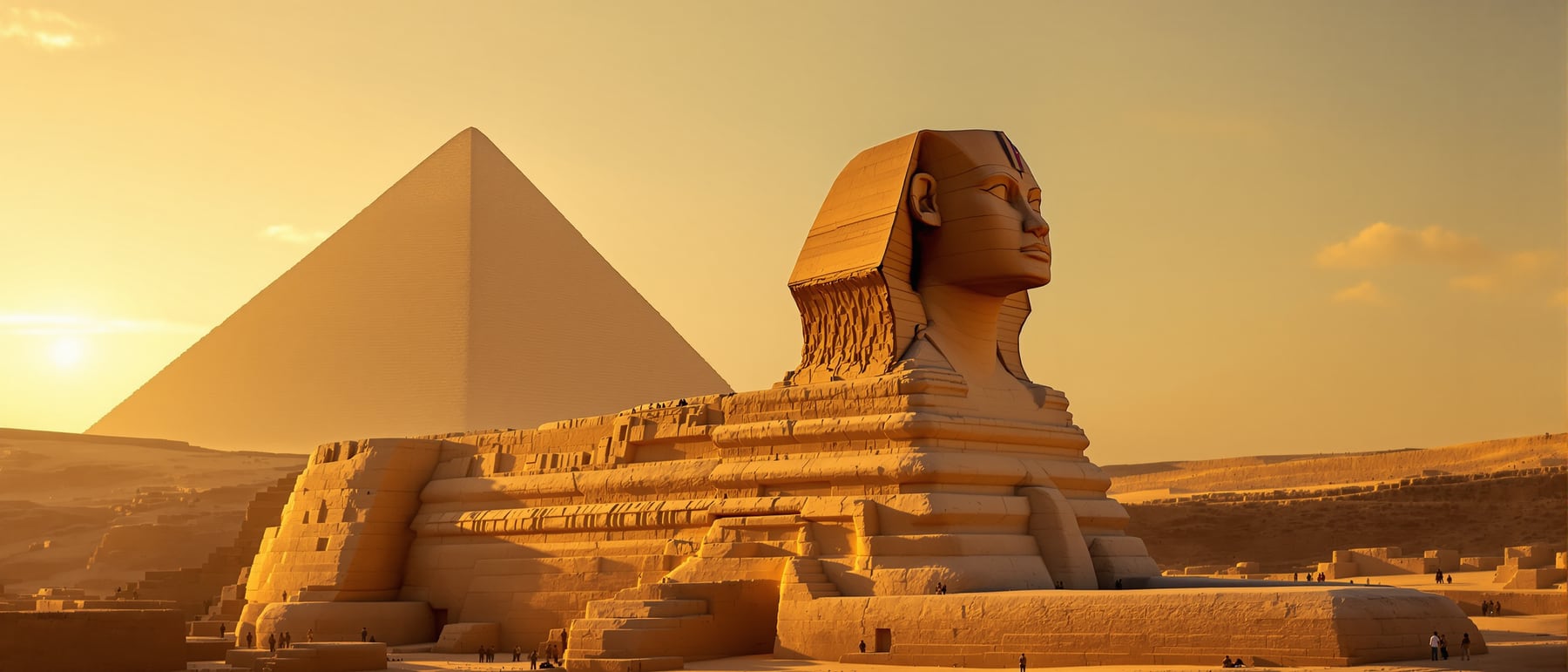
A recumbent lion with a pharaoh's face, carved where it lay from a single knoll of natural bedrock — the largest monolithic statue to survive from the ancient world, and a guardian released from the living rock rather than built upon it.
1. Carved from a single knoll of living rock
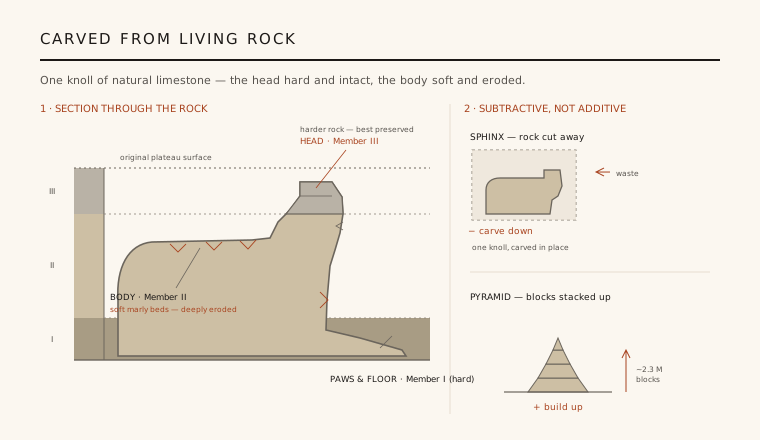
The Great Sphinx is the largest monolithic statue to survive from the ancient world — roughly 73 metres long and 20 metres high — and yet not one block of it was ever carried to the site. It was cut in place, downward and inward, from a single natural rise of limestone left standing on the Giza plateau. Where the three great pyramids beside it are additive — some 2.3 million quarried blocks stacked up into an artificial mountain — the Sphinx is the exact inverse: a mass revealed by taking rock away.
The method was subtractive, the sculptor's logic rather than the mason's. Old Kingdom workers quarried a deep horseshoe-shaped ditch around the chosen knoll, and the statue is simply the bedrock they chose not to remove. There are no joints, no courses and no mortar in the body — it is one continuous piece of the plateau, still rooted to the ground it was freed from. That is the Sphinx's first and deepest architectural fact: it is not a building placed on the land but a figure drawn out of it.
2. Lion body, pharaoh head — the guardian hybrid
The form fuses two bodies into one idea. Below is a recumbent lion — in Egyptian thought a solar animal and the natural guardian of thresholds and horizons. Above is the head of a king, wearing the pleated nemes headdress, once fitted with the royal uraeus cobra at the brow and a ceremonial divine beard (fragments of both survive). The result is a colossal statement that kingship is a guardian power: the strength of the lion given the face and authority of the pharaoh.
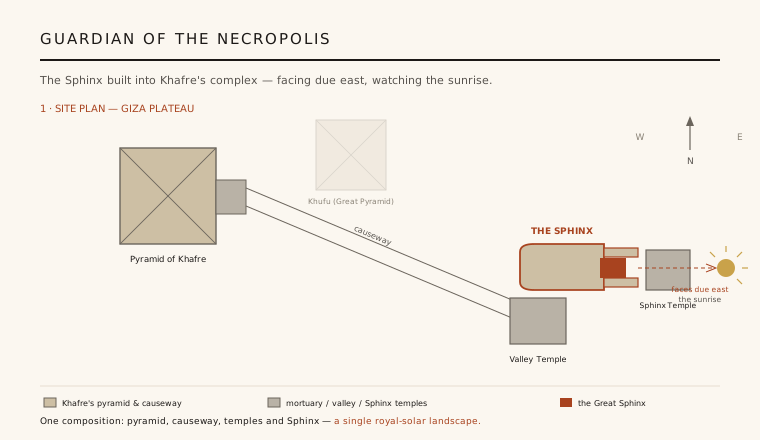
This is the editorial heart of the monument — architecture and sculpture fused, carved from one guardian stone. The Sphinx faces due east, so that at the equinoxes the sun rises directly before it, and the New Kingdom Egyptians who inherited it worshipped it as Hor-em-akhet, "Horus in the Horizon," a solar deity in its own right. As a work of design it is a single continuous image with no seams to hide: body, throne-like posture and royal head read as one indivisible sign of protection over the necropolis behind it.
3. Built into Khafre's pyramid complex
The Sphinx is not a lone marvel dropped into the desert; it is a component of a designed royal landscape. It lies immediately beside the valley temple of Khafre, at the lower (eastern) end of the pyramid complex, where the king's causeway ran down from his mortuary temple and pyramid to the edge of the cultivation. Directly in front of the Sphinx's paws stands its own Sphinx Temple, and the great blocks used to build both temples appear to have been quarried from the very ditch cut around the statue — so the act of making the Sphinx and the act of building its setting were one operation.
That physical and chronological knitting-together is the strongest evidence for the mainstream attribution: most Egyptologists, following Mark Lehner's and Zahi Hawass's fieldwork, read the Sphinx as part of Khafre's programme, c. 2500 BCE, its face very likely a portrait of that king. Read as architecture, the Sphinx completes a composition — pyramid, causeway, mortuary and valley temples, and guardian figure aligned to the rising sun — a single royal-solar ensemble rather than an isolated statue.
4. The geology that dooms it — and the restoration that never ends
The knoll the builders chose is not uniform stone but a stack of limestone beds of very different hardness, and that geology governs the statue's whole afterlife. The head was cut from a hard upper bed (geologists' Member III), which is why the face, though battered, still holds its form. The body was cut from Member II — soft, marly, salt-laden beds that flake, blister and crumble whenever moisture moves through them. The paws and the quarry floor are the hard lower Member I. The Sphinx is, in effect, well-built at the top and structurally poor through the middle by the accident of what layer sat where.
So the Sphinx has demanded repair almost from the beginning. It was casing-blocked and patched in the New Kingdom, and the famous Dream Stele of Thutmose IV (c. 1400 BCE), set between the paws, records a prince who cleared the sand-choked statue and, the text says, was promised the throne in return — the first documented restoration of a monument in history. Roman, medieval and modern campaigns followed; some twentieth-century repairs with hard cement actually accelerated decay of the soft core. Conservation here is not a single event but a permanent condition — the price of a body carved from stone that was never meant to last.
5. The honest arguments: date, attribution and the erosion theory
Because the Sphinx carries no builder's inscription, real scholarly debate persists at its edges, and it is worth stating plainly. The mainstream position — Fourth Dynasty, c. 2500 BCE, and most likely commissioned by Khafre — rests on the statue's structural and stratigraphic bond to Khafre's valley temple and causeway, on the style of the head, and on the quarrying sequence. A serious minority of Egyptologists (notably Rainer Stadelmann) has argued instead for Khufu, Khafre's father, on iconographic grounds. This is a genuine, still-live question about which Old Kingdom king, not about the era.
A separate and far more radical claim — the "water-erosion" hypothesis advanced by Robert Schoch and John Anthony West — reads the rounded weathering of the enclosure walls as rainfall damage requiring a Sphinx many thousands of years older, built by a lost civilization. Egyptologists and most geologists reject it: the profile is fully explained by the soft Member II limestone, salt crystallisation and wind-and-sand abrasion acting over 4,500 years, and no material culture supports a pre-dynastic monument of this scale. The honest summary is that the precise attribution remains open while the dating does not — and that the erosion debate belongs to the discipline's fringe, however often it is repeated.
Every monument still cut directly from the ground it stands on — the presidential faces of Mount Rushmore, the unfinished Crazy Horse Memorial, the rock-hewn churches of Lalibela — repeats the Sphinx's founding wager: don't build the figure, release it from the living rock.
References & further reading
- 01Lehner, M. (1997). The Complete Pyramids: Solving the Ancient Mysteries. Thames & Hudson, London.
- 02Lehner, M. (1991). Archaeology of an Image: The Great Sphinx of Giza. PhD dissertation, Yale University.
- 03Hawass, Z. & Lehner, M. (1994). The Sphinx: Who Built It, and Why?. Archaeology 47(5), 30–47.
- 04Gauri, K. L., Sinai, J. J., Bandyopadhyay, J. K. (1995). Geologic Weathering and its Implications on the Age of the Sphinx. Geoarchaeology 10(2), 119–133. https://doi.org/10.1002/gea.3340100204
- 05Zivie-Coche, C. (trans. D. Lorton) (2002). Sphinx: History of a Monument. Cornell University Press, Ithaca.
Last verified 2026-07-06. Ancient and vernacular works often have no single architect or firm date; dates are given as widely accepted approximations and the builder-culture is named where no individual designer is known.