
2 · Egypt & the Monumental ImpulseNo. 02 in era
Great Pyramid of Giza
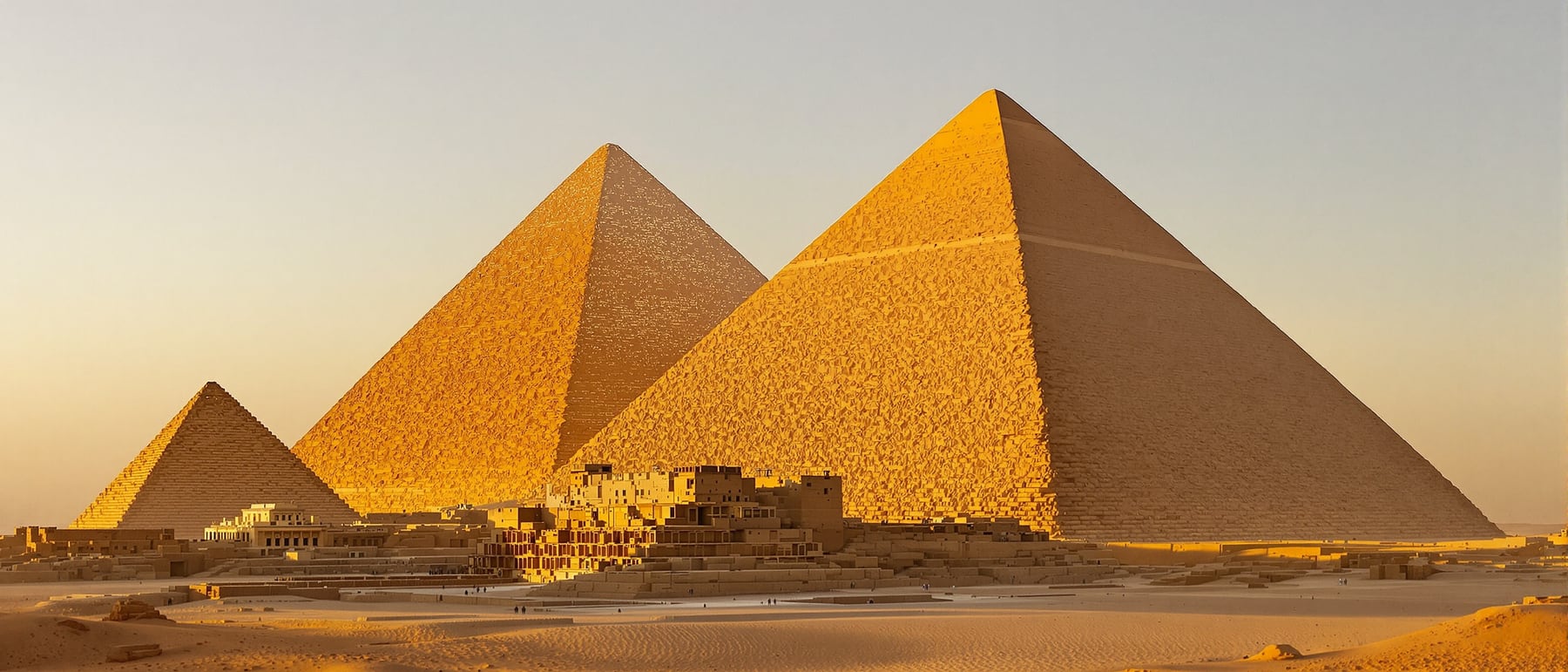
On the Giza plateau around 2560 BCE, the builders of King Khufu raised the largest stone monument the world had ever seen — the true pyramid perfected: mass, geometry and precision fused at colossal scale, and the last of the Seven Wonders of the Ancient World still standing.
1. The leap to the true pyramid
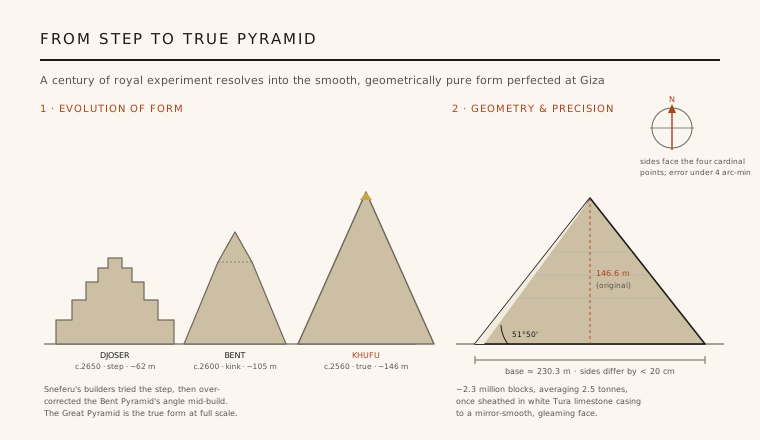
The Great Pyramid did not arrive from nowhere; it is the resolution of a century of experiment. Three generations earlier, Djoser's architects had stacked six shrinking rectangular mastabas into the Step Pyramid — a stairway of stone. Khufu's father, Sneferu, then chased the pure geometric ideal: he raised the Meidum pyramid, over-steepened and mid-course corrected the famous Bent Pyramid, and finally achieved the first fully realised smooth-sided monument at the Red Pyramid at Dahshur.
The Great Pyramid is that true form driven to its limit. Its four triangular faces rise in unbroken planes from a square base to a single point, a shape whose entire meaning is geometry made permanent — the primeval mound and the sun's rays turned to stone. What Sneferu proved could be built, Khufu's builders built bigger, steeper and more exactly than anyone before or, for millennia, after. The step becomes a stair to the sky; the stair becomes a smooth, unbroken ascent.
2. Precision at colossal scale
The numbers still astonish. The pyramid rose to about 146.6 metres (roughly 138.5 m survive today), and held the record for the tallest structure on Earth for some 3,800 years. Its base covers over five hectares, each side about 230.3 metres long — and the four sides differ from one another by only a handful of centimetres, the whole base near-level to within about two centimetres across that enormous span. The monument contains an estimated 2.3 million blocks averaging around two and a half tonnes, with far heavier granite beams hauled from Aswan, some 800 km up the Nile.
Most remarkable is the orientation. The four faces are set almost exactly to the cardinal points, with an error of only a few arc-minutes — an alignment likely achieved by sighting the circumpolar stars. The whole mass was originally sheathed in fine white Tura limestone casing, dressed and polished to a mirror-smooth face so precise that the joints are famously described as too fine to slip a blade between. Stripped for later building, only patches survive, but the ambition is unmistakable: a mountain of stone finished to the tolerance of a jewel.
3. The architecture within
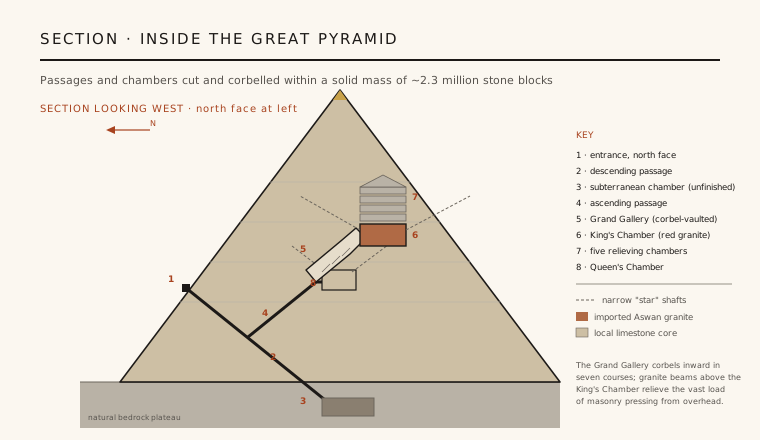
For all its solidity, the pyramid is threaded with a deliberate internal architecture. From the original entrance high on the north face, a descending passage bores down through the masonry into the bedrock to an unfinished subterranean chamber. Partway down, an ascending passage branches upward and opens into the pyramid's structural showpiece: the Grand Gallery, a soaring corbel-vaulted channel roughly 8.6 m high whose walls step inward in seven overlapping courses to bridge the void without a true arch — one of the boldest spaces of the ancient world.
The gallery climbs to the King's Chamber, a stark rectangular room lined entirely in red Aswan granite and roofed with nine granite beams each weighing dozens of tonnes. Above it sit five relieving chambers, stacked voids capped by a gabled pair of limestone rafters, engineered to divert the crushing weight of overhead masonry away from the flat ceiling below — a sophisticated answer to a real structural problem. A separate horizontal passage reaches the misnamed Queen's Chamber on the central axis, and narrow star shafts angle outward from both chambers toward the faces, aligning the tomb with the sky.
4. How was it built?
No question in architecture is asked more often, and the honest answer is that we do not know the full method — but the debate is a genuine engineering one, not a mystery. What is certain is that the work was done with copper tools, stone hammers, sledges, levers, ropes and vast organised labour, by a skilled, well-fed workforce housed in a nearby settlement — not slaves, and certainly not lost civilisations or extraterrestrials. The recently discovered Diary of Merer, the logbook of an official ferrying Tura limestone to Giza, gives us a rare eyewitness trace of the supply operation.
The live scholarly argument is about the ramps. A single long straight ramp would have needed a volume of material rivalling the pyramid itself; so scholars weigh alternatives — a ramp spiralling up the outer faces, ramps run internally within the growing core, or shorter ramps combined with levering blocks up in stages. Each theory fits some evidence and strains against other constraints, and the true solution was probably a combination that changed as the pyramid rose. That we can still debate the method honestly, from tool marks and quarry logistics, is exactly what separates archaeology from pseudo-archaeology.
5. The benchmark of permanence
Of the Seven Wonders of the Ancient World, the Great Pyramid is the only one still standing — the others long since toppled, burned or dispersed. For more than four and a half thousand years it has held its ground, outlasting the empire that built it, every conqueror who camped beneath it, and the very language of its makers. It remains the enduring measure of what monumental building can achieve: not decoration or shelter, but sheer, deliberate permanence.
That is its lasting gift to the discipline. The Great Pyramid fused mass, precise geometry and flawless execution into a single statement, and set a benchmark against which every later monument is quietly measured. Its power comes not from ornament but from proportion, alignment and the honesty of stone — a lesson that architecture's deepest effects can be achieved with the simplest of forms, built exactly, at overwhelming scale.
Every monument built to defy time on pure geometry — from Kahn's silent masses to the sheer, precisely engineered profile of a supertall tower — still answers to Khufu's benchmark: that permanence is achieved not by ornament but by mass, alignment and exactness carried to overwhelming scale.
References & further reading
- 01Lehner, M. (1997). The Complete Pyramids: Solving the Ancient Mysteries. Thames & Hudson, London.
- 02Edwards, I. E. S. (1993). The Pyramids of Egypt (revised edition). Penguin Books, London.
- 03Petrie, W. M. F. (1883). The Pyramids and Temples of Gizeh. Field & Tuer, London.
- 04Tallet, P. & Marouard, G. (2014). The Harbor of Khufu on the Red Sea Coast at Wadi al-Jarf, Egypt. Near Eastern Archaeology 77(1), 4–14.
- 05UNESCO World Heritage Centre (1979). Memphis and its Necropolis – the Pyramid Fields from Giza to Dahshur. UNESCO World Heritage List, ref. 86. https://whc.unesco.org/en/list/86/
Last verified 2026-07-06. Ancient and vernacular works often have no single architect or firm date; dates are given as widely accepted approximations and the builder-culture is named where no individual designer is known.