
3 · The Classical World (Greece)No. 07 in era
Great Altar of Pergamon
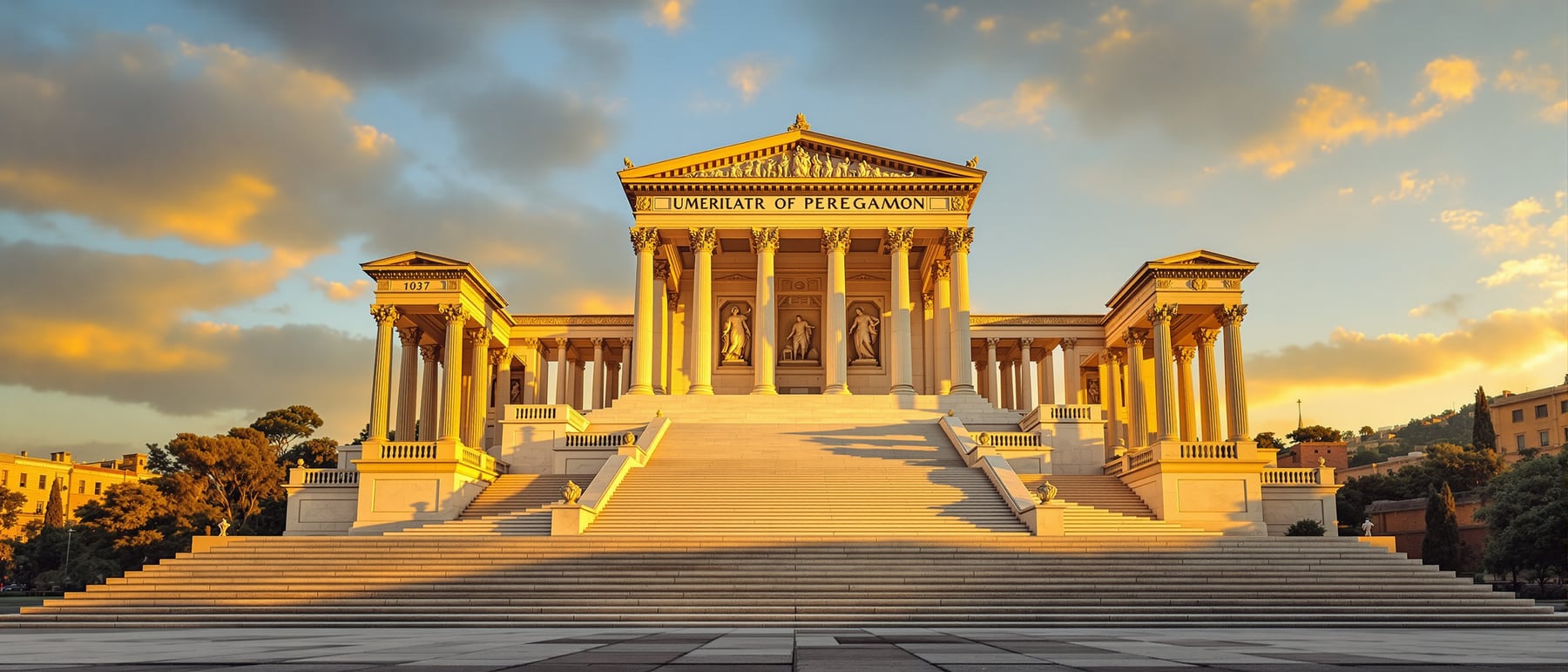
Hellenistic theatre in marble — the Great Altar of Pergamon fused architecture and sculpture into one dramatic monument, its Gigantomachy frieze of writhing gods and giants breaking out of its frame to spill onto the very steps the visitor climbs.
1. A building shaped like a stage
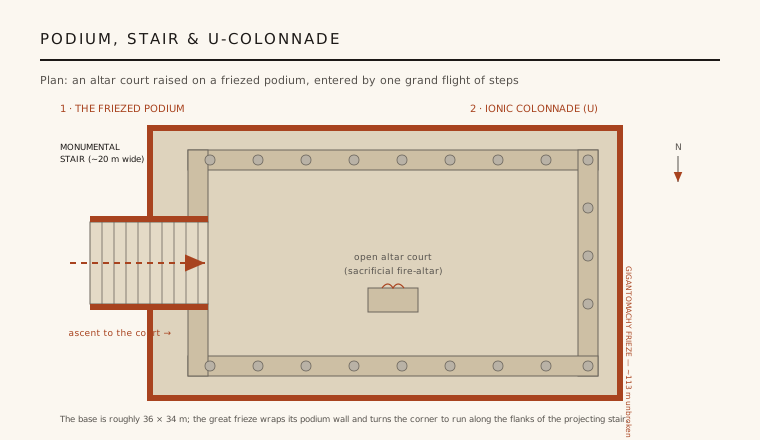
The Great Altar of Pergamon is not a temple but a monumental altar enclosure, raised on the citadel of Pergamon around 170 BCE under Eumenes II. Its form is deliberately theatrical: a broad rectangular podium, roughly 36 by 34 metres, lifts the ceremony off the ground, and a single monumental staircase some twenty metres wide is cut into the west front to draw the visitor up. Where a Greek temple hides its rites within a closed cella, this structure turns the act of ascent into architecture.
At the top, an Ionic colonnade wraps the platform in a U-shape, three wings of slender columns framing an open-air court that held the sacrificial fire-altar. The plan is essentially a raised courtyard entered through a proscenium of steps — a piece of civic-religious set design. The building does not merely house a rite; it choreographs one, positioning the worshipper, the climb and the altar as a single composed sequence.
2. From Classical restraint to Hellenistic drama
Classical Greek architecture of the fifth century — the Parthenon above all — prized balance, clarity and restraint: calm figures in shallow relief, held firmly within the metopes and pediments assigned to them. The Great Altar belongs to a different world. Built more than two centuries later, in the Hellenistic age, it trades that composure for movement, emotion and spectacle, the qualities that later critics would call the "Baroque of antiquity."
This shift is not decorative but conceptual. Hellenistic patrons like the Attalid kings of Pergamon wanted architecture that moved the viewer — that dramatised power, victory and divine favour rather than simply expressing proportion. The altar is one of the most complete surviving statements of that ambition: a monument designed to overwhelm, where scale, ascent and sculpture combine to stage feeling rather than to still it.
3. The Gigantomachy: sculpture that breaks its frame
Around the base of the podium runs the altar's astonishing achievement: the Gigantomachy frieze, a continuous high-relief band roughly 113 metres long depicting the Olympian gods in battle against the earth-born Giants. The figures are near life-size and carved so deeply — almost fully in the round, with drilled undercutting that throws pockets of black shadow — that bodies seem to tear free of the wall. Wings, snake-legged giants, straining torsos and streaming drapery pile into a single writhing, violent surge of movement.
Its most radical move is spatial. As the great staircase cuts into the podium, the frieze does not stop — it turns the corner and spills onto the flanks of the steps, so that kneeling giants appear to climb out of the marble toward the ascending visitor. Sculpture literally breaks out of its frame into the viewer's own space, collapsing the boundary between image and beholder. This is relief carving pushed to the edge of freestanding sculpture, and architecture and sculpture fused into one dramatic event.

4. Architecture as civic-religious spectacle
The Gigantomachy was never only a myth. For Pergamon it was political allegory: the gods' triumph over the chaotic Giants stood for the Attalid kings' own victories, especially over the invading Gauls (Galatians), casting the dynasty as the civilised order that defeats barbarism. The altar is thus a victory monument as much as a place of sacrifice — propaganda rendered in marble at the scale of a building.
Everything about the design serves that spectacle. The raised podium makes the monument visible across the terraced citadel; the wide stair gathers and slows the approaching crowd; the frieze meets them at eye level as they climb, wrapping them in the drama before they reach the altar above. Architecture here works as a stage-set for a public performance of piety and power — a fusion of building, image and ritual into one civic theatre.
5. Excavation, Berlin, and the question of removal
The altar's modern life began in the 1870s, when the German engineer Carl Humann, working at Pergamon (modern Bergama, Turkey), recognised that Byzantine wall rubble was full of ancient relief slabs. Under agreements with the Ottoman authorities, excavations in 1878–1886 recovered the frieze and much of the structure, and the fragments were shipped to Berlin. There, in the purpose-built Pergamon Museum (opened 1930), the west front, its great stair and the reassembled Gigantomachy were reconstructed at full scale indoors — one of the most spectacular museum installations anywhere.
That reconstruction is also the source of the altar's sharpest modern question. Like the Ishtar Gate displayed in the same museum, the monument now stands not on its citadel but in a European capital, raising the debate over removal and repatriation that runs through so much of archaeology's history. What we admire in Berlin is genuinely ancient and genuinely magnificent — and, at the same time, a product of nineteenth-century decisions about who excavates, who keeps, and where a nation's heritage is allowed to live.
Any building that dissolves the line between architecture and sculpture to overwhelm and choreograph its visitor — from Baroque church façades to Frank Gehry's writhing metal skins and immersive museum galleries staged as theatre — is heir to Pergamon's oldest ambition: to make a structure that does not just shelter a rite but performs it.
References & further reading
- 01Pollitt, J. J. (1986). Art in the Hellenistic Age. Cambridge University Press, Cambridge.
- 02Kästner, V. (2011). The Architecture of the Great Altar of Pergamon. in Pergamon: Panorama of the Ancient Metropolis, Staatliche Museen zu Berlin.
- 03Ridgway, B. S. (2000). Hellenistic Sculpture II: The Styles of ca. 200–100 B.C.. University of Wisconsin Press, Madison.
- 04Stewart, A. (2000). Pergamon Ara Marmorea Magna: On the Date, Reconstruction, and Functions of the Great Altar. in From Pergamon to Sperlonga, University of California Press.
- 05Staatliche Museen zu Berlin (2024). The Pergamon Altar (Pergamonmuseum, Antikensammlung). Staatliche Museen zu Berlin (institutional record). https://www.smb.museum/en/museums-institutions/pergamonmuseum/
Last verified 2026-07-06. Ancient and vernacular works often have no single architect or firm date; dates are given as widely accepted approximations and the builder-culture is named where no individual designer is known.