
1 · First Foundations (Prehistory & the Ancient Near East)No. 01 in era
Göbekli Tepe
On a limestone ridge in south-eastern Turkey, hunter-gatherers raised rings of five-metre stone pillars around 11,500 years ago — the oldest known monumental architecture on Earth, and proof that humans built temples before they farmed, potted, or turned a wheel.
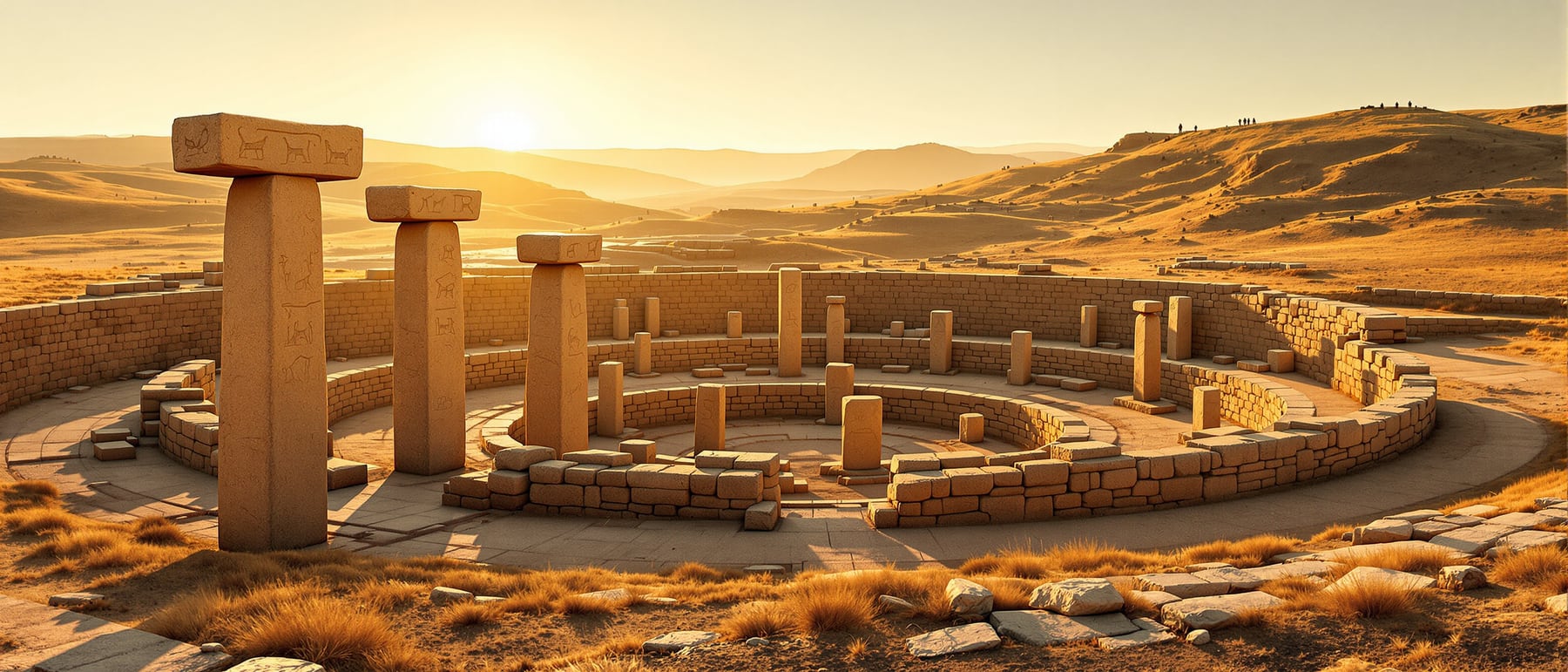
1. A temple raised before the town
Göbekli Tepe is a cluster of stone enclosures buried in an artificial mound on a barren ridge near Şanlıurfa. Excavated from 1995 by the German archaeologist Klaus Schmidt and his colleagues at the German Archaeological Institute (DAI), it revealed something no one expected: large, deliberately composed architecture built by mobile hunter-gatherers around 9500 BCE. There are no houses of the usual kind here, no ovens, no storage pits of a settled village at the earliest levels — only rooms made of standing stone.
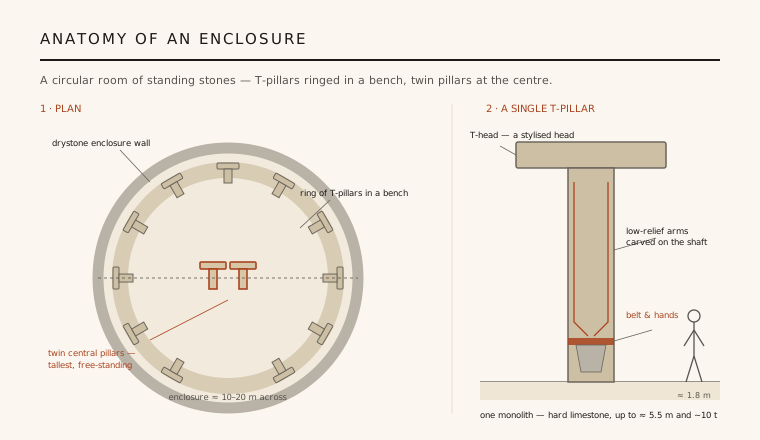
Each enclosure is a roughly circular or oval space, the largest about twenty metres across, walled in drystone and lined with a low bench. Set into that bench stands a ring of monumental T-shaped pillars, and in the middle of each room rise two still-taller pillars, free-standing and facing one another. It is a plan — a designed room with a centre, a wall and a rhythm of columns — a full millennium before the first farming villages and roughly six thousand years before Stonehenge.
2. The T-pillar: a column that is also a body
The pillars are the great invention of the site. Each is a single monolith of hard local limestone, quarried in one piece, dressed to a clean T — a broad flat capital carried on a slab-like shaft — and stood upright in a socket cut into the bedrock. This is a genuine structural member, a load-ready post shaped by design rather than found in nature, and it is the earliest such thing we know.
But the T is not only a column; it is a figure. On many shafts, low-relief arms bend down the sides to hands that meet at the front, above a carved belt and an animal-pelt loincloth — so the horizontal top reads as a stylised head and the whole stone as a schematic human, faceless and monumental. Schmidt read the twin central pillars as a pair of such beings presiding over the room. Wild animals — foxes, boars, snakes, cranes, scorpions — are carved in relief across many pillars, making the enclosure a walled congregation of stone bodies. Architecture here begins already fused with sculpture and meaning.
3. Older than farming, pottery and the wheel
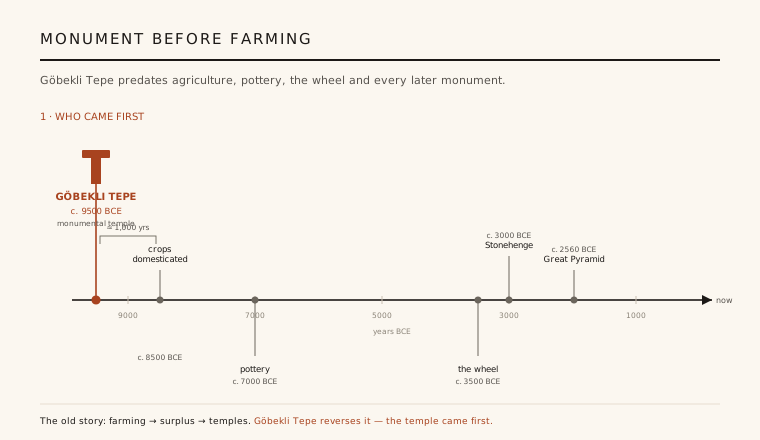
The reason Göbekli Tepe matters so much to the history of building is chronological. Radiocarbon dates place the earliest enclosures around 9500 BCE, in the Pre-Pottery Neolithic — before ceramics, before metal, before domesticated crops and herds, before the wheel, and long before writing or cities. The people who raised these ten-tonne stones were still hunters and gatherers of wild plants.
That order of events overturns a long-standing story. Archaeology had assumed the sequence ran farming first — agriculture produces a surplus, surplus frees labour, and only then can a society afford monuments and temples. Göbekli Tepe reverses it: the monumental, communal project appears to come first, and some researchers argue the effort of gathering and feeding large work parties at such places may itself have helped push the domestication of the wild wheats that grew in these very hills. Whether or not that causal claim holds, the precedence is clear — building on this scale did not wait for the farm.
4. How it stands up: drystone, monolith and muscle
The construction is austere and entirely pre-metal. The curved enclosure walls are drystone — undressed limestone blocks laid without mortar, packed to hold a bench and steady the ring of pillars. The pillars themselves were quarried from the surrounding bedrock, where an unfinished example still lies in its trench, and moved and tilted upright with nothing but ropes, levers, ramps and coordinated human labour, since there were no draught animals, pulleys or wheels.
The engineering intelligence is real but restrained: sockets cut to seat each monolith, stones packed at the base to plumb it, benches and walls doing the double duty of enclosing space and buttressing the uprights. It is architecture reduced to its irreducible acts — quarry, carry, raise, enclose — and it demonstrates that the organisation of many hands, not any advanced tool, is the first and deepest technology of monumental building.
5. Buried on purpose — and why the sequence matters
Perhaps the strangest thing about Göbekli Tepe is that its enclosures were deliberately filled in. The excavators found the rooms packed with tonnes of rubble, sediment, flint and animal bone, with fragments and worked heads placed among the fill near the central pillars — evidence, on the leading reading, of a structured decommissioning, the ritual burial of a building at the end of its active life. (How much of the infill is intentional versus slope-wash is still debated, and later levels do include more ordinary domestic building, so "pure temple" is a claim to hold loosely.) That burial is why the site survived so complete.
For the discipline, the lesson outlasts the arguments. Göbekli Tepe shows that monumental architecture came first — that the impulse to gather, to make a permanent shared place, to shape stone into meaning, predates the settled economy we assumed was its precondition. Building was not a luxury that civilisation earned; it looks more like one of the acts that helped bring civilisation about.
Every contemporary gathering-space built to bind a community before the community fully exists — a civic hall, a memorial, a place of worship raised on faith that people will come — repeats Göbekli Tepe's founding wager: build the shared room first, and let it make the society around it.
References & further reading
- 01Schmidt, K. (2012). Göbekli Tepe: A Stone Age Sanctuary in South-Eastern Anatolia. ex oriente, Berlin.
- 02Schmidt, K. (2010). Göbekli Tepe – the Stone Age Sanctuaries: new results of ongoing excavations. Documenta Praehistorica 37, 239–256. https://doi.org/10.4312/dp.37.21
- 03Dietrich, O., Heun, M., Notroff, J., Schmidt, K., Zarnkow, M. (2012). The role of cult and feasting in the emergence of Neolithic communities: new evidence from Göbekli Tepe. Antiquity 86(333), 674–695. https://doi.org/10.1017/S0003598X00047840
- 04Banning, E. B. (2011). So Fair a House: Göbekli Tepe and the Identification of Temples in the Pre-Pottery Neolithic. Current Anthropology 52(5), 619–660. https://doi.org/10.1086/661207
- 05UNESCO World Heritage Centre (2018). Göbekli Tepe (inscription record). UNESCO World Heritage List, ref. 1572. https://whc.unesco.org/en/list/1572/
Last verified 2026-07-06. Ancient and vernacular works often have no single architect or firm date; dates are given as widely accepted approximations and the builder-culture is named where no individual designer is known.