
26 · Vernacular, Gardens & Engineering WondersNo. 08 in era
Fez Medina (al-Qarawiyyin)
Founded in 859 by a merchant's daughter, al-Qarawiyyin is widely held to be the oldest continuously operating university on earth — and it sits at the dead centre of a city that has no plan at all. Fes el-Bali is a labyrinth of some nine thousand lanes, one of the largest car-free places in the world, an entire medieval organism grown around water, craft and a single mosque.
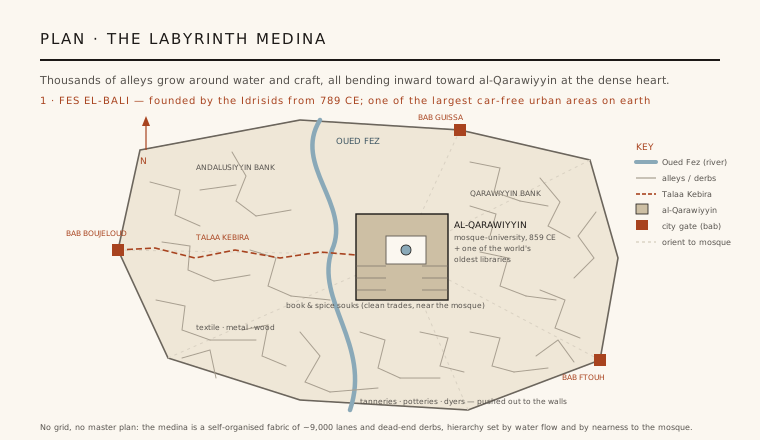
1. A city with no plan: the medina as an organism
Fes el-Bali is the opposite of a designed city. Where a Roman town imposes a grid, the Fez medina grew — accreting house by house and trade by trade over more than a thousand years into a dense, walled fabric of roughly nine thousand lanes, almost none of them straight and most too narrow for a cart. It is one of the largest car-free urban areas on the planet, still moved through on foot and by mule, and to a first-time visitor it reads as pure labyrinth.
Yet the tangle is deeply ordered. A few main thoroughfares — above all the Talaa Kebira — descend from the upper gates toward the centre, branching into quarter streets, which branch again into private, dead-end derbs serving a cluster of houses. Every neighbourhood is a near-complete cell with its own mosque, fountain, oven, bathhouse and Qur'an school, and the whole system bends inward toward al-Qarawiyyin. The plan is invisible because it is social and hydraulic rather than geometric.
2. Al-Qarawiyyin: a hypostyle mosque that became a university
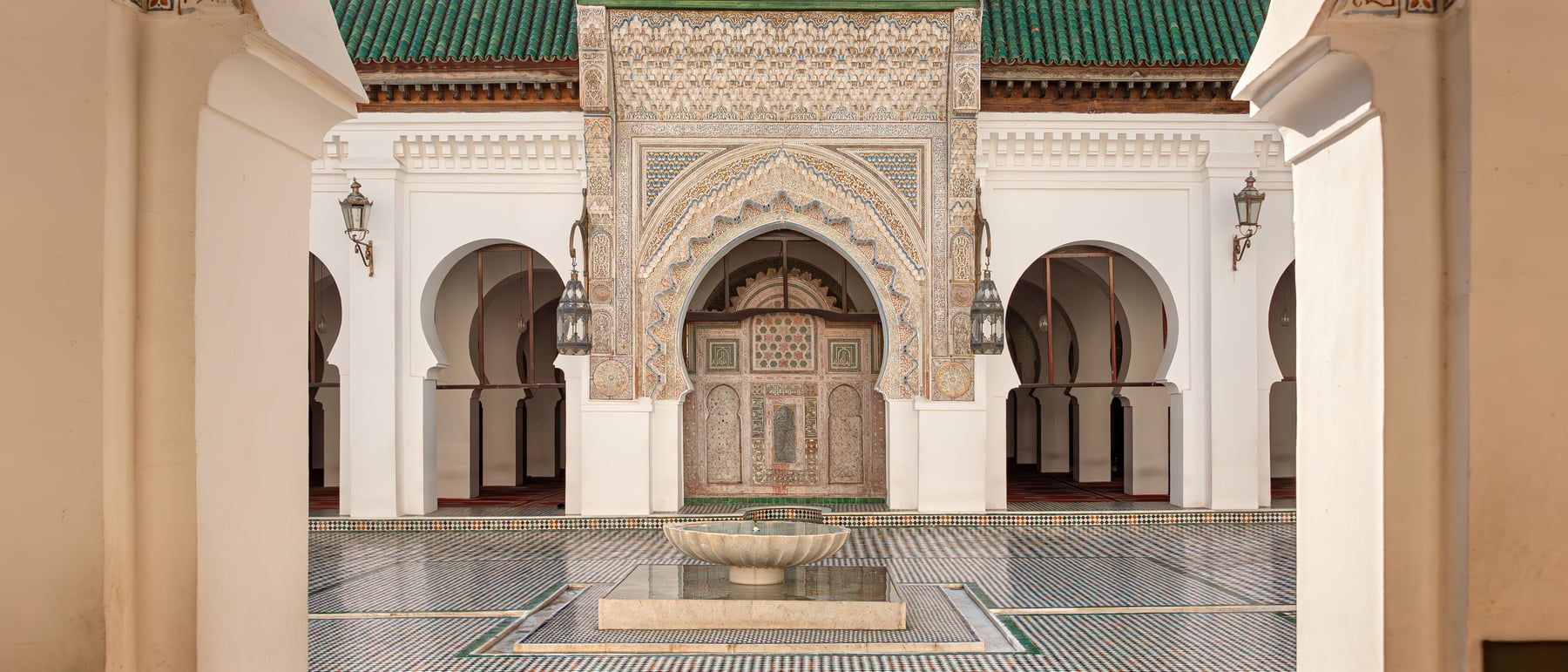
At the heart of the medina stands the great congregational mosque of al-Qarawiyyin, traditionally founded in 859 CE by Fatima al-Fihri from the inheritance of a family that had fled Kairouan in Tunisia — hence the name, the Kairouanese. Its prayer hall is a classic western-Islamic hypostyle: a forest of piers carrying horseshoe arches in long aisles running parallel to the qibla wall, opening onto an arcaded courtyard, the sahn, with its fountains. There is no dominating dome and no facade; the building is an interior, a shaded field of columns rather than a sculpted mass.
It was here, in the teaching circles that gathered against those piers, that a university took shape, and UNESCO and others regard al-Qarawiyyin as the oldest existing, continuously operating degree-granting institution in the world — though what counts as a "university" before the medieval European charter is genuinely debatable. Architecturally its key moment is the Almoravid enlargement of about 1135 under Ali ibn Yusuf, which nearly doubled the hall and inserted muqarnas vaults along its axial nave — among the earliest honeycomb cupolas in the western Islamic world. Alongside it grew one of the oldest working libraries anywhere, its manuscripts recently conserved and reopened.
3. Tile, plaster and cedar: the three-register wall
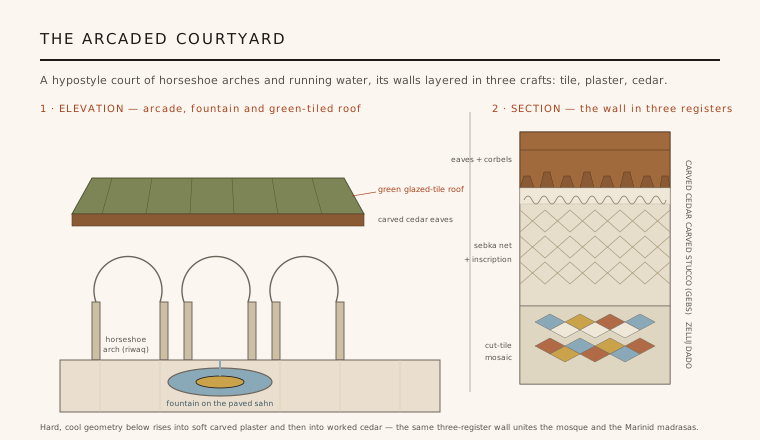
The visual language of Fez is codified above all in the Marinid madrasas of the 14th century — the al-Attarine (c. 1323–25) beside the perfumers' market and the Bou Inania (c. 1350–55) — jewel-box colleges built around tiny arcaded courts with a central basin. Every madrasa and much of al-Qarawiyyin follows the same layered system: a hard, cool zellij dado of hand-cut glazed tiles set into dazzling geometric star patterns; above it, a band of carved stucco (gebs), worked into net-like sebka lattice, arabesque and Arabic inscription; and crowning it, carved and painted cedar — friezes, corbels and deep eaves.
The logic is one of ascent and dissolution. Matter begins heavy, geometric and colour-saturated at floor level, then thins into pale, infinitely intricate plaster, then into the warmth of worked wood at the top, so the wall seems to lose mass as the eye rises. It is decoration organised as a strict grammar rather than as free ornament — the same three registers repeated at every scale, from a fountain niche to a full courtyard, unifying an entire building culture.
4. Water and craft: the hidden order of the labyrinth
The true master plan of Fez is its river. The Oued Fez enters the walls and is split into an intricate lacework of channels, sluices and norias (water-wheels) that once reached almost every quarter, feeding the mosques' ablution fountains, the public hammams, the drinking basins — and, crucially, the industries. The city was founded on two banks by two refugee communities, Kairouanese to the west and Andalusians (from Córdoba) to the east, each with its own great mosque, so water and settlement were braided together from the start.
Craft, in turn, is organised radially around the sanctuary. The cleanest, most prestigious trades — booksellers, and the perfumers and spice-dealers of the attarine — cluster tight against al-Qarawiyyin, while noisier and fouler processes are pushed progressively outward, so that the great Chouara tanneries, a honeycomb of stone dye-vats worked by hand almost exactly as in the Middle Ages, sit at the downstream edge. Funduqs — courtyard merchant inns that stabled animals below and lodged traders above — punctuate the trade routes. The medina is, in effect, a pre-industrial machine whose plan is dictated by flow: of water, of goods, and of people toward the mosque.
5. What Fez still teaches
It is worth being honest about the layering. The medina is a palimpsest of a dozen centuries: the Idrisid foundation dates are approximate, the Almoravids and Almohads rebuilt and enlarged, the Marinids gave it its madrasas, and the Saadians added the delicate courtyard pavilions of al-Qarawiyyin in imitation of the Alhambra. Much zellij and stucco has been repaired or renewed, and the famous "oldest university" and "oldest library" claims depend on how strictly one defines those institutions — the continuity of use, more than any single original fabric, is what is remarkable.
Its lessons remain sharp for a discipline rediscovering the walkable city. Fes el-Bali is a working demonstration that extreme density, mixed use and a purely pedestrian fabric can be humane and durable, and that a coherent architecture can emerge without a designer — from shared craft rules, a hierarchy of public to private streets, and orientation toward common institutions. In an age of car-choked sprawl, the labyrinth looks less like disorder and more like a sophisticated urban intelligence.
Every argument today for the dense, mixed-use, car-free "15-minute city" — and every contemporary building that revives cut-tile, carved plaster and screened courts to cool itself without machines — is reaching back to the lesson Fez has kept alive for over a thousand years.
References & further reading
- 01Terrasse, H. (1968). La Mosquée al-Qaraouiyin à Fès. Librairie C. Klincksieck, Paris.
- 02Bloom, J. M. (2020). Architecture of the Islamic West: North Africa and the Iberian Peninsula, 700–1800. Yale University Press, New Haven.
- 03Le Tourneau, R. (1949). Fès avant le protectorat: étude économique et sociale d'une ville de l'occident musulman. Société Marocaine de Librairie et d'Édition, Casablanca.
- 04Marçais, G. (1954). L'architecture musulmane d'Occident: Tunisie, Algérie, Maroc, Espagne et Sicile. Arts et Métiers Graphiques, Paris.
- 05UNESCO World Heritage Centre (1981). Medina of Fez. World Heritage List, ref. 170. https://whc.unesco.org/en/list/170
Last verified 2026-07-11. Ancient and vernacular works often have no single architect or firm date; dates are given as widely accepted approximations and the builder-culture is named where no individual designer is known.