
19 · Early Modernism & the PioneersNo. 09 in era
Einstein Tower
A short tower on a hill outside Potsdam, poured — or so it seems — in a single molten gesture. The Einstein Tower is the supreme icon of Expressionist architecture: a working solar observatory that looks less built than modelled, as if the whole mass had been pulled up out of the ground while still soft.
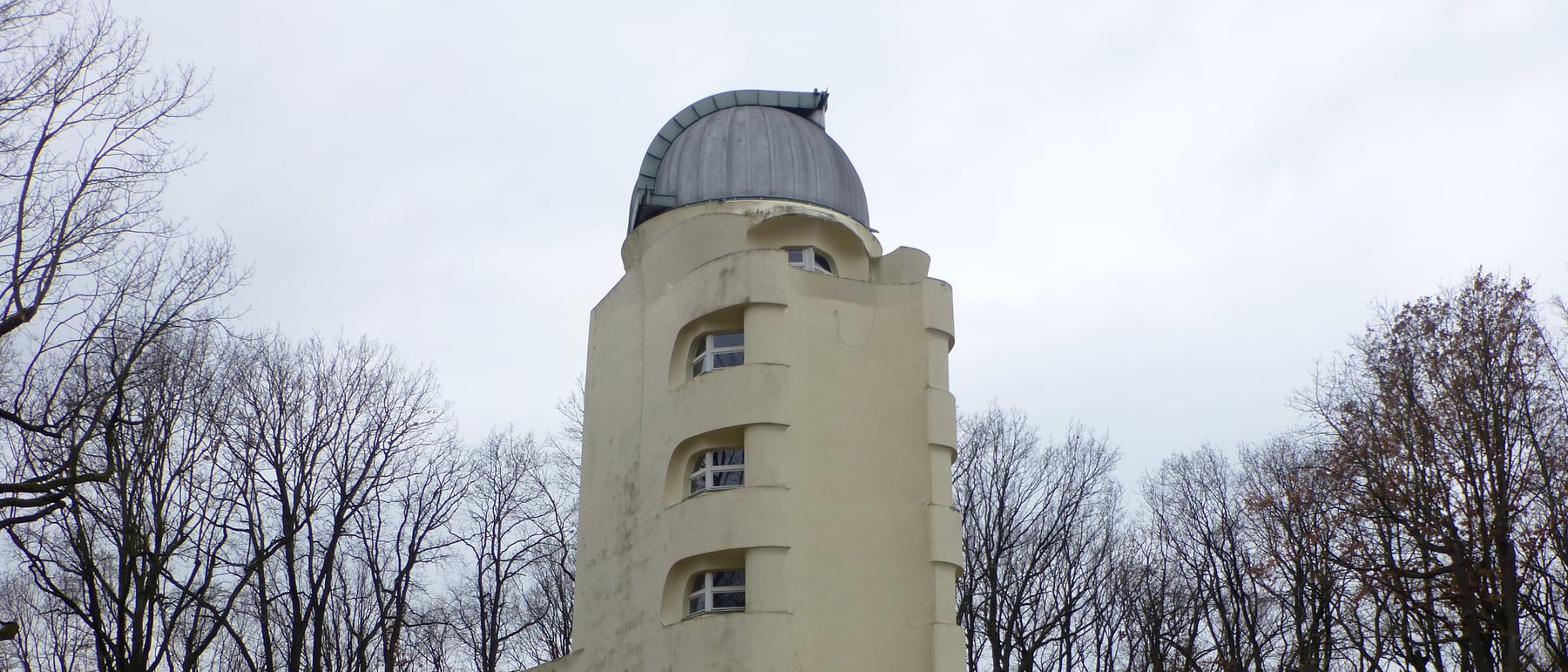
1. A building that looks poured, not built
Almost everything about the Einstein Tower refuses the right angle. Where the architecture of its moment was learning to be flat, planar and orthogonal, Erich Mendelsohn set out to make a building that was plastic — a single continuous body of curved surfaces, rounded corners and windows that seem pulled and smeared into the mass rather than punched through a wall. The silhouette is streamlined and almost aerodynamic, swelling from a broad base to the domed observatory on top, so that the whole tower reads as one sculptural gesture instead of a composition of parts.
This is Expressionism in three dimensions: the conviction that a building should express energy and movement, that form itself could carry emotion. Mendelsohn wanted the eye to slide over the tower without ever catching on a joint or an edge. The result feels modelled in wax or clay — a mass caught mid-flow — and it made the Einstein Tower, on completion, instantly the most photographed and argued-over building in Germany.
2. Sketched in the trenches
The tower began not as a commission but as a stream of tiny, furious sketches. Mendelsohn drew streamlined, dynamic towers and factories throughout the First World War, some of them literally in the trenches of the Eastern and Western Fronts, filling notebooks with buildings that surged and leaned as if in motion. These sketches — barely more than a few charged strokes each — were exhibited in Berlin in 1919 under the title Architecture in Steel and Concrete, and they announced a sensibility years before there was a building to attach it to.
When the astronomer Erwin Finlay-Freundlich needed an observatory and knew Mendelsohn personally, the drawings found their subject. The Einstein Tower is, in effect, one of those wartime sketches finally realised at full scale — which is why it retains the immediacy of a drawing, a form conceived whole in a single motion rather than assembled from a program. Its success launched Mendelsohn's career and made him, almost overnight, one of the most sought-after architects in Europe.
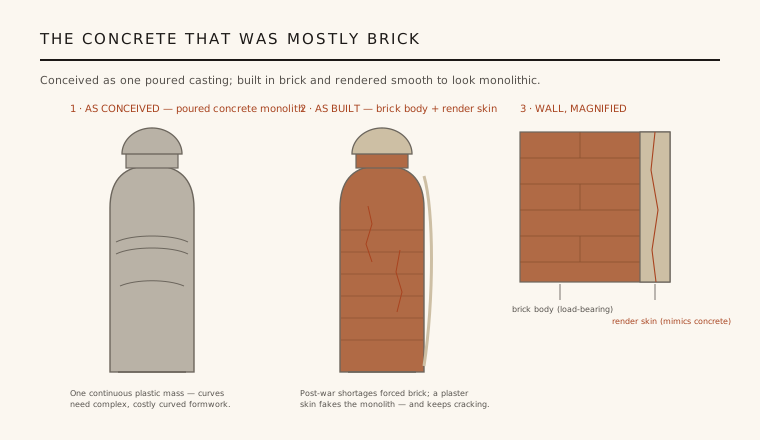
3. The concrete that was mostly brick
Here lies the building's famous, honest irony. Mendelsohn conceived the tower as a monolith of poured, reinforced concrete — a material whose liquid plasticity was the natural partner for such flowing curves; you cast the shape you want and it sets. But casting complex, doubly-curved surfaces demands elaborate bespoke timber formwork, and post-war Germany was desperately short of both concrete and skilled labour. So most of the tower was in fact built the old way, in brick, and then rendered — plastered smooth with a special concrete-imitating stucco — to disguise the masonry as one seamless casting.
The sculpture, in other words, is largely a brick body wearing a concrete-coloured skin. It is worth saying plainly because the deception has consequences: brick and render expand and contract differently, and the smooth surface has cracked, weathered and been patched almost continuously since the 1920s. The Einstein Tower is one of the most restored buildings of the modern movement — a monument whose maintenance is itself part of its story, and a cautionary tale about form conceived faster than construction could honestly follow.
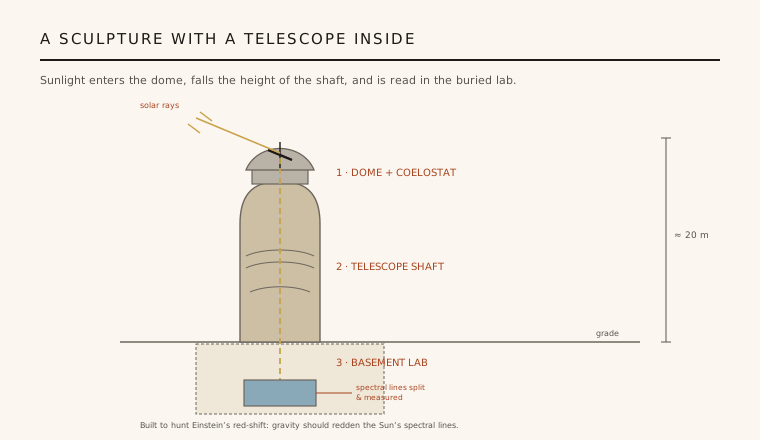
4. A sculpture with a telescope inside
For all its expressive drama, the Einstein Tower is a precise scientific instrument. It is a tower telescope: a coelostat — a driven mirror — sits in the dome at the top and tracks the Sun, sending a fixed beam of sunlight straight down the vertical shaft that forms the core of the tower. The beam falls the full height of the building to a laboratory buried in the basement, where a large spectrograph splits it into its spectrum so the solar absorption lines can be measured with great accuracy.
Its scientific purpose was breathtakingly of its moment: to test Albert Einstein's newly published General Theory of Relativity by detecting the tiny gravitational red-shift — the reddening of the Sun's spectral lines predicted by a strong gravitational field. Freundlich's programme never delivered the clean confirmation he hoped for, but the ambition explains everything about the building's fame. Here was architecture built to interrogate the cosmos, its romantic, surging form wrapped around the very apparatus meant to prove the century's most revolutionary idea.
5. The icon of Expressionist architecture
German Expressionist architecture produced few completed masterpieces — much of it lived in visionary drawings, glass fantasies and stage sets — which makes the survivors precious. The Einstein Tower stands with Bruno Taut's crystalline Glass Pavilion (1914) and Peder Vilhelm Jensen-Klint's brick Grundtvig's Church in Copenhagen as one of the movement's supreme built statements, and it is the one most people picture when the word Expressionist is spoken. Where Grundtvig climbs in ecstatic verticals, Mendelsohn's tower flows.
Its lesson outlasted the style. Expressionism as a movement dissolved within a few years, and Mendelsohn himself moved toward the sleeker, horizontal dynamism of his 1920s department stores. But the Einstein Tower proved that a building could be a single plastic form charged with feeling — an idea that would return, decades later, in the sculptural concrete of Le Corbusier's Ronchamp and the free-flowing masses of contemporary architecture. It remains a working observatory, run today by the Leibniz Institute for Astrophysics Potsdam, and remains — as it has always been — under repair.
Every building that reads as one continuous molten form — from Le Corbusier's Ronchamp to Zaha Hadid's poured, seamless masses — is working Mendelsohn's move: treat the whole structure as a single sculptural gesture rather than an assembly of walls and openings.
References & further reading
- 01Pehnt, W. (1973). Expressionist Architecture. Thames & Hudson, London.
- 02James-Chakraborty, K. (1997). Erich Mendelsohn and the Architecture of German Modernism. Cambridge University Press.
- 03Stephan, R. (ed.) (1999). Erich Mendelsohn: Dynamics and Function — Realised Buildings 1919–1933. Hatje Cantz, Ostfildern.
- 04Zevi, B. (1999). Erich Mendelsohn: The Complete Works. Birkhäuser, Basel.
- 05Leibniz Institute for Astrophysics Potsdam (AIP) (2024). 100 Years of the Einstein Tower: A Solar Observatory Connecting Art and Science. AIP (institutional record). https://www.aip.de/en/institute/locations/einstein-tower/
Last verified 2026-07-08. Ancient and vernacular works often have no single architect or firm date; dates are given as widely accepted approximations and the builder-culture is named where no individual designer is known.