
26 · Vernacular, Gardens & Engineering WondersNo. 19 in era
Charles Bridge
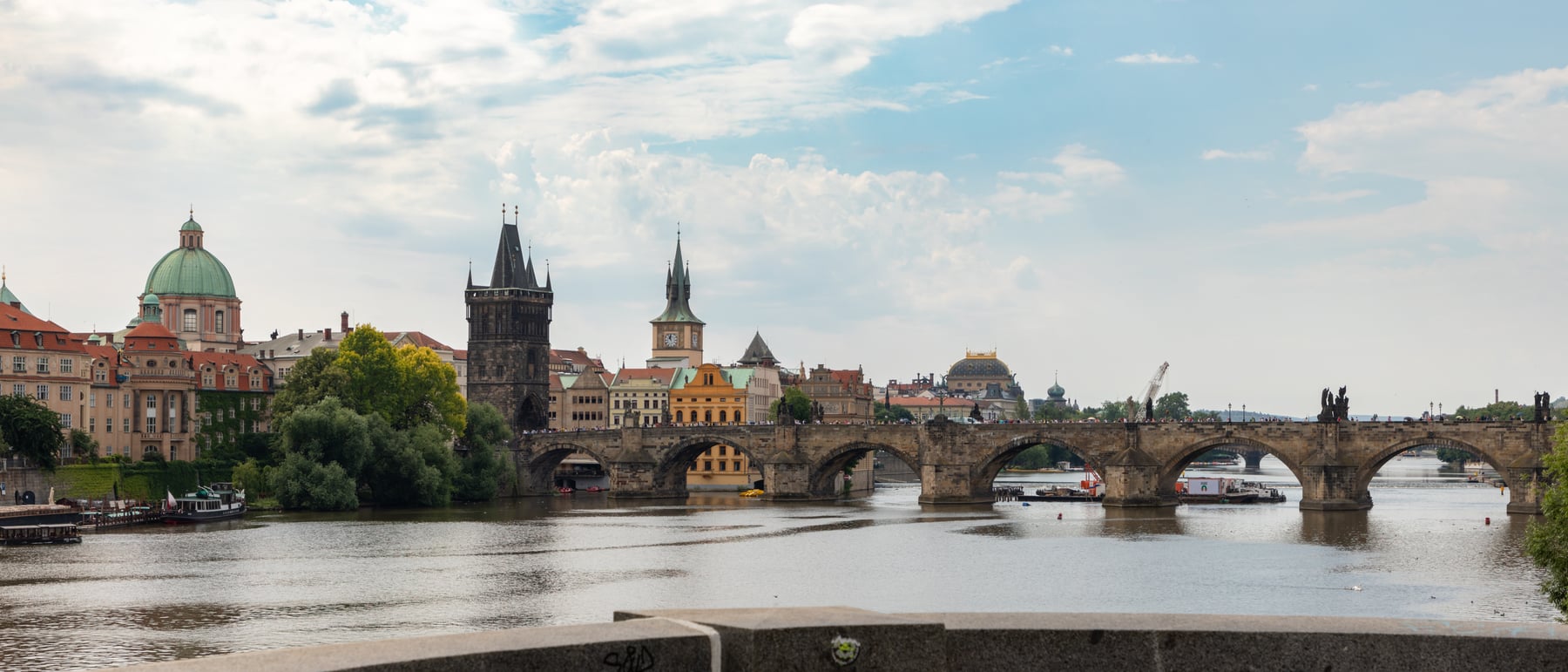
Across the Vltava at the heart of Prague runs a bridge that is really two buildings in one. Beneath the deck is a Gothic engineering work — sixteen sandstone arches begun in 1357 under Emperor Charles IV and his master mason Peter Parler, guarded at each end by tall fortified towers that could seal the crossing shut. Above the deck is a later Baroque theatre — an avenue of some thirty statues of saints added around 1700, turning a defensible river crossing into an open-air sculpture gallery and processional way. To read Charles Bridge is to separate the medieval structure from its Baroque skin.
1. A stone crossing for an imperial capital
Charles Bridge was born of catastrophe. Prague's earlier Romanesque crossing, the Judith Bridge, was swept away by a Vltava flood in 1342, cutting the two halves of a city that Emperor Charles IV intended to make the capital of the Holy Roman Empire. Charles ordered a new bridge in stone, and tradition holds that its foundation stone was laid on 9 July 1357 — a date and time (reputedly 5:31 in the morning) later celebrated as an auspicious ascending-and-descending palindrome of odd numbers, 1-3-5-7-9-7-5-3-1. That numerological story is a charming later gloss rather than documented fact, but the 1357 founding is secure.
Design and construction were entrusted to the workshop of Peter Parler, the young German-born master who was simultaneously raising the choir of St Vitus Cathedral on the hill above. The bridge was not finished quickly: the arches, the deck and the great towers were built over roughly half a century, with the crossing substantially complete by the early 1400s (often given as c. 1402). For nearly five hundred years — until 1841 — it remained the only bridge over the Vltava in Prague, the single stone thread binding the Old Town to the castle side.
2. The Gothic arcade: sixteen arches on the Vltava
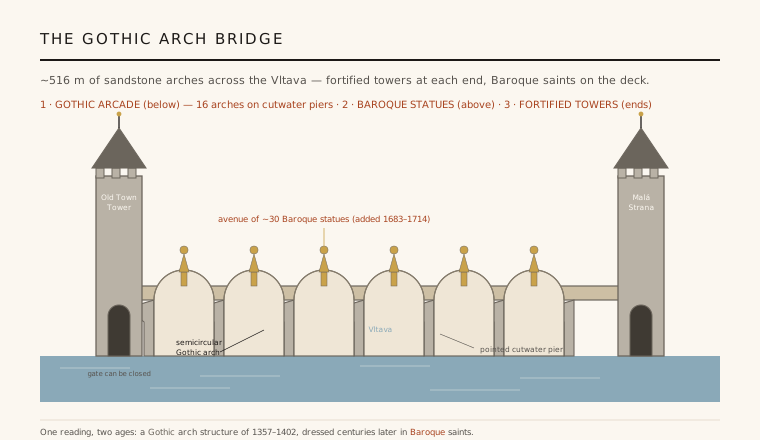
The structure itself is a masterpiece of medieval bridge engineering. Some 516 metres long and about 10 metres wide, it is carried on sixteen arches springing from massive piers built of dressed Bohemian sandstone blocks. The arches are broadly semicircular rather than pointed — a conservative, immensely strong profile for a bridge that had to resist the shove of a large river — and the piers between them are the key to survival: each is fronted on the upstream side by a pointed cutwater that splits the current, deflects debris and ice, and protects the masonry from scour.
What makes the bridge read as Gothic is less the arch geometry than its scale, its precision ashlar, and above all its integration into a fortified urban ensemble. The piers rest on timber grillages and stone foundations sunk into the riverbed, and the deck was laid to a gentle camber so that flood water and cart traffic drained and moved freely. It is a piece of civil infrastructure conceived with the same care as a cathedral — the same Parler workshop, the same sandstone, the same command of thrust and load applied to spanning water rather than enclosing space.
3. Fortress on a river: the bridge towers
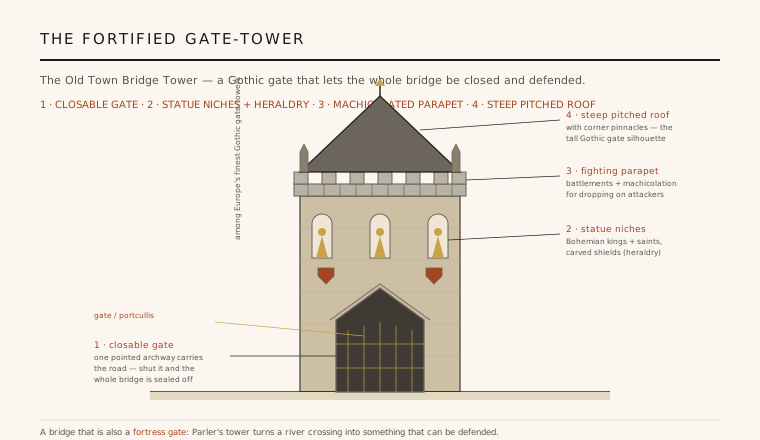
A medieval bridge was also a gate, and Charles Bridge was designed to be closed and defended. At each end Parler's workshop raised tall Gothic bridge towers pierced by a single pointed archway carrying the roadway: shut the gate and the whole crossing is sealed. The finest of them, the Old Town Bridge Tower, is widely regarded as one of the most beautiful Gothic gate-towers in Europe — a slender, richly carved block crowned by a machicolated fighting parapet, battlements and a steep pitched roof, its street front lined with statue niches holding figures of Bohemian kings and saints together with heraldic shields.
At the far, castle-side end stand the two Malá Strana (Lesser Town) towers: a squat older tower inherited from the vanished Judith Bridge and a taller Gothic companion, linked by a crenellated gateway. Together the towers turned the bridge into a defensible extension of the city walls, a controllable choke-point on the route between the Old Town, the Lesser Town and Prague Castle. The tower is where the bridge's architecture is most explicitly ceremonial and military at once — a triumphal gateway on the coronation route of Bohemian kings that could, at need, become a fortress.
4. The Baroque avenue of saints
The statues that everyone pictures on Charles Bridge are not part of Parler's Gothic bridge at all. For its first three centuries the parapets were bare stone. Only from the late 17th century, in the fervent atmosphere of the Catholic Counter-Reformation in Bohemia, were they lined with an avenue of some thirty sculptures of saints, mostly carved between about 1683 and 1714. The first and most venerated was the bronze St John of Nepomuk (1683), the priest said to have been thrown from this very bridge; the rest are Baroque stone groups by sculptors such as Matthias Braun and the Brokoff family, arranged in facing pairs down the deck.
The effect is a deliberate transformation of meaning. A medieval trade-and-defence structure was re-scripted as a sacred processional way, an open-air gallery in which the pilgrim walks a gauntlet of gesturing saints toward the castle and cathedral. Architecturally the lesson is one of layering: the load-bearing body of the bridge is Gothic, but its public image — the silhouette of dark figures against the sky that defines Charles Bridge in the popular imagination — is Baroque, applied nearly 300 years after the arches were built. Most of the figures now on the parapet are weather-resistant copies; the eroded originals have been moved to museums such as the Lapidarium of the National Museum.
5. Egg yolks, floods and endurance
No structure this old lacks its legends, and Charles Bridge's most enduring is that its mortar was strengthened with egg yolks — and, in richer versions, with wine, milk and cheese hauled in from towns across Bohemia. The tale is almost certainly folklore, though it captures a real medieval preoccupation with the quality of lime mortar; modern conservation analyses have not confirmed it. What is beyond doubt is the bridge's extraordinary durability: built to shrug off the Vltava, it has survived centuries of floods, including devastating inundations in 1784, 1890 (which collapsed several arches) and the great flood of 2002, each time repaired rather than replaced.
That survival is itself the deepest architectural point. Charles Bridge demonstrates how a well-founded masonry arch bridge — deep piers, sharp cutwaters, redundant arches, generous stone — can outlast the technology that made it and remain in daily use for the better part of seven centuries. It stands today exactly where Parler set it, carrying pedestrians instead of coronation processions, a Gothic engineering work still legible beneath its Baroque saints and still doing the job it was founded to do in 1357.
Every conservation-led rebuild of an ageing bridge or viaduct — repaired arch by arch rather than demolished — inherits Charles Bridge's lesson that a robust masonry structure can be a piece of civic infrastructure and a public monument at once, worth keeping for centuries.
References & further reading
- 01Boehm, B. D. & Fajt, J. (eds.) (2005). Prague, the Crown of Bohemia, 1347–1437. The Metropolitan Museum of Art / Yale University Press, New York & New Haven.
- 02Fajt, J. (ed.) (2006). Karl IV. Kaiser von Gottes Gnaden: Kunst und Repräsentation des Hauses Luxemburg 1310–1437. Deutscher Kunstverlag, Munich & Berlin.
- 03Rosario, I. (2000). Art and Propaganda: Charles IV of Bohemia, 1346–1378. Boydell Press, Woodbridge.
- 04Frankl, P. & Crossley, P. (2000). Gothic Architecture. Yale University Press (Pelican History of Art), New Haven, rev. ed..
- 05UNESCO World Heritage Centre (1992). Historic Centre of Prague. World Heritage List no. 616, UNESCO, Paris. https://whc.unesco.org/en/list/616
Last verified 2026-07-11. Ancient and vernacular works often have no single architect or firm date; dates are given as widely accepted approximations and the builder-culture is named where no individual designer is known.