
9 · Medieval India — Temple Cities & SultanatesNo. 07 in era · ▸ India
Chand Baori (stepwell)
In a village on the arid edge of Rajasthan, a square mouth in the ground opens onto one of the oldest, largest and deepest stepwells in India — thirteen storeys of interlocking stairs falling to a jewel of green water. Chand Baori turns the humble act of fetching water into hypnotic, load-bearing geometry.
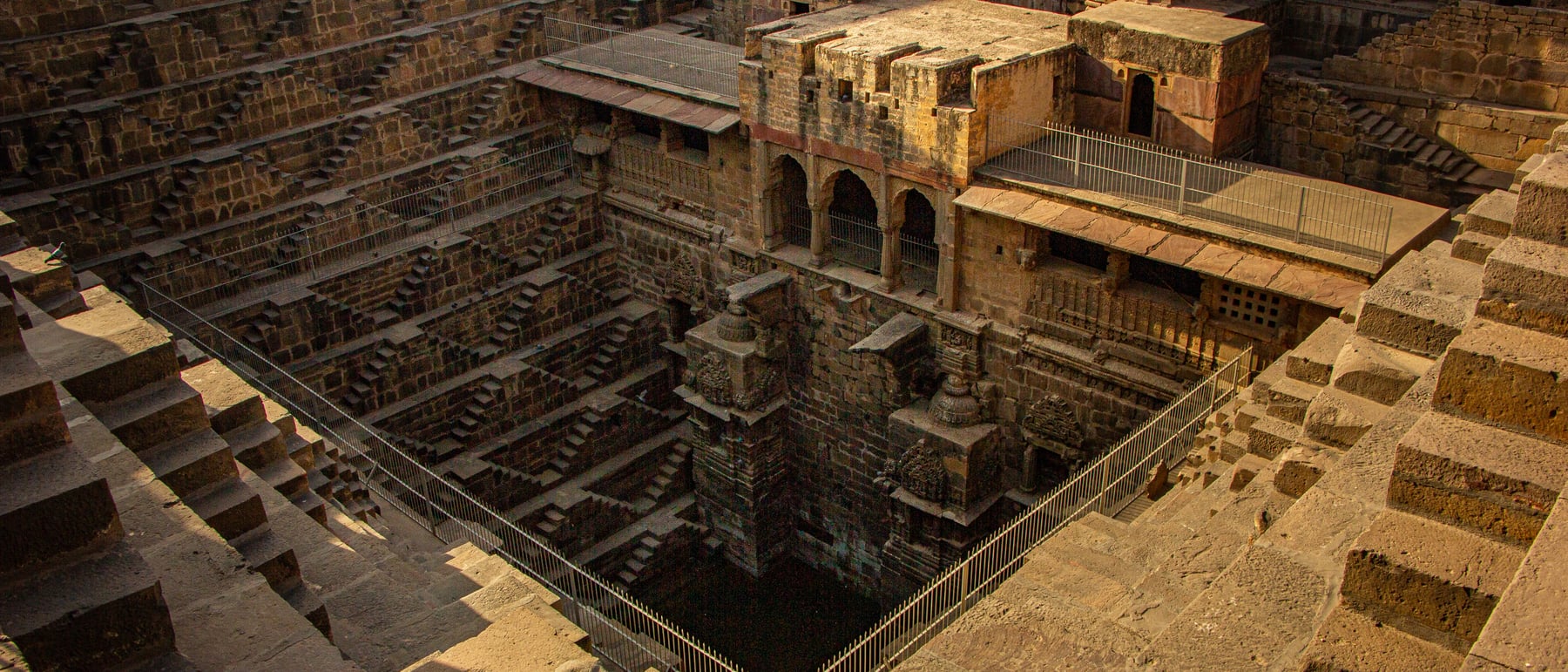
1. A square carved downward
Chand Baori inverts the logic of a monument: instead of rising, it descends. A great square pit is cut into the flat Rajasthan ground and lined with masonry, so that architecture is experienced by walking down into it rather than up toward it. Three of the four sides are given entirely to stairs, while the fourth is built up as a multi-storey pillared pavilion — the palatial face of the well.
The genius is in how the stairs are packed. Rather than one long ramp, the treads run in short double flights that go down, meet a landing, reverse, and go down again, interlocking into a near-fractal lattice of V and diamond shapes. This folding fits an enormous stair length — a popular tradition counts some 3,500 steps — onto a compact square, and lets a person reach the water at whatever level it happens to stand.
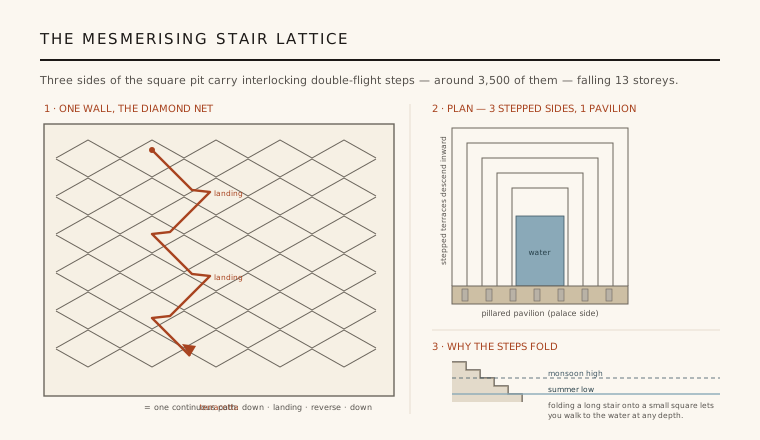
2. The moiré of light and shadow
Because every flight sits at an angle to its neighbours, the walls read as a shifting field rather than a static surface. As the sun moves, each tiny riser casts its own shadow, and the stacked V-shapes flicker between light and dark — a moiré that changes hour by hour and makes the well famous far beyond its engineering.
This is not merely decorative. The relentless repetition of a single module — one modest step — scaled up across thirteen storeys is what produces the visual power. Chand Baori demonstrates a principle later prized in modern architecture: that pattern and depth, generated by pure repetition of a functional element, can be as moving as any carved ornament.
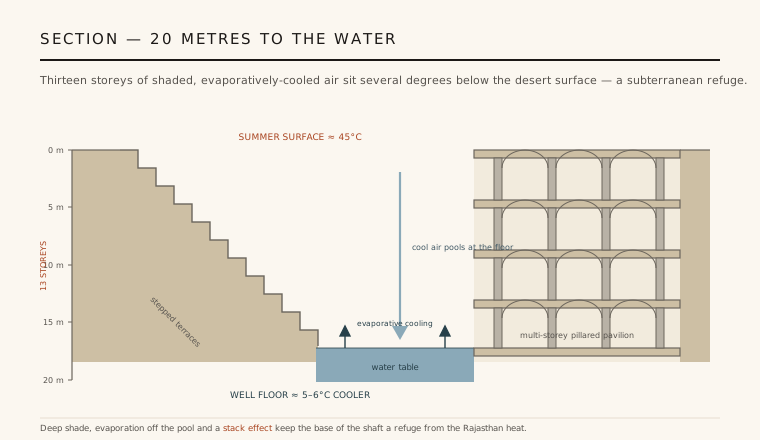
3. Twenty metres of engineered cool
The well is a climate machine as much as a reservoir. Descending roughly twenty metres puts a visitor into deep, permanent shade, and the air at the bottom can sit several degrees cooler than the searing surface — by tradition five to six degrees on a summer day. Evaporation off the pool draws heat from the surrounding air, while the narrow, sunken shaft traps a body of cool air that warmer air above cannot easily displace.
That thermal logic made the base of the stepwell a social space, not just a water source. Landings and the shaded pavilion offered a communal refuge where people gathered in the cool during the fiercest heat. The well thus solved two desert problems at once — storing scarce water and manufacturing shade — and did so with nothing but masonry, geometry and depth.
4. Water, table and monsoon
Rajasthan's rainfall arrives in a brief, violent monsoon and then vanishes, leaving a water table that rises and falls sharply through the year. The stepwell is a response tuned to exactly this: an open shaft dug down to the aquifer so that, whatever the level, a continuous stair always lets a hand or a pot reach the surface of the water.
In effect Chand Baori is rainwater harvesting made architectural. It captures and stores water through the dry months, buffers the seasonal swing of the table, and turns a purely practical need into civic infrastructure — the reason stepwells (baori, vav, kalyani) spread across the arid west of the subcontinent for more than a thousand years.
5. Dating, temple and afterlife
The well faces the Harshat Mata temple and is traditionally credited to a ruler of the Nikumbha line, with the core commonly placed in the eighth to ninth century — though it should be said plainly that the date is approximate, resting on style and regional history rather than a firm inscription. Like most long-lived monuments, it is not the work of a single moment.
The severe lattice of steps is the oldest part; the arcaded upper galleries and the more refined chambers of the pavilion, with their cusped arches, were added much later under Mughal-era patronage. Chand Baori is therefore a palimpsest — an early Hindu waterwork wrapped, centuries on, in an Indo-Islamic upper storey, still holding its green water at the bottom of the desert.
Its lesson — that depth, shade and evaporation can cool a space with no energy at all — is exactly what today's passive-cooling and sunken-courtyard architecture is relearning for a warming climate.
References & further reading
- 01Livingston, M. and Beach, M. (2002). Steps to Water: The Ancient Stepwells of India. Princeton Architectural Press, New York.
- 02Jain-Neubauer, J. (1981). The Stepwells of Gujarat in Art-Historical Perspective. Abhinav Publications, New Delhi.
- 03Lautman, V. (2017). The Vanishing Stepwells of India. Merrell Publishers, London.
- 04Hegewald, J. A. B. (2002). Water Architecture in South Asia: A Study of Types, Developments and Meanings. Brill, Leiden.
- 05Archaeological Survey of India (n.d.). Chand Baori (Abhaneri) — Monument record, Jaipur Circle. Archaeological Survey of India.
Last verified 2026-07-06. Ancient and vernacular works often have no single architect or firm date; dates are given as widely accepted approximations and the builder-culture is named where no individual designer is known.