
11 · The Americas & Africa (Pre-Modern)No. 06 in era
Caral
On a dry terrace above the Supe Valley, a thousand years before the Inca and roughly contemporary with the pyramids of Giza, people raised six great platform mounds and sank round plazas into the earth — a planned city built without pottery, without writing, and without walls.
1. The oldest city in the Americas
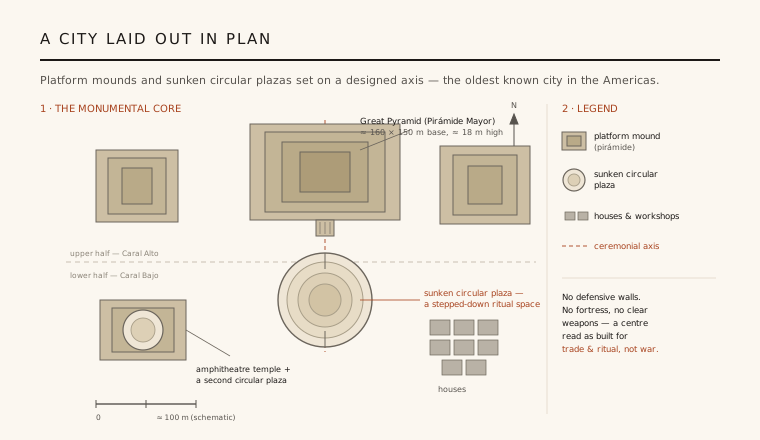
Caral lies about 200 km north of Lima and some 23 km inland, on a bench above the Supe Valley. Its monumental core covers roughly 66 hectares and is unmistakably planned: six large platform mounds are arranged around open plazas, split between an upper half (Caral Alto) carrying the biggest monuments and a lower half (Caral Bajo), with distinct ceremonial and residential sectors. This is not a settlement that grew by accretion but a layout whose geometry and axes were decided before the first stone was set.
Radiocarbon dates place the main phase of construction between roughly 2600 and 2000 BCE, in the Late Archaic. That makes Caral the oldest known urban centre in the Americas and a near-contemporary of Old Kingdom Egypt — yet it was reached by a wholly independent route, with no pottery, no metal, and no writing in any conventional sense. Monumental urbanism here arrives before the technologies we usually assume must come first.
2. Building a mountain: the platform mounds
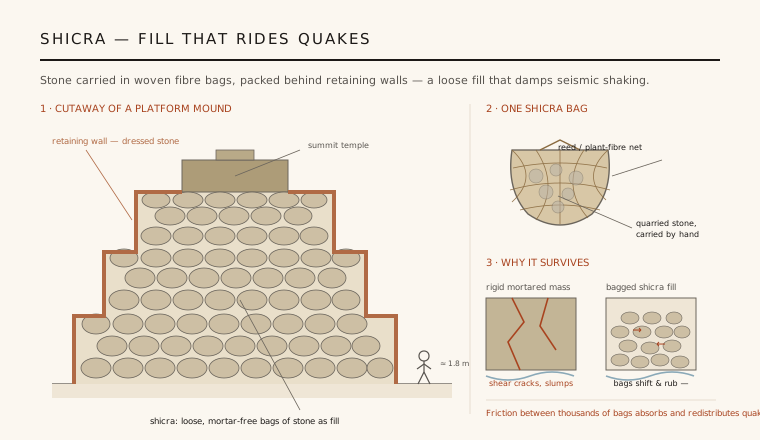
The pirámides of Caral are not solid masonry pyramids but artificial mountains built by the retaining-wall-and-fill method. A perimeter of dressed and rough stone was raised as a retaining wall, the space behind it packed with fill, and the process repeated to stack terrace upon terrace. Staircases climb the principal face on axis, and the flat summits carried plastered atria and small rooms — the sacred destination the whole mass exists to lift into view.
The largest, the Pirámide Mayor, spans about 160 by 150 metres at its base and stands some 18 metres high. Without arch, vault or true pyramid geometry, the builders achieved monumental height by the simplest of means — walls that hold, fill that stays put, and a summit raised above the valley floor. The genius is less in the silhouette than in what fills the interior.
3. Shicra: bagged fill as earthquake engineering
The fill inside the mounds was not loose rubble but shicra: quarried stones carried and packed into loosely woven bags of reeds and plant fibre, then piled by the hundred-thousand behind the retaining walls. Those same fibres are what let us date Caral at all — radiocarbon on the reed bags and associated textiles fixed the site's chronology (Shady, Haas and Creamer, 2001). The dates are broad and still debated, but they land consistently in the third millennium BCE.
Modern engineers read the shicra as seismic design. The Peruvian coast is intensely earthquake-prone, and a loose, mortar-free fill of countless bags can shift and settle, its innumerable bag-to-bag contacts absorbing and redistributing shaking energy while resisting the slumping and liquefaction that would crack a rigid mass. Whether the builders reasoned this out or simply kept the method that survived, the result is empirical: the mounds have stood for roughly 4,500 years in seismic country.
4. The sunken circular plaza
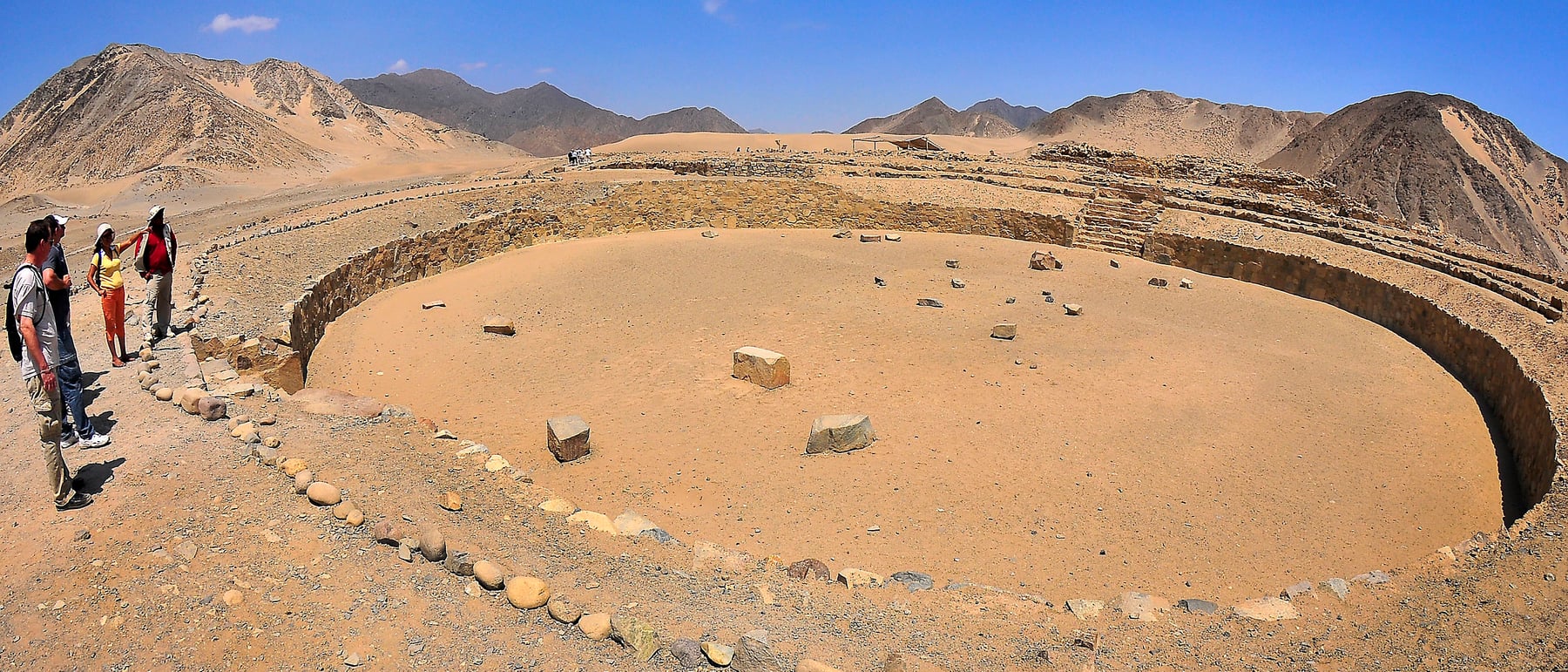
In front of the major mounds the builders did the opposite of piling up — they dug down. Their sunken circular plazas are round arenas recessed below ground level and ringed by stepped stone walls, gathering people beneath the horizon for ceremony. It is a deliberate architectural counterpoint: the solid, ascending mound answered by a hollow, descending court, void set against mass on a single ceremonial axis.
The amphitheatre temple has its own large sunken circular plaza, and it was there that archaeologists recovered a cache of thirty-two flutes made from condor and pelican bone — instruments for the gatherings the space was shaped to hold. The pairing of raised platform and sunken round plaza became a signature of Andean ceremonial architecture, echoing down the coast and highlands for millennia after Caral was abandoned.
5. A city without walls
Caral has no fortifications, no defensive walls and no clearly identifiable weapons — an absence many archaeologists read as evidence of a society organised around trade and religion rather than war. Its economy joined two worlds: cotton grown in the irrigated valley was spun into fishing nets and textiles and exchanged with coastal communities such as Áspero for the anchovies and sardines that supplied protein, alongside squash, beans and guava. Record-keeping, meanwhile, may have run through a quipu of knotted string rather than script.
Honesty demands the caveats. Scholars still argue over which Norte Chico site came first, over whether Áspero on the coast is as old or older, and over whether Caral is best called a city, a state or a great ceremonial centre. But on the architecture the message is steady: here, monumental planned building preceded pottery, metal and organised warfare — and did so with a construction detail that reads, 4,500 years on, like intentional earthquake engineering.
Today's base-isolated skyscrapers and earthbag (superadobe) shelters chase the same insight the shicra builders reached in the third millennium BCE: give a structure a deliberately loose, flexible layer so it can ride an earthquake rather than rigidly resist it.
References & further reading
- 01Shady Solís, R., Haas, J., & Creamer, W. (2001). Dating Caral, a Preceramic Site in the Supe Valley on the Central Coast of Peru. Science 292(5517), 723–726. https://doi.org/10.1126/science.1059519
- 02Haas, J., Creamer, W., & Ruiz, A. (2004). Dating the Late Archaic occupation of the Norte Chico region in Peru. Nature 432, 1020–1023. https://doi.org/10.1038/nature03146
- 03Shady Solís, R. (2006). America's First City? The Case of Late Archaic Caral. In Andean Archaeology III (Isbell & Silverman, eds), Springer, pp. 28–66.
- 04Moseley, M. E. (1975). The Maritime Foundations of Andean Civilization. Cummings, Menlo Park.
- 05UNESCO World Heritage Centre (2009). Sacred City of Caral-Supe. UNESCO World Heritage List (institutional record). https://whc.unesco.org/en/list/1269/
Last verified 2026-07-06. Ancient and vernacular works often have no single architect or firm date; dates are given as widely accepted approximations and the builder-culture is named where no individual designer is known.