
10 · East & Southeast AsiaNo. 13 in era
Bulguksa & Seokguram
On a wooded ridge above the old Silla capital of Gyeongju sit two masterpieces built as one commission: Bulguksa, a temple whose wooden halls ride on a landscape of precisely fitted granite terraces, and Seokguram, an artificial grotto crowned by a corbelled granite dome over a serene, sunrise-facing Buddha. Together they are the summit of Unified Silla's stone-and-timber architecture — and, at Seokguram, one of the most sophisticated pieces of stone vaulting and passive climate engineering in all of East Asia.
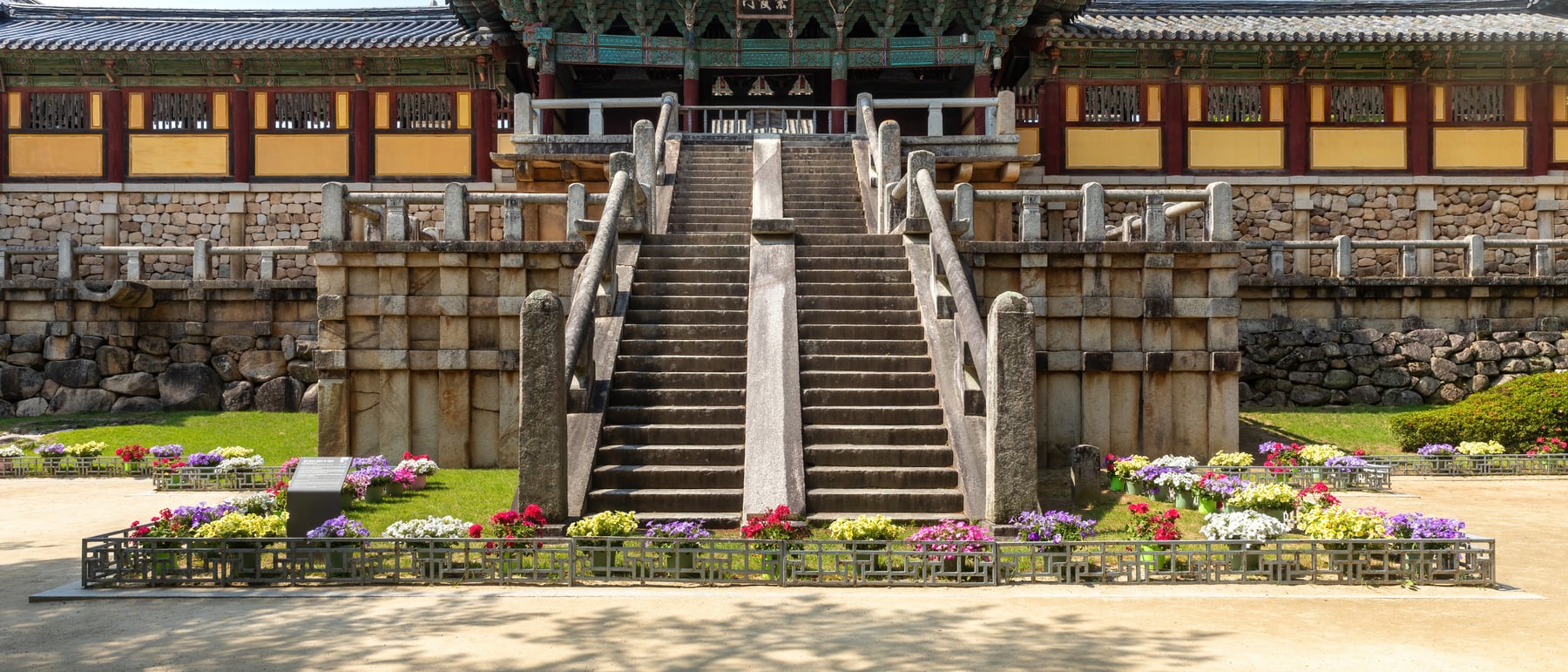
1. The stone podium: Bulguksa's granite terraces
Bulguksa and Seokguram are a single commission and a single UNESCO listing, raised on the flanks of Toham Mountain above Gyeongju, the Silla capital, at the height of the kingdom's Buddhist golden age. Their present form was begun in 751 CE under the chief minister Kim Daeseong, and they stand as the two summits of Unified Silla architecture. Bulguksa means 'Temple of the Buddha Land', and although its halls are of wood, the building's genius is stone: the temple sits on a landscape of precisely fitted granite terraces and retaining walls that turn a hillside into a serene, geometric podium.
The retaining walls are a lesson in fitted masonry — a base course of large, rounded natural boulders over which rectangular cut blocks are laid and locked, cut stone dovetailed to raw rock. Through them climb two famous twin bridge-staircases: Cheongungyo ('Blue Cloud') and Baegungyo ('White Cloud') to the main gate, with a second lotus-named pair alongside. They are called bridges because they arch on stone over what was once a lotus pond, and the ascent up their steps is the point — a deliberate passage from the earthly world below to the Buddha-land on the terrace above.
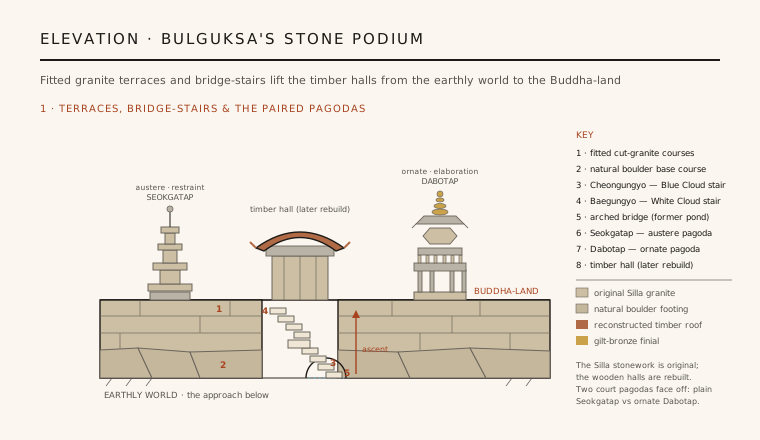
2. Two pagodas: restraint against richness
In the main courtyard stand two stone pagodas of the same moment but opposite character — a pairing made on purpose. Seokgatap, the Sakyamuni pagoda, is austere: a three-story granite pagoda of the classic Silla type, its cubic bodies and broad, flat roof-stones pared down to pure proportion, restraint offered as an aesthetic in its own right. It is so plain it earned the nickname the 'Shadowless Pagoda', and during a 1966 repair it yielded the Great Dharani Sutra, among the oldest surviving examples of woodblock printing anywhere.
Facing it, Dabotap — the 'Many Treasures Pagoda' — is the antithesis: elaborate, with stairways on all four sides, corner piers framing an open lower story, a carved stone balustrade, and an octagonal upper body beneath a canopy. It is one of the most ornate stone structures in East Asia, prized enough to appear on the South Korean ten-won coin. The two enact a scene from the Lotus Sutra, in which the Sakyamuni and Many-Treasures Buddhas sit side by side; architecturally, they present simplicity and elaboration as equal ideals sharing one court.
3. Seokguram: the corbelled granite dome
On the ridge above the temple, Seokguram is an artificial grotto built entirely of fitted granite. A rectangular antechamber, its walls carved with guardian figures and roofed by flat stone lintels, opens through a short passage into a circular domed rotunda about 6.8 metres across. At its centre a monumental granite Buddha, roughly 3.5 metres high, sits in perfect calm, facing east toward the sunrise over the East Sea, while a ring of superb wall reliefs — bodhisattvas, the ten disciples and the Four Heavenly Kings — encircles the space.
The dome is the structural marvel. It is a hemisphere corbelled from curved granite panels stacked in diminishing rings and locked not by a true keystone arch but by protruding 'peg-stones' (dongbatdol) that jut radially into the surrounding earth and pin each course in place, the whole closed at the crown by a single round lotus capstone. Assembled above ground from some three hundred and sixty dressed blocks and then buried under an earth mound to become a cave, it is a dry-stone vaulting solution without real parallel in East Asia.
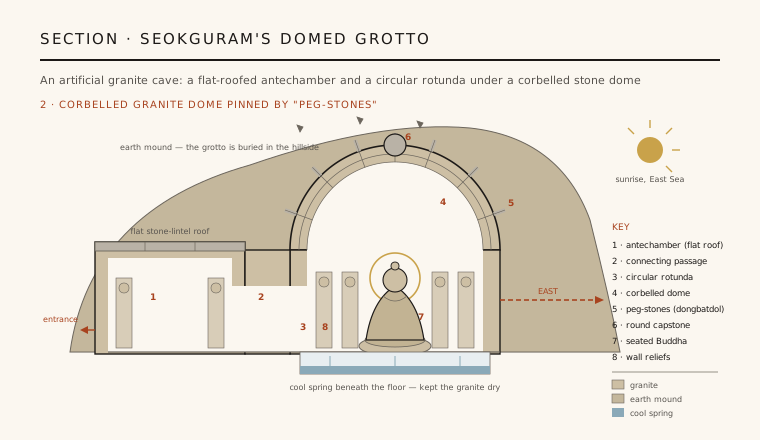
4. Building physics: the spring beneath the floor
Seokguram was also an early exercise in building science. A sealed granite chamber in a humid climate faces one enemy above all — condensation on cold stone, which would streak and rot the sculpture. The Silla builders answered it passively: a cold spring was channelled beneath the stone floor, keeping the floor cooler than the walls and the statue, so that airborne moisture condensed harmlessly on the floor rather than on the Buddha. It was, in effect, passive humidity control more than a thousand years before mechanical air-conditioning.
That delicate balance was undone by modern intervention. A Japanese colonial restoration of 1913–15 encased the dome in concrete, sealing off the natural ventilation; damp and moss soon followed, and in the 1960s Korean authorities installed air-conditioning and a glass screen to protect the interior. The grotto is now machine-climatised, its original passive system lost — a cautionary tale about restoring a building whose engineering was never fully understood.
5. What survives, and why it matters
It is worth being honest about the fabric. Much of what a visitor sees at Bulguksa — the timber halls, bracket sets and painted roofs — are reconstructions, most substantially rebuilt in the 1970s after centuries of fire and neglect, the temple having been largely burned during the Japanese invasion of 1593. The Silla achievement that genuinely survives is the stone: the terraces, the bridge-stairs, the two pagodas and the grotto. Even the dating leans on the thirteenth-century Samguk Yusa, which credits Kim Daeseong and gives 751 as the start; the precise building phases remain debated.
Between them, the pair fixes a distinctly Korean synthesis — Chinese Buddhist models absorbed and refined into a stone architecture of extraordinary precision and calm, where geometry, landscape and doctrine are made one. Jointly inscribed by UNESCO in 1995, Bulguksa and Seokguram remain the touchstone of Silla art and the clearest demonstration that eighth-century Korea could cut and fit granite with a control equal to anything of its age.
Seokguram's earth-buried granite dome — a single revered object met at the end of a processional route, in a chamber whose humidity was tuned by design — anticipates the modern earth-sheltered museum and its climate-controlled, top-lit gallery built around one masterwork.
References & further reading
- 01UNESCO World Heritage Centre (1995). Seokguram Grotto and Bulguksa Temple (inscription record). UNESCO World Heritage List, ref. 736. https://whc.unesco.org/en/list/736/
- 02McCune, E. (1962). The Arts of Korea: An Illustrated History. Charles E. Tuttle, Rutland & Tokyo.
- 03Portal, J. (2000). Korea: Art and Archaeology. British Museum Press, London.
- 04Lee, Ki-baik (trans. E. W. Wagner with E. J. Shultz) (1984). A New History of Korea. Harvard University Press, Cambridge MA.
- 05Kim, Lena (2007). Buddhist Sculpture of Korea. Korean Culture Series 8, Hollym, Seoul.
Last verified 2026-07-06. Ancient and vernacular works often have no single architect or firm date; dates are given as widely accepted approximations and the builder-culture is named where no individual designer is known.