
16 · The Industrial Revolution — Iron, Glass & the New ProgramNo. 08 in era
Brooklyn Bridge
A pair of Gothic granite towers wading in the East River, strung with four cables of spun steel wire — the first steel-wire suspension bridge, the longest span on Earth for a generation, and the enduring emblem of American engineering nerve.
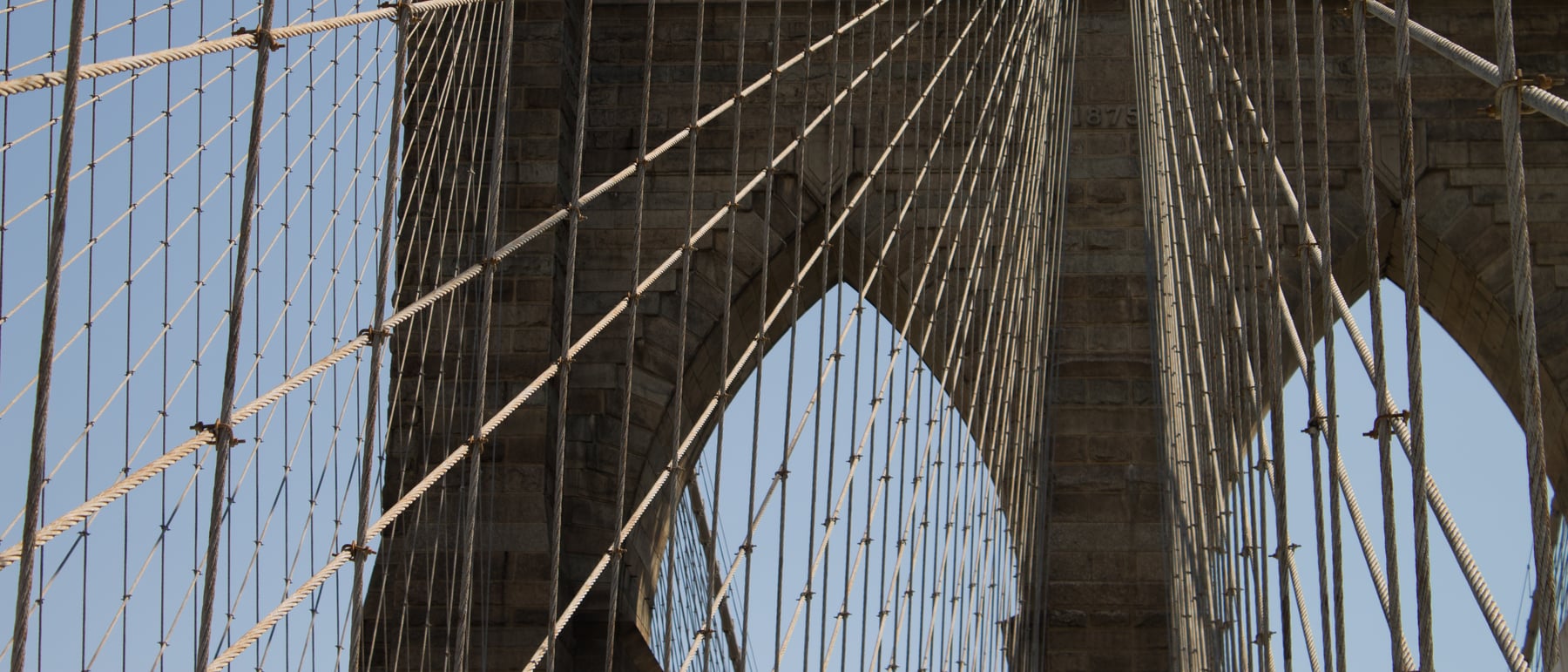
1. Old stone, new steel
The Brooklyn Bridge is a bridge made of two conversations between eras. Rising from the water are two colossal towers of granite and limestone, each pierced by twin pointed Gothic arches — a deliberately medieval, cathedral-like monumentality that gave a frightened public something solid and familiar to trust. Yet those masonry giants exist to do one modern thing: carry cable. They are the abutments of a machine.
The cables themselves were the revolution. John Roebling specified steel wire rather than the wrought iron every earlier suspension bridge had used — the first structural use of steel wire in a great bridge, and steel is far stronger. The result is a hybrid of the archaic and the industrial: stone piers straight out of the Gothic imagination holding up a web of high-tensile metal that only the 1870s could make. Chapter 16's theme — new materials meeting an old formal language — is written into the bridge's silhouette.
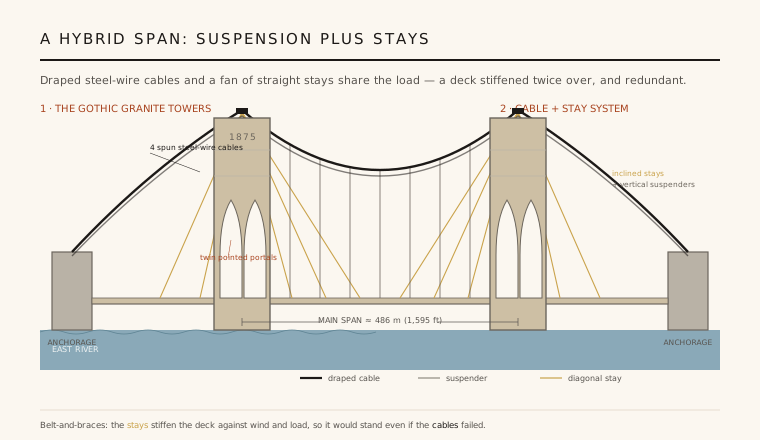
2. The longest leap of its age
The clear span between the towers is about 486 m (1,595 ft) — and when it opened in 1883 that was, by roughly half, the longest suspension span in the world. No structure had reached so far across open water. To a city of church spires and low masonry, the deck strung 40-odd metres above the river was a genuinely new kind of space: a public promenade in the sky, with a dedicated pedestrian walk raised above the road and rail lanes.
Length on this scale is not just bragging; it is a structural argument. A span this long is dominated by its own weight and by wind, and every earlier long suspension bridge had a terrifying habit of writhing and, occasionally, tearing itself apart. Roebling knew this history intimately, and the bridge's real genius is not the record distance but the system he devised to keep so long a deck from misbehaving.
3. Sinking the towers — and the human cost
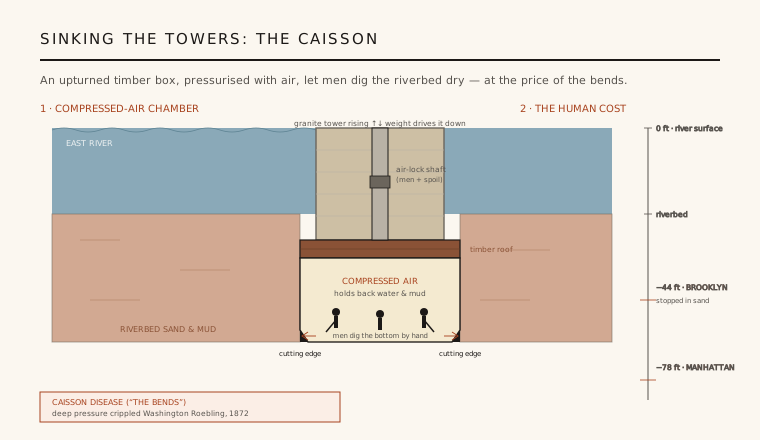
Before anything could rise, the towers had to reach bedrock through the riverbed. The engineers used pneumatic caissons: enormous upside-down timber boxes, open at the bottom, sunk into the river and pumped full of compressed air to hold back water and mud while men dug out the bottom by hand. The masonry tower was built on the caisson roof, and its growing weight drove the whole box slowly down. The Brooklyn foundation stopped near 44 ft; the Manhattan caisson pushed to about 78 ft.
The price was brutal. Coming up too fast from that pressurised depth gave workers caisson disease — "the bends" — a then-unexplained agony that killed several men and left many crippled. Among the crippled was chief engineer Washington Roebling himself, who in 1872 was left partly paralysed and bedridden. It is the darkest lesson of the industrial bridge: the new spans were built on a physiology no one yet understood.
4. Roebling's insurance policy: the diagonal stays
Look closely and the cable web is doing two jobs at once. Below the graceful draped main cables, with their vertical suspenders, runs a second set of straight, inclined stays radiating downward from each tower top to the deck. This makes the Brooklyn Bridge a hybrid of the suspension and the cable-stayed bridge — decades before cable-stayed design became common. The stays, working with a stiffening truss along the deck, brace the roadway against wind and moving loads that would otherwise set a pure suspension span oscillating.
Roebling built in this redundancy on purpose. He designed the cables to something like six times the strength strictly required, and claimed the stayed deck was so stiff it would stand even if the main cables were removed. That over-engineering proved providential: during construction a contractor fraudulently supplied defective wire, but the margins were so generous that the bridge remained safe. Redundancy — more strength and more load-paths than the sums demand — is one of the discipline's most mature ideas, and here it is monumental.
5. A dynasty, a tragedy, and an icon
No great building has a stranger authorship. John Augustus Roebling, who designed the bridge and pioneered its in-situ cable-spinning, died of tetanus in 1869 from a foot injury while surveying the site — before a stone was laid. His son Washington Roebling took over as chief engineer and was then broken by the bends. For the final decade the project was effectively directed by Washington's wife, Emily Warren Roebling, who taught herself the higher mathematics and cable engineering, carried his instructions to the site daily, and stood in for him with contractors and officials. She was, fittingly, the first to ride across when it opened.
The cable-spinning itself was Roebling's patented method: individual wires run back and forth across the span by a travelling wheel and bound in place into the finished cables — 5,434 galvanised steel wires per cable, spun over the river. Since 1883 the bridge has become pure cultural icon — painted, filmed, and quoted endlessly as the image of the modern city. It is the rare feat of engineering that a whole society adopted as a symbol of what it could build.
Every long-span crossing that mixes cable systems for stiffness and builds in redundant load-paths — and every restored steel structure dressed in monumental civic stone — is still working Roebling's insight that a span should survive the failure of any one part.
References & further reading
- 01McCullough, D. (1972). The Great Bridge: The Epic Story of the Building of the Brooklyn Bridge. Simon & Schuster, New York.
- 02Trachtenberg, A. (1979). Brooklyn Bridge: Fact and Symbol. University of Chicago Press, Chicago.
- 03Petroski, H. (1995). Engineers of Dreams: Great Bridge Builders and the Spanning of America. Alfred A. Knopf, New York.
- 04Weigold, M. E. (1984). Silent Builder: Emily Warren Roebling and the Brooklyn Bridge. Associated Faculty Press, Port Washington, NY.
- 05Historic American Engineering Record (1969). Brooklyn Bridge, HAER NY-18. Library of Congress, Prints & Photographs Division. https://www.loc.gov/item/ny0331/
Last verified 2026-07-08. Ancient and vernacular works often have no single architect or firm date; dates are given as widely accepted approximations and the builder-culture is named where no individual designer is known.