
15 · Neoclassicism & the EnlightenmentNo. 06 in era
British Museum
A Greek-revival temple of collections — the encyclopaedic museum housed behind a monumental Ionic colonnade, and the founding type of the imperial-era public museum, raised in the heart of Bloomsbury as an argument that all the world's knowledge could be gathered, ordered and shown.
1. A museum rebuilt as a quadrangle
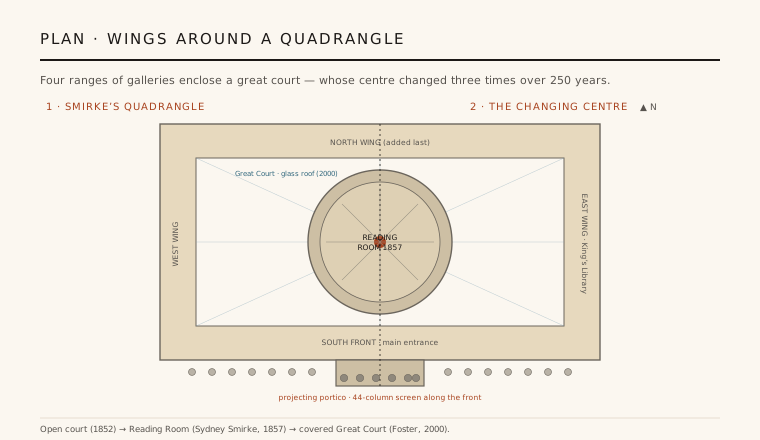
The British Museum was founded in 1753 as the world's first free national public museum, but the building we know is Sir Robert Smirke's — begun in 1823 and finished, wing by wing, around 1852. Smirke replaced the cramped seventeenth-century mansion it had outgrown with a single vast composition: four long ranges of top-lit galleries wrapped around a great rectangular court, entered through a colonnaded south front on Great Russell Street. It is a rational plan, a picture-frame of galleries, designed so an ever-swelling encyclopaedic collection could be laid out room after room in orderly sequence.
The east wing came first, built to hold the King's Library — George III's collection, one of the noblest neoclassical interiors in Britain, a gallery some 90 metres long lined with columns and a coffered ceiling. Around it the museum grew: the plan was conceived from the start to be filled, extended and re-hung as the Enlightenment project of collecting everything ran on. The quadrangle is less a finished object than a system for absorbing the world.
2. A classical skin over a hidden iron skeleton
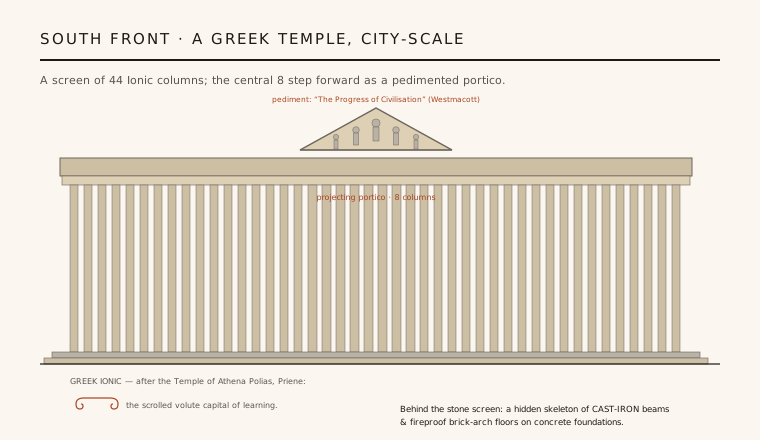
The stone envelope is archaeologically correct Greek; the construction behind it is aggressively modern. Smirke was one of the pioneers of structural iron in Britain, and the Museum is carried on a concealed frame of cast-iron beams and columns, with fireproof floors of brick jack-arches sprung between iron joists — a response to the terror of fire in a building stuffed with irreplaceable manuscripts and antiquities. He also laid the whole thing on beds of mass concrete, among the earliest large-scale uses of concrete foundations in English building.
This is the quiet lesson of the British Museum for the discipline: the Greek Revival's cool marble faces frequently hid the century's new industrial technologies. A temple front could be a fireproof, iron-framed warehouse for civilisation. The classical language supplied the meaning — order, antiquity, permanence — while cast iron supplied the spans, the fire resistance and the sheer scale that no ancient temple ever needed.
3. The Greek temple front, at civic scale
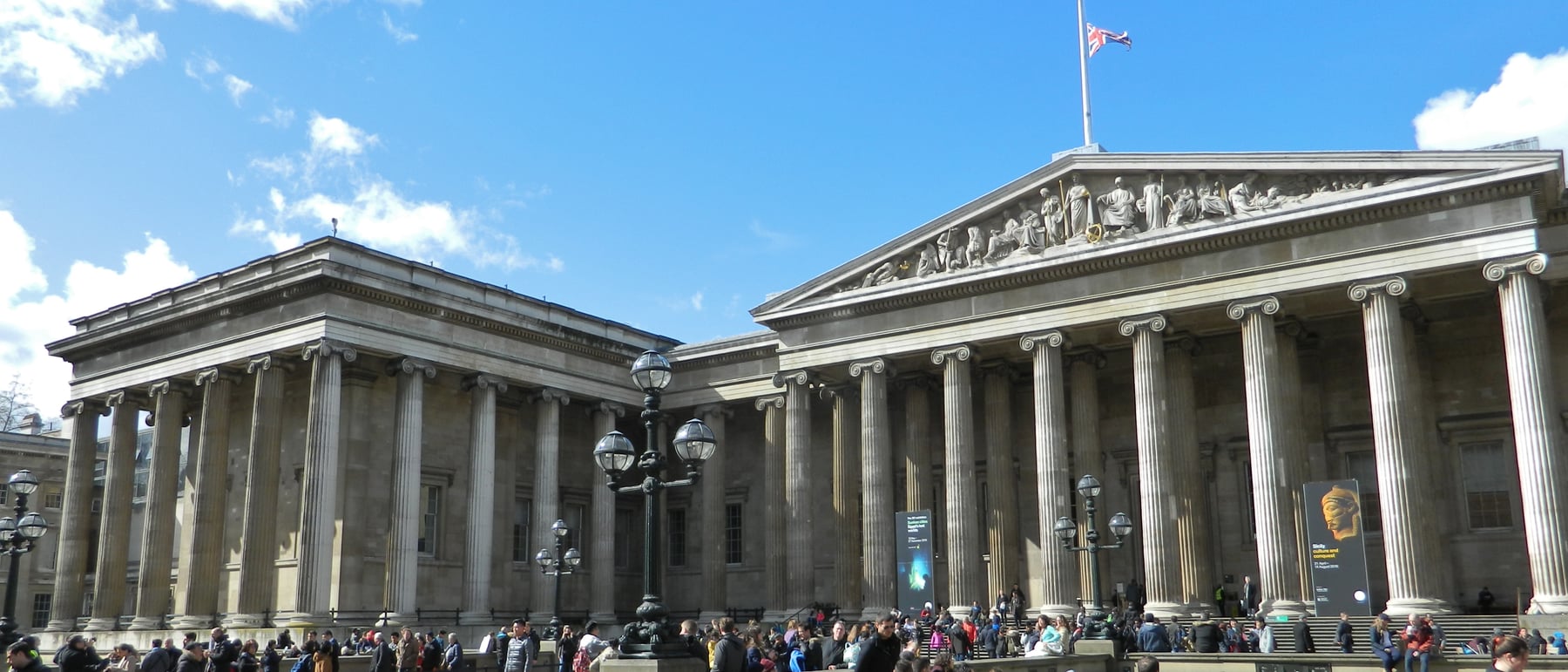
The south front is a temple facade blown up to the size of a public institution: a giant screen of 44 Ionic columns marching the full width of the building, with the central eight stepping forward as a projecting portico crowned by a triangular pediment. Filling that pediment is Richard Westmacott's sculpture group, The Progress of Civilisation — an allegory of humankind rising from ignorance to enlightenment, sited exactly where a Greek temple would have shown its gods. The message is deliberate: this is a shrine, but to learning.
Smirke chose the Greek Ionic, its capitals modelled on the Temple of Athena Polias at Priene, and the choice is a scholarly argument. By the 1820s the Greek Revival had come to stand for reason, democracy and the archaeologically authentic — the true, studied antique against the looser Roman classicism of earlier generations. Wrapping a national museum in accurate Greek Ionic declared the building itself an instrument of the Enlightenment, and it set the pattern for the columned public museum copied across Europe and America ever since.
4. A centre that changed three times
Smirke's quadrangle enclosed a large open court that was, almost at once, a waste of space. In 1857 his brother Sydney Smirke filled it with one of the great rooms of the nineteenth century: the circular Reading Room, roofed by an iron-and-glass dome about 42.6 metres across — then one of the widest domes in the world, only just short of the Pantheon — under which Marx, Woolf and generations of scholars worked at radiating desks. The open court had become a covered rotunda of knowledge.
In 2000 the centre changed again. When the British Library moved out to St Pancras, Norman Foster reclaimed the courtyard as the Great Court: the surrounding walls and the Reading Room drum were kept, and the leftover space between them was roofed by a single undulating lattice of steel and 3,312 unique glass panes — the largest covered public square in Europe. The building's heart thus evolves from open quadrangle to domed reading room to glazed civic plaza, one court reimagined for three different ideas of the public museum.
5. Enlightenment, empire and an unfinished argument
The British Museum is the purest built expression of the Enlightenment museum — the encyclopaedic idea that the whole of human culture could be collected in one place and opened, free, to everyone. That is a genuinely radical civic invention, and much of the world's museum architecture descends from it. But the collection behind the colonnade was assembled at the height of the British Empire, and a great deal of it arrived through conquest, war and coercion rather than fair purchase, so the noble facade sits over a deeply contested history.
The point cannot be glossed. The Parthenon (Elgin) Marbles were stripped from the Athenian Acropolis under Ottoman occupation; the Rosetta Stone passed to Britain as spoils of the defeat of France in Egypt; the Benin Bronzes were looted in the punitive British sacking of Benin City in 1897. Athens, Nigeria, Greece and others have long sought their return, and repatriation remains a live, unresolved debate about ownership, restitution and what a universal museum is for. The building's beauty and its argument are inseparable — a temple of learning that is also an unfinished reckoning with how the learning was gathered.
Every later national museum wrapped in a classical colonnade descends from this front — and so does the still-open argument it provoked, answered most pointedly by Bernard Tschumi's Acropolis Museum in Athens, built with an empty gallery waiting for the Parthenon Marbles to come home.
References & further reading
- 01Crook, J. Mordaunt (1972). The British Museum. Allen Lane / Penguin Press, London.
- 02Crook, J. Mordaunt (1972). The Greek Revival: Neo-Classical Attitudes in British Architecture, 1760–1870. John Murray, London.
- 03Caygill, M. & Date, C. (1999). Building the British Museum. British Museum Press, London.
- 04Wilson, David M. (2002). The British Museum: A History. British Museum Press, London.
- 05The British Museum (2024). The Museum's Story: Architecture and the Great Court. The British Museum (institutional record). https://www.britishmuseum.org/about-us/british-museum-story
Last verified 2026-07-06. Ancient and vernacular works often have no single architect or firm date; dates are given as widely accepted approximations and the builder-culture is named where no individual designer is known.