
15 · Neoclassicism & the EnlightenmentNo. 04 in era
Brandenburg Gate
A gate is only a threshold — yet few thresholds have been asked to carry so much. Raised as a Gate of Peace on the road out of Berlin, the Brandenburg Gate was modelled with deliberate archaeological nerve on the Propylaea of the Athenian Acropolis, making it one of the first great works of the Greek Revival in Germany. Over two centuries its screen of Doric columns has stood behind Prussian parades, Nazi torchlight, and the death strip of the Berlin Wall — and finally became the supreme emblem of a reunified nation. Its stones never changed; its meaning never stopped.
1. A customs gate raised as a monument of peace
When King Frederick William II commissioned the gate in 1788, he was not building a triumphal arch but rebuilding a tollgate. Berlin was then ringed by the Customs Wall — a low excise barrier pierced by some eighteen gates — and the crossing on the western road to Brandenburg an der Havel was one of them. Langhans replaced the plain Baroque gate that stood there with something without precedent in the city: a broad, temple-fronted screen of stone that turned a point of tax collection into a work of civic art.
The king framed it as a monument of peace. The chariot planned for its summit was driven by a goddess first read as Eirene, the personification of Peace, and the gate itself was understood as a Friedenstor, a Gate of Peace, opening the capital to the world rather than defending it. That founding intention — peaceful, civic, welcoming — matters, because almost everything that happened to the gate afterward pulled against it. The building began as an argument that architecture could be dignified without being martial.
2. The Athenian model and the Greek Revival
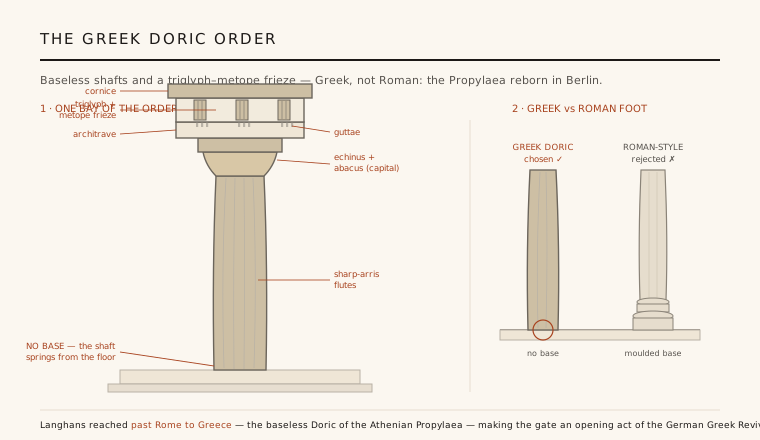
Langhans reached past the obvious source for a monumental gate. The Roman triumphal arch — round-arched, richly carved — was the ready template, and almost every earlier city gate of ambition had used it. Instead he looked to Greece, and specifically to the Propylaea, the great columnar gateway that admits visitors to the Athenian Acropolis. This was a conscious return to Greek rather than Roman sources, and it places the Brandenburg Gate among the opening works of the Greek Revival — the movement, driven by new archaeological surveys of Athens, that held Greek architecture to be the purer and more virtuous origin of the classical tradition.
The choice was ideological as much as aesthetic. To build a Greek gateway in Prussia was to claim descent from Athens rather than imperial Rome, from a republic of citizens rather than a machine of conquest — a flattering genealogy for an Enlightenment monarchy. The gate is therefore not a copy of the Propylaea but a translation of its idea: a screen of columns as a ceremonial threshold, sober and archaeologically informed, standing at the head of a European capital that wished to be seen as a new Athens on the Spree.
3. The Doric order and the columnar screen
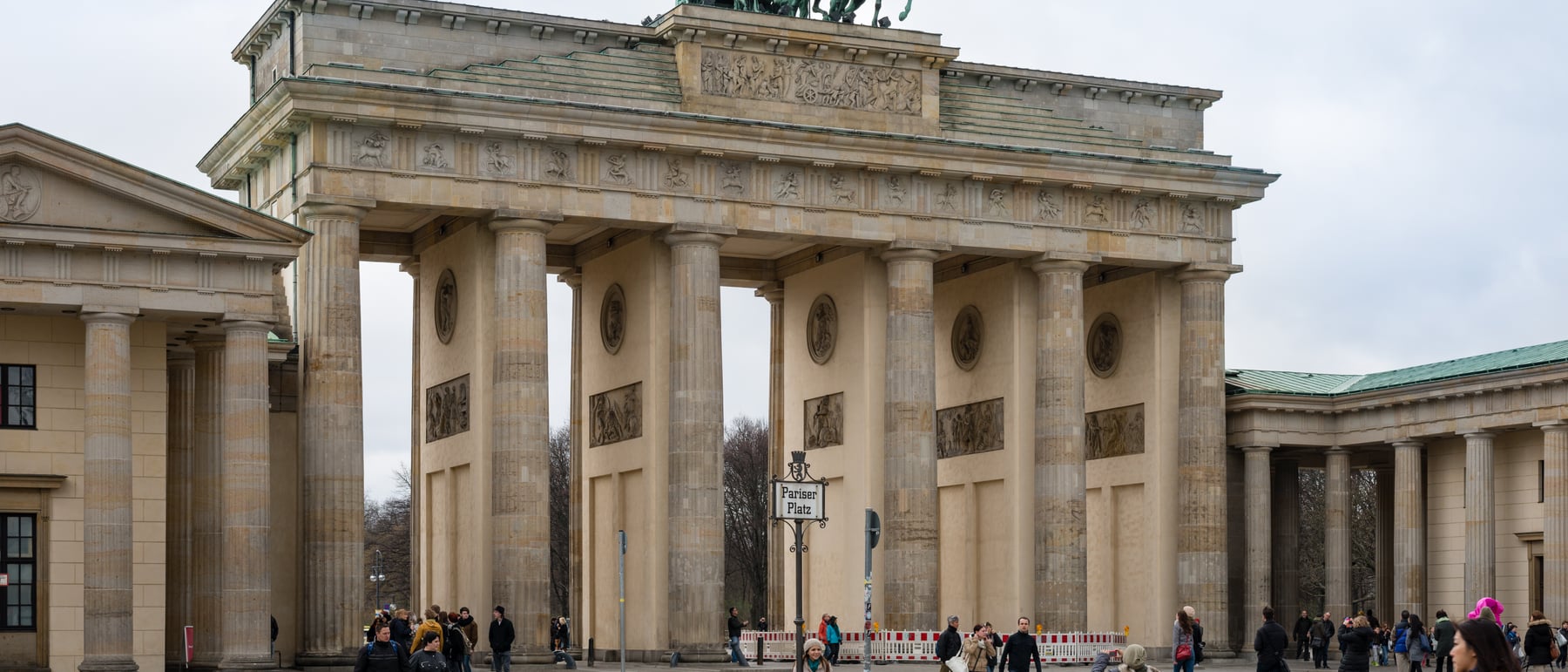
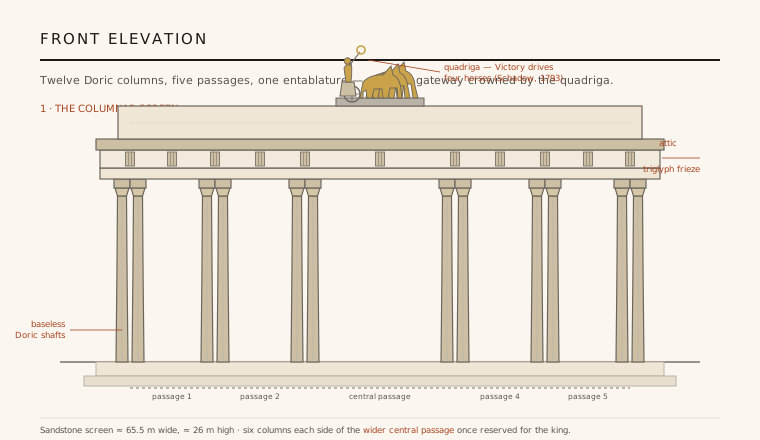
The form is a screen, not a wall. Twelve columns — six to each side of the centre, read as three pairs a side — stand on a stepped sandstone platform and carry a continuous entablature, and the gaps between them open five passages through the depth of the gate. The central passage is the widest, once reserved for the royal carriage; the flanking passages served ordinary traffic. Behind the front row runs a matching rank of columns, so that the gate is a short colonnaded tunnel rather than a thin façade, roughly 65.5 metres wide and 26 metres high, and built throughout of pale Elbe sandstone.
The order is the baseless Greek Doric, and its severity is the whole point. The fluted shafts rise straight from the stylobate without the moulded bases a Roman column would stand on; the capitals are the plainest of cushions; and the frieze above is the correct Doric alternation of grooved triglyphs and blank metopes, with little peg-like guttae beneath. This is archaeological correctness deployed as an argument — sober, civic and structural rather than ornate. Two low guardhouse wings, later given their own small temple fronts, flank the gate and frame the square behind it, so the composition reads as a Greek propylon set down at the edge of Berlin.
4. The quadriga and its captivity
The crown of the gate is Johann Gottfried Schadow's quadriga of 1793: a chariot drawn by four horses abreast, driven by a winged goddess who holds a standard aloft. Beaten from sheet copper, it is one of the most ambitious pieces of monumental sculpture of its age, and it gives the sober Doric screen its single note of movement and drama. In 1806, after Napoleon crushed Prussia at Jena and Auerstedt and entered Berlin, he had the quadriga dismantled and carried off to Paris as a spoil of war — the trophy of a defeated capital.
It came home in 1814, after Napoleon's own defeat, and returned changed. The architect Karl Friedrich Schinkel redesigned the emblem the goddess carries, setting the Prussian eagle and the newly created Iron Cross within an oak wreath on her staff. With that gesture the figure was quietly rebranded — from a goddess of peace into a Victoria, a goddess of Prussian victory. The gate that began as a Gate of Peace now advertised military triumph, and the slippage between the two, embodied in a single sculpture, is the first sign of how unstable the building's meaning would prove to be.
5. A symbol that will not hold still
No monument in Europe has been made to mean so many contradictory things. It served as a backdrop for Prussian and imperial parades; in January 1933 columns of Nazi torchbearers marched through it to celebrate Hitler's appointment as Chancellor, and the regime made the gate a stage for its own theatre. It was badly damaged in the Battle of Berlin in 1945 and the original quadriga destroyed; the gate was restored in 1956–58 in a rare act of cooperation between East and West Berlin, and a new copper quadriga cast from surviving pre-war moulds. To be honest about this building is to admit that its symbolism is layered and genuinely contested — it has stood for peace, for conquest, for tyranny, and for freedom, sometimes within a single lifetime.
Then came the strangest chapter. When the Berlin Wall went up in 1961 the gate was left stranded in the no-man's-land — the death strip — just east of the barrier, sealed off and unreachable, a classical gateway that led nowhere. For twenty-eight years it was the visual shorthand for a divided Germany. When the Wall fell in November 1989 and the gate reopened that December, the same stones became overnight the emblem of reunification — the place a nation chose to celebrate becoming whole again. The Doric screen never moved; history simply kept arriving at it and leaving a new meaning behind.
Every civic threshold that tries to carry public memory rather than military triumph — from Maya Lin's Vietnam Veterans Memorial to the reconstructed Reichstag dome a few streets away — inherits the Brandenburg Gate's hard lesson: that a monument's form is fixed but its meaning is authored, again and again, by whoever stands beneath it.
References & further reading
- 01Watkin, D. & Mellinghoff, T. (1987). German Architecture and the Classical Ideal, 1740–1840. Thames & Hudson / MIT Press, London & Cambridge MA.
- 02Honour, H. (1968). Neoclassicism. Penguin Books (Style and Civilization), Harmondsworth.
- 03Middleton, R. & Watkin, D. (1980). Neoclassical and 19th Century Architecture. Harry N. Abrams / Faber & Faber, New York & London.
- 04Cullen, M. S. (2004). Der Brandenburger Tor: Geschichte eines deutschen Symbols. Berlin Story Verlag, Berlin.
- 05Crook, J. M. (1972). The Greek Revival: Neo-Classical Attitudes in British Architecture 1760–1870. John Murray, London.
Last verified 2026-07-06. Ancient and vernacular works often have no single architect or firm date; dates are given as widely accepted approximations and the builder-culture is named where no individual designer is known.