
6 · Byzantium & the Dome of the EastNo. 03 in era
Basilica of San Marco
On the edge of the Adriatic, Venice built not a Western cathedral but a piece of Byzantium. The present Basilica of San Marco — begun around 1063 as the doge's private chapel — is a Greek cross roofed by five domes on pendentives, consciously modelled on the lost Church of the Holy Apostles in Constantinople. Over the centuries it was encrusted with looted marble, mismatched columns and the famous bronze horses, much of it seized in the 1204 sack of that very city. It is the great Western outpost of the Eastern empire — a treasury of gold mosaic and plunder, and a hinge between East and West.
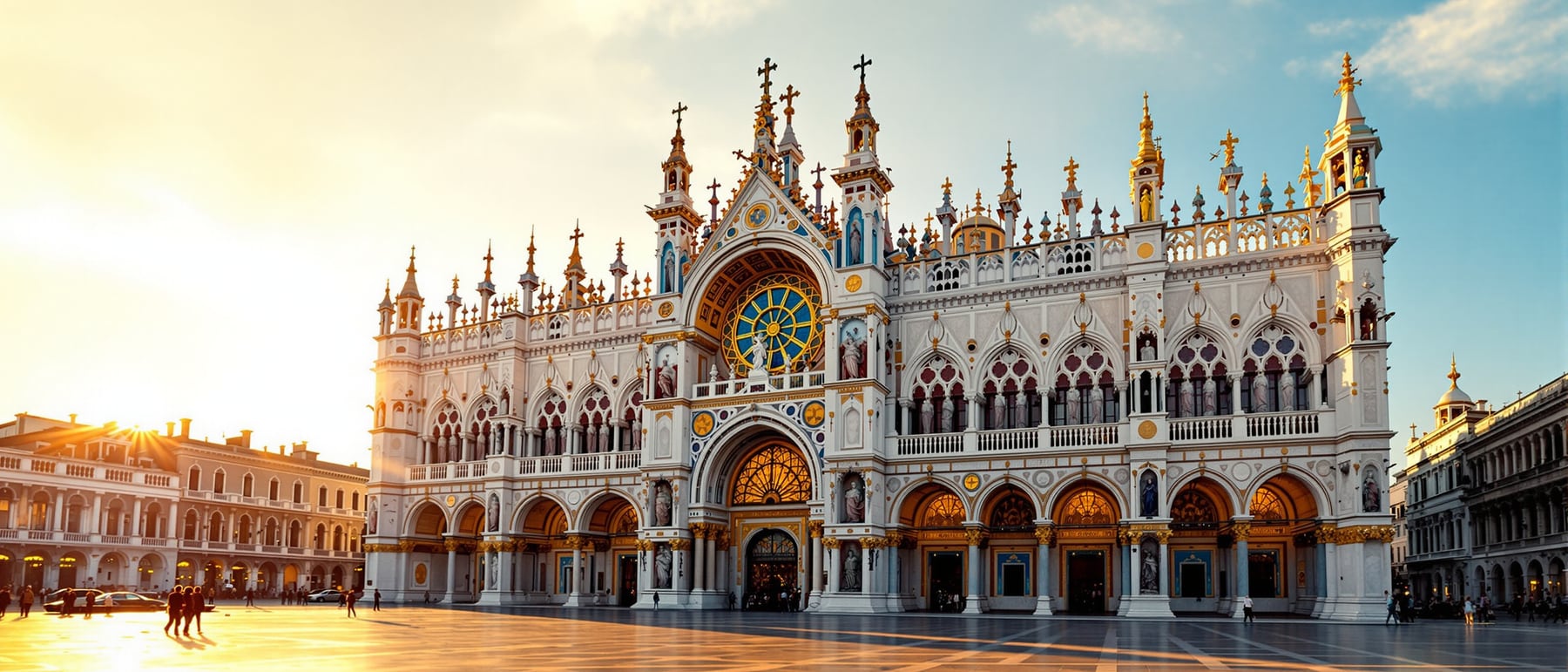
1. Byzantium in the lagoon
San Marco is the most complete surviving image of an idea that has otherwise vanished. Venice grew rich as the West's trading gateway to the Byzantine East, and when its rulers built a shrine for the relics of St Mark — smuggled, so the legend runs, from Alexandria in 828 — they reached not for the Latin basilica of Rome but for the domed churches of Constantinople. The present building, the third on the site, was begun around 1063 under Doge Domenico Contarini and consecrated by 1094. It is not Venetian architecture borrowing a Byzantine motif; it is a Byzantine church built on Italian soil.
The plan makes the debt explicit. San Marco is a Greek cross — four arms of equal length meeting at a central square — where the Western church is a long Latin cross with a dominant nave. Its declared model was the Church of the Holy Apostles in Constantinople, the great five-domed imperial mausoleum-church that no longer stands. San Marco is, in effect, our best surviving witness to what that lost building looked like: the Eastern capital's architecture preserved in the West precisely because Venice copied it so faithfully.
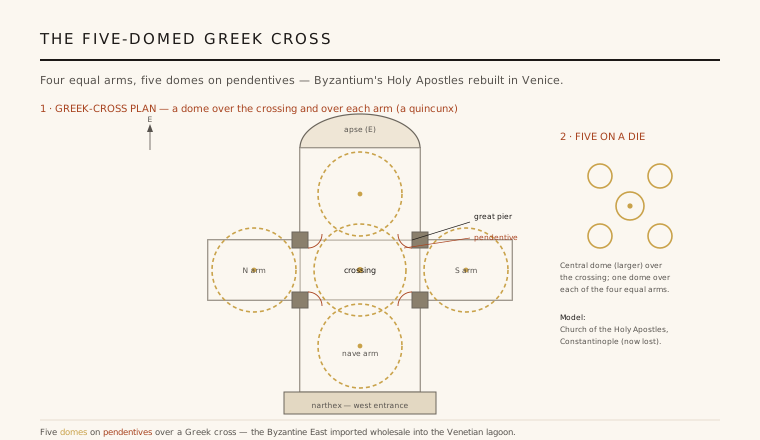
2. Five domes on pendentives
The building's genius is its roof. Each of the five square bays — the central crossing and the four arms — is capped by a hemispherical dome carried on pendentives: the curved triangular spandrels that let a round dome sit on a square of four arches, the structural invention perfected a few years earlier at Hagia Sophia. The thrust of each dome is gathered onto four massive piers at the corners of its bay, and the piers are themselves hollowed with passages and stairs, so that the whole church reads as a canopy of floating vaults rather than a mass of wall.
What one sees today is doubled. The original masonry domes are relatively shallow; from the 13th century they were sheathed in taller, bulbous outer shells of timber and lead to make a more commanding skyline over the piazza. So San Marco carries two profiles at once — the low Byzantine cupola inside, the swelling Eastern dome outside — an early instance of the double-dome device that domed churches from St Peter's onward would exploit.
3. A treasury of spolia and plunder
San Marco is as much a display case as a building. For four centuries its brick Byzantine core was slowly encrusted with spolia — reused marble columns, carved capitals, porphyry panels, screens and reliefs brought back from across the eastern Mediterranean. The columns of the facade and interior are a deliberately mismatched collection, of different marbles, heights and orders, because they were not quarried for San Marco at all; they were acquired, and their very variety advertises the reach of Venetian trade and conquest.
The greatest single influx came in 1204, when the Fourth Crusade — diverted and financed by Venice — stormed and sacked Christian Constantinople. The loot poured into San Marco: sculpted panels, the porphyry group of the Tetrarchs set into a corner of the treasury, and above all the four gilded bronze horses, ancient works carried off from the Hippodrome and mounted over the central portal. The facade became, quite literally, the trophy wall of an empire Venice had helped to destroy — architecture as the exhibition of plunder.
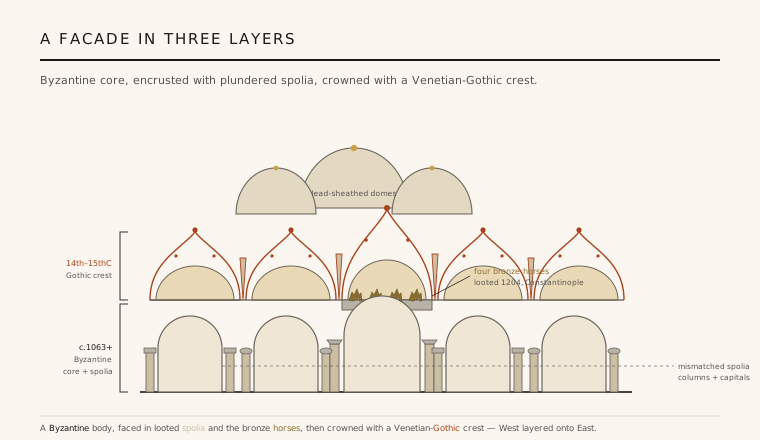
4. A firmament of gold
Inside, the architecture dissolves into light. More than 8,000 square metres of the domes, vaults and upper walls are sheathed in gold-ground mosaic, built up over some six centuries from the 12th century onward. Millions of tesserae — many of clear glass backed with gold leaf — are set at slight, deliberate angles so that they catch and scatter the light, making the whole upper church shimmer and seem to shift as one moves beneath it. The curved Byzantine surfaces are not decorated so much as immaterialised.
The scheme is theological as well as optical. The gold reads as a heavenly, placeless space; against it float saints, prophets and the great narrative cycles of Genesis and the life of Christ, culminating in the domes — the Pentecost dome over the crossing, the Ascension dome above the nave. San Marco is the fullest surviving Byzantine-tradition mosaic interior in the world, and the clearest demonstration of how the Eastern church used the pendentive dome as a curved screen on which to project heaven.
5. West layered onto East
For most of its life San Marco was not the cathedral of Venice but the doge's private chapel, physically joined to his palace and controlled by the state rather than the bishop. That made it the ceremonial heart of the Republic — the stage on which doges were shown to the people and Venetian identity was performed — and it explains the ceaseless enrichment: every campaign and trade coup added another trophy to the state church. Only in 1807, after the Republic had fallen, did it finally become the seat of Venice's patriarch.
The building also records Venice turning slowly westward. In the 14th and 15th centuries a Venetian-Gothic crest of ogee arches, crocketed gables and pinnacles was grafted onto the round-arched Byzantine facade, layering the pointed vocabulary of the Latin West onto the domed body of the East. That collision is the whole meaning of San Marco: a church that is neither wholly Eastern nor Western but the hinge between them — the point where Byzantium, brought home as both model and plunder, meets the emerging art of the Italian city-state.
Every museum built to house an imperial collection of spoils — from the British Museum to the great encyclopaedic galleries — still works San Marco's logic: architecture as the treasury and display case of an empire's reach, where the building itself is the trophy wall.
References & further reading
- 01Demus, O. (1960). The Church of San Marco in Venice: History, Architecture, Sculpture. Dumbarton Oaks Studies 6, Washington, D.C..
- 02Demus, O. (1984). The Mosaics of San Marco in Venice. University of Chicago Press, Chicago.
- 03Krautheimer, R. (1986). Early Christian and Byzantine Architecture. Yale University Press (Pelican History of Art), New Haven, 4th ed..
- 04Howard, D. (2002). The Architectural History of Venice. Yale University Press, New Haven, rev. ed..
- 05Mango, C. (1985). Byzantine Architecture. Electa/Rizzoli, New York.
Last verified 2026-07-06. Ancient and vernacular works often have no single architect or firm date; dates are given as widely accepted approximations and the builder-culture is named where no individual designer is known.