
19 · Early Modernism & the PioneersNo. 01 in era
AEG Turbine Factory
On a Berlin street in Moabit, Peter Behrens gave a factory the gravity of a temple — a column-free machine hall wrapped in a monumental mask of concrete and glass, and, in the same stroke, one of the founding works of the Modern Movement and of corporate design.
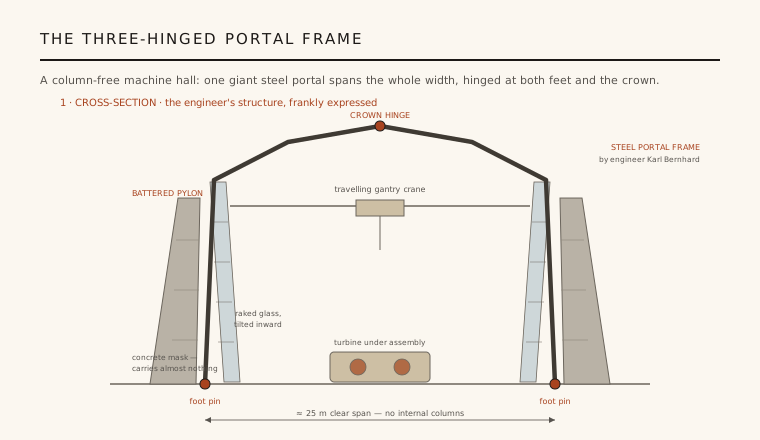
1. The engineer's hall: one frame, no columns
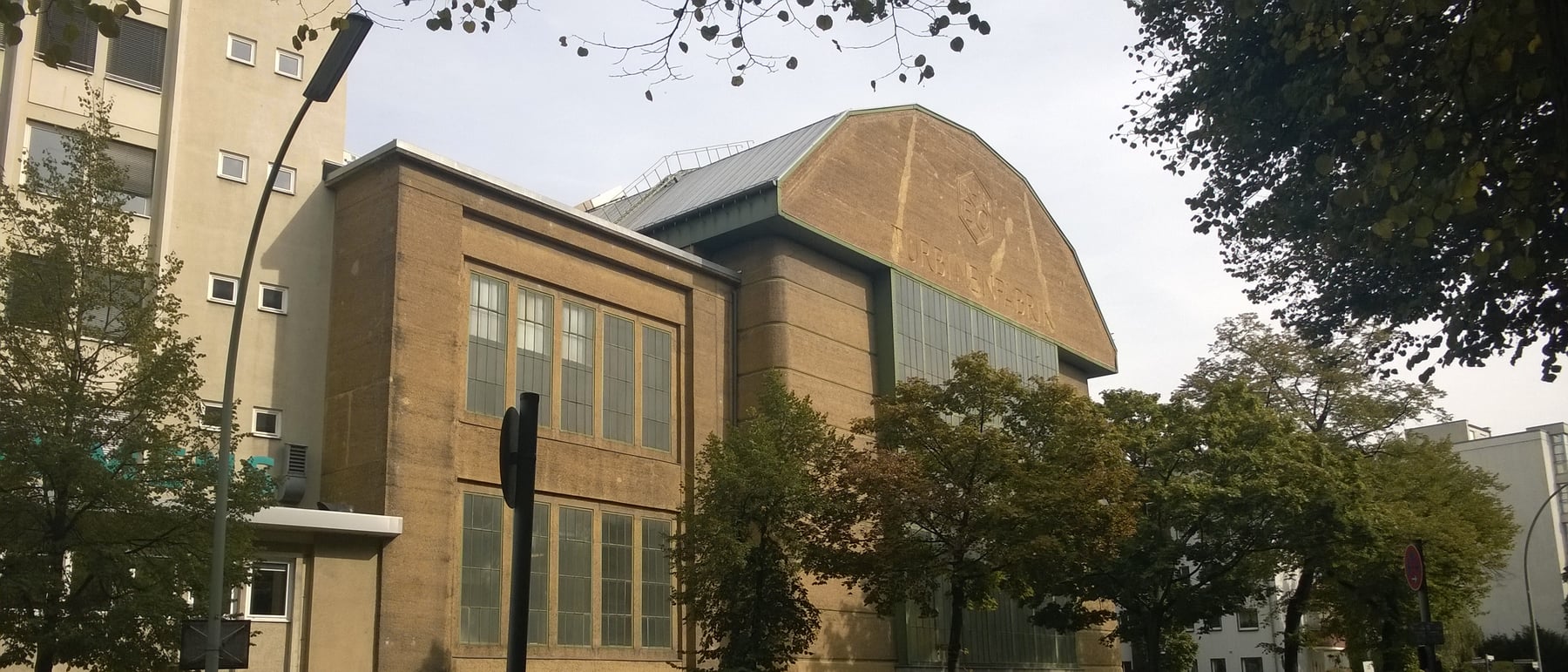
Behind its solemn face the AEG Turbine Factory is, first, a superbly rational shed. The turbine hall is roofed by a row of great three-hinged steel portal frames engineered by Karl Bernhard: each frame is pinned at its two feet and hinged again at the crown, so that as loads and temperature shift, the structure can flex at those joints without cracking. Because a single frame carries the whole span, the assembly floor is left completely column-free — a clear span of roughly twenty-five metres — so that a travelling gantry crane can move heavy turbines the length of the hall unobstructed.
Crucially, Behrens did not hide this structure. Down each long side the steel stanchions of the frames stand proud on the face of the building, and the metal is frankly expressed rather than clad in masonry. Between the stanchions sit the walls: steeply raked, many-paned glass screens that tilt inward at their base, flooding the workshop with daylight. Here the building is entirely honest — an engineer's diagram made visible, and one of the reasons a generation of young architects treated it as a manifesto.
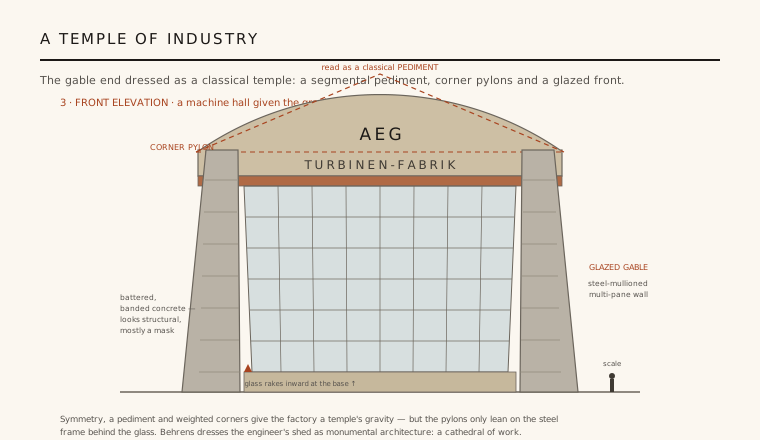
2. The monumental mask
Over this rational frame Behrens laid a deliberately monumental image. At the street gable the corners are weighted by massive battered pylons — walls of concrete that lean slightly inward and are grooved with horizontal bands, so they read as heavy, load-bearing masonry anchoring the building to the ground. They are, in truth, largely a mask: the real work is done by the steel behind them, and the pylons carry almost nothing. It is a conscious piece of stagecraft, structure and appearance pulled deliberately apart.
The gable itself is crowned by a wide, low polygonal (segmental) gable that Behrens treats exactly like a classical pediment, and beneath it the concrete band carries the company's name. The effect is calculated: symmetry, a pediment and weighted corners are the grammar of a Greek temple, here applied to a hall for building turbines. The glazed gable wall, raked back over its plinth, sits between the pylons like the open front of a portico — engineering framed as architecture.
3. A temple for the machine age
This is the building's great argument: that the factory and the machine deserved serious, ennobling architecture. In an age that still thought of industrial sheds as utilitarian and beneath notice, Behrens gave one the dignity, gravity and near-sacred symmetry of a temple — contemporaries quickly called it a temple of industry and a cathedral of work. The composition asserts, in stone-coloured concrete and steel, that modern industry was a fit subject for monumental design.
There is an honest tension at its heart, and Behrens knew it. The pylons pretend to a structural role they do not have; the pediment is borrowed from a world of gods, not generators. Later Modernists would reject exactly this kind of rhetorical mask in favour of pure structural truth. Yet the power of the AEG hall lies in the collision itself — an unashamedly industrial, glass-and-steel interior wrapped in the idea of permanence and seriousness, a machine hall that insists on being taken as architecture.
4. Behrens and the invention of corporate identity
The factory was one product of an extraordinary appointment. From 1907 Behrens served as artistic adviser to AEG (the Allgemeine Elektricitäts-Gesellschaft), and he is often called the first true corporate identity designer. He designed not only AEG's buildings but its products — electric kettles, fans, lamps — its graphics, typography and logo, and its showrooms, folding them all into a single, coherent visual language. For the first time a giant firm presented itself to the world as one designed thing, from the mark on a letterhead to the pediment on a factory.
The AEG offices were also, briefly, the crucible of modern architecture. Working in Behrens's studio in these years were three men who would define the century: Walter Gropius, Ludwig Mies van der Rohe and Le Corbusier. What they absorbed there — the marriage of industrial production and serious form, the embrace of glass and steel, the discipline of a unified design programme — runs straight into the Bauhaus, the glass tower and the whole Modern Movement.
5. Why it matters
The AEG Turbine Factory sits at a hinge in architectural history. Behind it lies the nineteenth-century engineer's tradition of iron and glass — train sheds, exhibition halls — buildings admired for structure but rarely counted as architecture. The Turbinenhalle fused that engineering with the ambitions of high design, and in doing so it demonstrated that the industrial building could carry cultural weight. It gave the Modern Movement one of its founding images: industrial form taken seriously.
Its influence was double. To architects it modelled the frank use of steel and glass and the drama of the column-free, top-lit hall; to industry it modelled the idea that a company could be designed as a whole. The building still stands and works on Huttenstrasse, a protected monument. Its lesson — that the ordinary machinery of modern life deserves architecture of gravity and grace — remains one of the most consequential ideas of the twentieth century.
Every time a tech company treats its factories, products, typography and logo as one designed identity — an Apple, a Braun, a Dyson — it is working in the tradition Behrens invented at AEG, where the machine hall and the letterhead were drawn by the same hand.
References & further reading
- 01Anderson, S. (2000). Peter Behrens and a New Architecture for the Twentieth Century. MIT Press, Cambridge MA.
- 02Buddensieg, T. & Rogge, H. (1984). Industriekultur: Peter Behrens and the AEG, 1907–1914. MIT Press, Cambridge MA.
- 03Banham, R. (1980). Theory and Design in the First Machine Age (2nd ed.). MIT Press, Cambridge MA.
- 04Frampton, K. (2007). Modern Architecture: A Critical History (4th ed.). Thames & Hudson, London.
- 05Curtis, W. J. R. (1996). Modern Architecture Since 1900 (3rd ed.). Phaidon Press, London.
Last verified 2026-07-08. Ancient and vernacular works often have no single architect or firm date; dates are given as widely accepted approximations and the builder-culture is named where no individual designer is known.