
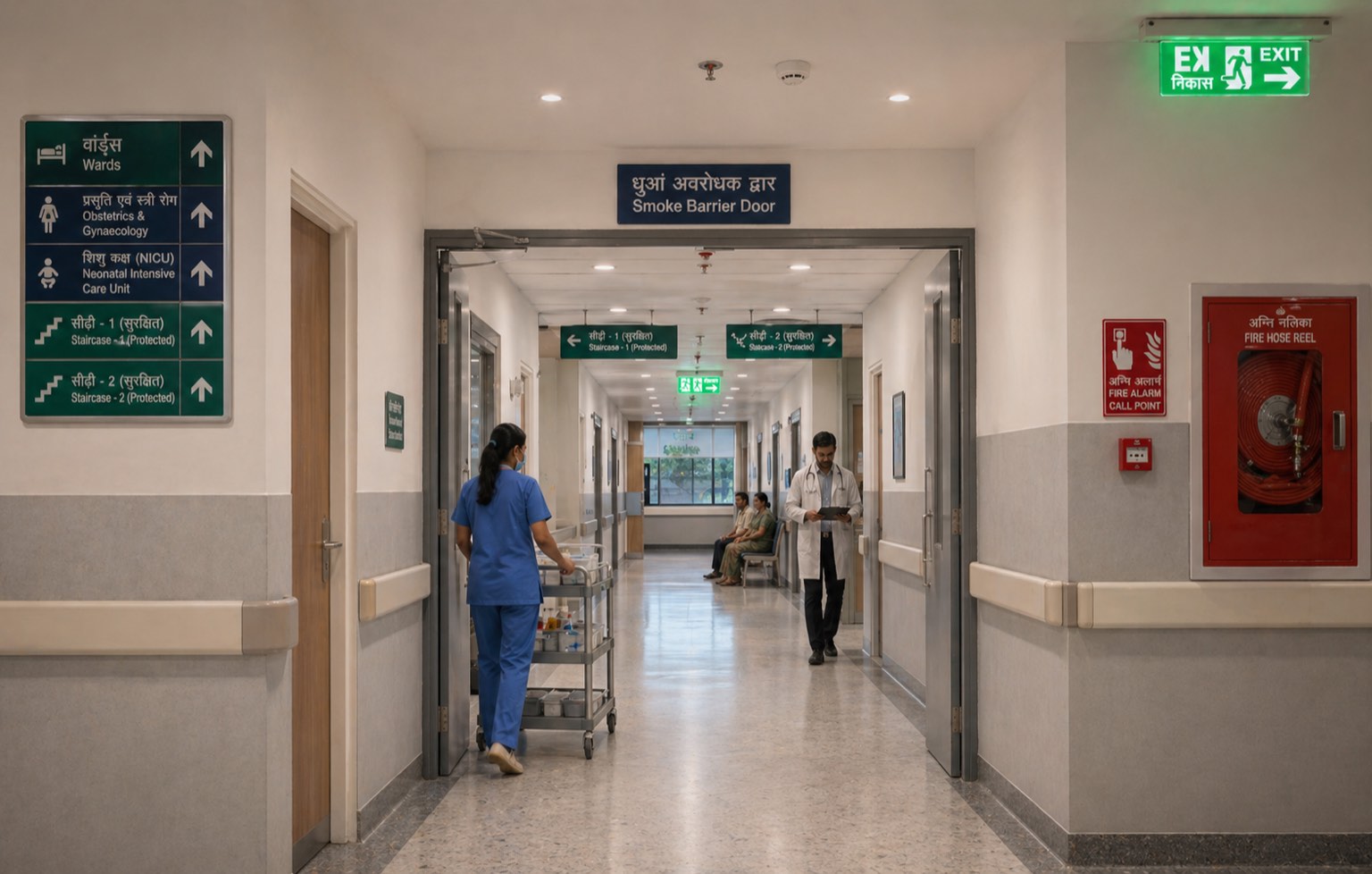
NBC 2016 Group C-1: The Architect's Working Reference for Healthcare Buildings
Decoding the National Building Code's Institutional Provisions — Sub-Classification, Occupant Load, Travel Distance, Stairways, Refuge, Smoke Compartments, Fire-Rated Compartmentation, Vertical Transportation, Active Suppression and Detection, Service-Shaft Sealing — Translated into Working Architectural Detail
The National Building Code of India 2016 is the architect's primary fire-and-life-safety reference for any healthcare building. Part 4 — Fire and Life Safety — places hospitals in Group C, with the most stringent sub-class C-1 covering buildings ordinarily occupied by sick or infirm people who cannot evacuate themselves. The provisions of Group C-1 are not advisory — they are the binding floor for fire NOC across all states, and they are the framework that state fire codes layer on rather than replace.
This guide is the fifth in the ten-part series and the first regulatory deep-dive after the three facility-type articles. It assumes the reader has read the pillar reference and the facility-type guides on hospitals, nursing homes, and clinics.
The intention of this guide is operational: it converts NBC's prescriptive language into the design-stage decisions an architect actually makes — bay sizing, staircase placement, smoke-compartment lines, refuge floor location, lift core proportions, sprinkler riser shafts, fire pump room sizing, and the detailing of penetration seals through fire-rated walls. The guide is structured to mirror the order in which these decisions arise on the project — from block plan to detailed GFC drawings.
"Codes are written by people who have seen what happens when codes are absent. Every clause in NBC Part 4 has a fire behind it." — Ar. K.T. Ravindran, urban planner and former Dean SPA Delhi, paraphrased from a 2015 IIA Mumbai lecture
"The fire safety strategy is determined in the plan. By the time the architect is detailing fire doors, the strategy is already decided — for better or worse." — David Yates, fire engineer, paraphrased from FSE Magazine (2013)
1. Group C Classification — C-1, C-2, C-3
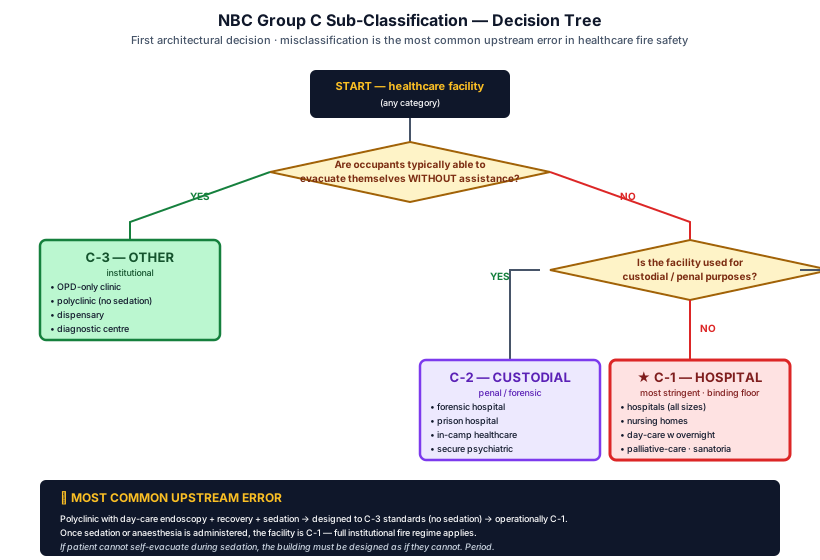
NBC Part 4 classifies institutional buildings as Group C with three sub-classes:
| NBC Sub-Group | Description | Healthcare Application |
|---|---|---|
| C-1 — Hospitals & Sanatoria | Buildings ordinarily occupied by sick or infirm persons unable to evacuate themselves without assistance | Hospitals (all sizes), nursing homes, day-care centres with overnight, palliative-care facilities |
| C-2 — Custodial | Buildings used for custodial / penal purposes with healthcare provision | Forensic hospital, prison hospital, in-camp healthcare |
| C-3 — Other institutional | Buildings serving as institutions but where occupants can typically evacuate themselves | Outpatient clinics, polyclinics, day-care without overnight, dispensaries, diagnostic centres |
The architect's first decision: which sub-group applies? A 25-bed nursing home is C-1. A polyclinic with day-care endoscopy and recovery is also generally C-1 if anaesthesia or sedation is administered. A standalone OPD clinic without sedation is typically C-3. Misclassification — designing C-3 standards for what is operationally a C-1 facility — is the most common upstream error.
2. Occupant Load — The Calculation Foundation
Occupant load is the basis for sizing all egress components — stairs, corridors, exit doors, refuge area. NBC prescribes occupant-load factors for healthcare:
| Healthcare Space | NBC Occupant Load Factor | Typical Application |
|---|---|---|
| In-patient ward area | 1 person per bed + 25% (visitors) | Multiply bed count by 1.25 |
| OPD waiting | 1 person per 1.4 m² | High-density |
| OPD consultation | 1 person per 9 m² | Doctor + 1–2 attendants |
| Emergency / casualty | 1 person per 1.4 m² | High-density during peak |
| ICU / critical care | 1 person per bed × 2 (nurse + family) | Round up |
| OT suite | 4–6 persons per OT (surgical team) | Plus recovery |
| Diagnostic — radiology, pathology | 1 per 2.5 m² | Moderate |
| Administrative / office | 1 per 9 m² | Standard |
| Public lobby | 1 per 1.4 m² | Peak |
| Cafeteria | 1 per 1.4 m² | Peak meal time |
A 100-bed hospital at peak might compute as: 100 beds × 1.25 = 125 patients/visitors (ward); 80 m² OPD × 0.71 = 56 (OPD); 30 staff (OT, ICU); 50 administrative + visitor lobby. Total occupant load ≈ 260 persons, distributed by floor.
The occupant-load total per floor sets the staircase width, exit door width, and corridor width via the NBC capacity factors below.
| Egress Component | Capacity per Person Width |
|---|---|
| Stairway | 30 mm per person; min 2.0 m for hospital |
| Corridor | 30 mm per person; min 2.4 m clear for hospital |
| Exit door | 15 mm per person width via the door |
In practice, the staircase capacity becomes architecturally non-binding at small floor occupant loads — the minimum staircase width (2.0 m) governs in most ward floors. The exit door width and corridor width become binding at higher occupant loads (atriums, OPD lobbies).
3. Travel Distance — The Plan-Level Constraint
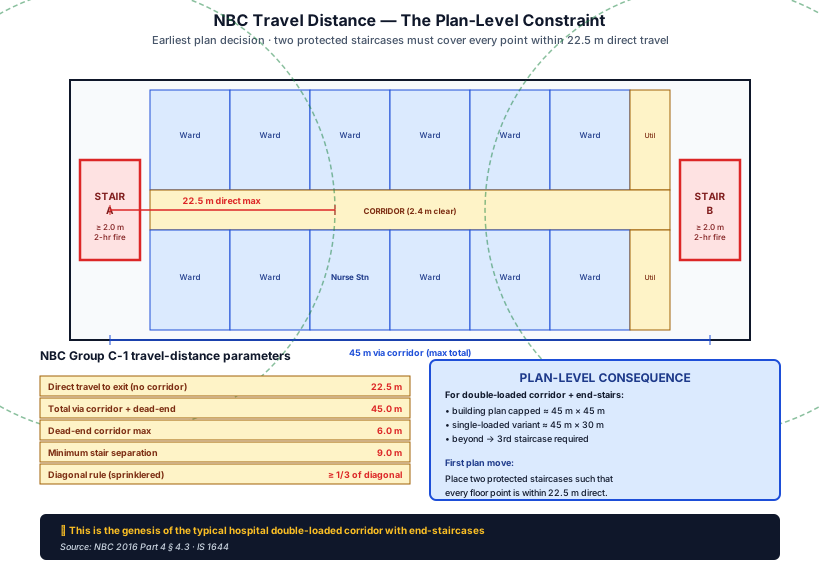
Travel distance is the single most consequential plan-level NBC parameter. It dictates how deep a ward can extend from the staircase, how long a corridor can run, and where the second staircase must sit.
| Travel Distance Parameter | NBC Group C-1 Value |
|---|---|
| Maximum direct travel distance to exit (no corridor) | 22.5 m |
| Maximum total travel distance via corridor + dead-end | 45.0 m |
| Maximum dead-end length (corridor terminating without exit) | 6.0 m |
| Distance between exits — staircases | Minimum 9.0 m |
| Diagonal of building rule | Two exits to be located such that the line between them is at least one-third (or one-half if not sprinklered) of the diagonal of the floor |
Design implication: for a typical hospital floor with central corridor and wards on both sides, the building must have two protected staircases located at or near opposite ends, no part of the floor can be more than 22.5 m from the nearest staircase along any direct line, and no corridor can dead-end more than 6 m from a staircase. This effectively caps the building's plan dimension at approximately 45 m × 30 m for a single-loaded corridor or 45 m × 45 m for double-loaded — beyond which a third staircase is required.
The architect's earliest plan decision is therefore: place the two protected staircases such that the entire floor plate is within 22.5 m direct travel of one or the other. This is the genesis of the typical hospital double-loaded corridor with end-staircases.
4. Stairways — Configuration & Detailing
| Stairway Element | NBC Group C-1 Specification |
|---|---|
| Minimum count | 2 protected staircases per floor; 3 if floor area > 1500 m² |
| Minimum width | 2.0 m (1.5 m only if occupant load < 50/floor) |
| Tread width | ≥ 280 mm |
| Riser height | ≤ 150 mm |
| Headroom | ≥ 2.2 m |
| Handrail | Both sides, at 900 mm |
| Fire-resistant separation | Stair enclosure 2-hour rated; doors 90-minute rated, self-closing |
| Pressurisation | Required for buildings > 24 m or > 6 storeys above ground; air supply ≥ 50 Pa positive |
| Direct discharge to exterior | Stair must discharge to ground level outside, not through occupied space |
| Smoke-stop lobby | Recommended for stairs serving ≥ 6 floors |
| Surface | Non-slip; cove skirting; emergency lighting |
Architectural detailing notes:
- The two stair cores should be on opposing facades; co-located stairs do not satisfy NBC's diagonal rule.
- Stair pressurisation requires a dedicated shaft to roof, fan room space at top or basement, and pressure-relief dampers on each landing — significant architectural-services coordination.
- The fire-rated door must remain self-closing under pressurisation differential — door specification is critical (300 N maximum opening force).
- The discharge-to-exterior rule disqualifies hospitals where the stair empties into a covered car porch or lobby — a common error in tight-site hospitals.
5. Refuge Area — Where Non-Ambulatory Patients Wait
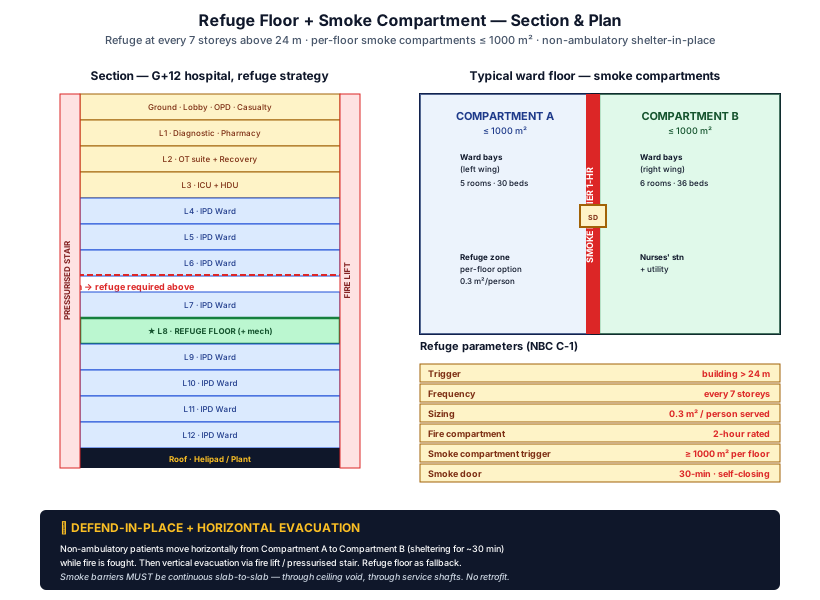
Refuge is the architectural innovation specific to high-rise institutional buildings. Patients who cannot evacuate vertically wait in a fire-protected zone for assistance.
| Refuge Parameter | NBC Group C-1 Value |
|---|---|
| Trigger | Building height > 24 m (effectively > 7 storeys) |
| Frequency | One refuge floor every 7 storeys above the first refuge |
| Sizing | 0.3 m² per person served by the refuge |
| Location | Adjacent to staircase; protected by fire-rated separation |
| Ventilation | Cross-ventilated or mechanically ventilated; smoke-clear |
| Communication | Fire-warden phone; PA system |
| Fire compartment | 2-hour rated separation from main floor |
| Refuge floor option | A full refuge floor at every 7 storeys is permitted as an alternative to per-floor refuge zones |
Architectural strategy choice: small per-floor refuge balcony vs. dedicated refuge floor. The per-floor option is space-efficient but requires consistent integration on every typical floor. The dedicated refuge floor (often combined with mechanical floor) is operationally simpler but loses one rentable / clinical floor every seven floors.
For a typical 12-storey hospital with G+12 above ground, the architect must designate refuge at floor 8 (and roof if used as evacuation point). Refuge sizing for a 100-person served floor: 30 m² minimum, structural and fire-rated.
6. Smoke Compartments — The Within-Floor Separation
Smoke compartmentation prevents smoke spread within a floor — a critical safety strategy for non-ambulatory patients who shelter in place.
| Smoke Compartment Parameter | NBC Group C-1 Value |
|---|---|
| Trigger | Each floor with usable floor area ≥ 1000 m² (in C-1) |
| Compartment size | ≤ 1000 m² each; smaller compartments preferred for high-risk areas (ICU, OT) |
| Cross-corridor smoke barrier | 1-hour fire-rated full-height partition with self-closing 30-minute fire-rated smoke door |
| Smoke barrier alignment | Continuous slab-to-slab; no gaps in ceiling void |
| Detection at smoke barrier | Smoke detector in barrier corridor segment |
| Door swing | Smoke doors swing in direction of egress |
| Vision panel | Wired-glass vision panel in smoke door |
Architectural lesson: smoke barriers cannot be retro-fitted cleanly. They require slab-to-slab construction, continuous through ceiling void and through service-shaft penetrations. The smoke barrier line must be designed at concept stage in coordination with the structural grid, the corridor layout, and the nurses' station / utility cluster placement.
7. Fire-Resistance Ratings — Compartmentation & Materials
NBC and IS codes specify fire-resistance ratings for various compartments in healthcare buildings.
| Compartment / Element | Fire-Resistance Rating | IS Reference |
|---|---|---|
| Stair enclosure (C-1) | 2 hours | IS 1641 / IS 1642 / IS 1643 / IS 1644 |
| Stair door | 90 minutes | IS 3614 |
| Lift shaft enclosure | 2 hours | IS 14435 |
| Lift door | 90 minutes (60 minutes for low-rise) | IS 14435 |
| Fire-rated wall — between compartments | 2–4 hours per scenario | IS 1641 |
| Smoke barrier wall | 1 hour | IS 1641 |
| Smoke barrier door | 30 minutes; self-closing | IS 3614 |
| OT suite compartmentation | 2 hours | IS 1641 |
| ICU compartmentation | 2 hours | IS 1641 |
| Generator room | 4 hours from main building | IS 1641 |
| Switchgear / electrical | 2 hours | IS 1641 |
| Kitchen | 2 hours from adjacent occupancy | IS 1641 |
| Storage / record room | 2 hours | IS 1641 |
| Service shaft penetration | Sealed with fire-rated stop to maintain rating of host wall | IS 3614 / IS 12777 |
| External wall — between buildings within campus | 2 hours if separation < 6 m | IS 1641 |
| Atrium enclosure (where atrium present) | 1 hour glazing or sprinklered backshelf | IS 1641 |
Architectural detailing: fire-rated walls require coordination with services. Every penetration through a fire-rated wall — for HVAC duct, plumbing pipe, conduit, data — must be sealed with an approved fire-stop product to maintain the rating. The architectural specification must include the fire-stop product schedule. A 2-hour wall with unsealed conduit is a 0-hour wall.
8. Vertical Transportation — Fire Lift, Stretcher Lift, Regular Lift
NBC distinguishes between fire lifts (for fire service use during emergency), stretcher lifts (for patient movement), and regular lifts.
| Lift Type | NBC Group C-1 Specification | Architectural Implication |
|---|---|---|
| Fire Lift | Mandatory ≥ 15 m or ≥ 4 storeys above ground; minimum 1; rope-suspension with emergency power; landing in fire-protected lobby; capacity ≥ 545 kg | Lift core lobby with 2-hour fire-rated walls and 90-minute door; emergency power circuit; manual recall to ground |
| Stretcher Lift | Mandatory for IPD floors; cabin minimum 1100 × 2400 mm; door opening ≥ 1100 mm | Larger lift core than typical commercial; coordinated with door schedule |
| Regular / Visitor Lift | Per occupant load and waiting-time analysis | Standard sizing |
| Lift lobby pressurisation | Where lift serves both fire and non-fire functions, lobby pressurisation required | Air supply, dampers |
| Lift counterweight | Counterweight zone in shaft must be fire-separated | Shaft detailing |
A typical hospital of 100 beds requires: 1 fire lift, 1 stretcher lift (sometimes the same as fire lift if specifications met), 1–2 visitor lifts, 1 service lift (kitchen, linen). Above 200 beds: 2 fire lifts (separate cores preferred), 2 stretcher lifts, 2 visitor lifts, 1–2 service lifts. The lift-core area allocation thus scales with bed strength and is a major architectural-planning input.
9. Sprinklers, Wet Riser, Hose Reel, Hydrant — Active Suppression
NBC requires comprehensive active suppression in Group C-1.
| System | NBC Group C-1 Trigger | Architectural Implication |
|---|---|---|
| Sprinkler | Mandatory throughout C-1 (all floors, all spaces) | Ceiling void ≥ 0.5 m for sprinkler piping; riser shaft locations |
| Sprinkler exemption | OT (clean-agent suppression FM-200 or Novec 1230 substitute); MRI room (separate strategy) | Clean-agent storage room near OT |
| Wet riser | Mandatory; 100 mm dia minimum riser; landing valves at each floor | Riser shaft 600 × 1000 mm minimum |
| Hose reel | One per 60 m of corridor; cabinet with 30 m hose | Recess in corridor wall |
| External hydrant | Around perimeter at 60 m intervals; min one per face | Site planning constraint |
| Fire pump | Jockey + main + standby; per IS 15301 | Pump room min 30 m² |
| Fire water tank | Capacity per IS 15301; typically 100,000–200,000 litres for 100-bed | Underground or overhead; structural |
| Pressure-reducing valves | Where pressure exceeds 5 bar at hose | Per riser |
Architectural strategy: the fire-water tank, fire-pump room, riser shafts, and ceiling void are determined at preliminary design. A 100-bed hospital typically needs: 1.5 lakh litres of fire water, 30 m² fire-pump room with 2-hour separation, 4–6 wet-riser shafts at 600 × 1000 mm each, and 0.5 m sprinkler-piping ceiling void throughout.
10. Detection, Alarm, and Voice Evacuation
NBC requires comprehensive detection in Group C-1.
| System | Specification | Architectural Implication |
|---|---|---|
| Smoke detection — addressable | Throughout, including patient rooms (with multi-criteria sensors to reduce false alarms) | Cabling in ceiling void; BMS interface |
| Heat detection | Kitchen, plant rooms | Local |
| Manual call points | At every staircase, every exit, at 30 m intervals on corridor | Wall-mounted, 1.4 m AFL |
| Fire alarm panel | Main + repeater at security / fire control room | Panel room near main entry |
| Public-address & voice evacuation | Required throughout C-1 | Speaker layout to OT, ICU, ward, lobby; IP-PA preferred |
| Beacon / strobe | Visual alarm in noisy areas (kitchen, plant) | Coordinated with PA layout |
| Emergency lighting | Throughout escape routes; battery-backed 2 hours | Fixture schedule |
| Exit signage — illuminated | At every exit; battery-backed | Self-luminous or LED |
| BMS integration | Fire alarm interface with HVAC (smoke damper closure), lift (emergency recall), access control (fail-safe) | Cabling and gateway |
A 100-bed hospital fire detection system typically comprises 800–1200 detection points, 120–180 manual call points, and 60–90 PA speakers — coordinated through one or two addressable loops.
11. Service Shaft Compartmentation & Penetration Sealing
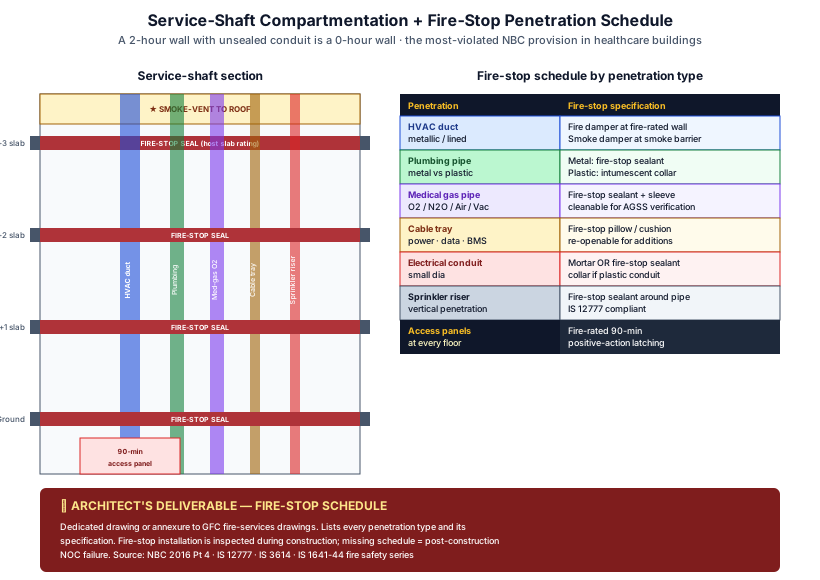
The most-violated NBC provision in healthcare buildings: service-shaft compartmentation.
| Provision | Requirement |
|---|---|
| Vertical service shafts (HVAC, plumbing, electrical, data, gas) | Each floor's penetration into the shaft must be sealed at floor level with material maintaining the host slab's fire rating |
| Shaft top vent | Smoke-vent at top of shaft to discharge any fire to roof, away from occupied space |
| Shaft access panels | Fire-rated, 90-minute |
| Cable tray penetrations | Fire-stop sealant or pillow material |
| HVAC duct penetrations | Fire damper at fire-rated wall crossing; smoke damper at smoke barrier |
| Pipe penetrations | Intumescent collar for plastic; fire-stop sealant for metal |
| Electrical conduit | Sealed with mortar or fire-stop |
Architectural deliverable: a fire-stop schedule listing every penetration type and its specification. The schedule is a dedicated drawing or annexure to the GFC fire-services drawings. Fire-stop installation is inspected during construction; a hospital that has not maintained the schedule will be found out at the post-construction NOC inspection.
12. NBC C-1 Design Checklist — 25 Items
| # | Item | Stage |
|---|---|---|
| 1 | Sub-group classification (C-1, C-2, C-3) confirmed | Brief |
| 2 | Occupant load by floor calculated | Concept |
| 3 | Travel distance ≤ 22.5 m verified for every point | Concept |
| 4 | Two protected staircases at opposing locations | Concept |
| 5 | Stair width ≥ 2.0 m, separation ≥ 9 m | Concept |
| 6 | Refuge floor / per-floor refuge designed if > 24 m height | Concept |
| 7 | Smoke compartments per floor; ≤ 1000 m² each | Concept |
| 8 | Fire-rated separation around OT, ICU, generator, kitchen, switchgear | Concept |
| 9 | Stair pressurisation if > 24 m | Preliminary |
| 10 | Lift cores sized — fire, stretcher, visitor, service | Preliminary |
| 11 | Lift lobby pressurisation if combined function | Preliminary |
| 12 | Sprinkler riser shafts located | Preliminary |
| 13 | Wet-riser shafts located | Preliminary |
| 14 | Fire-pump room sized (≥ 30 m²) | Preliminary |
| 15 | Fire-water tank capacity calculated and located | Preliminary |
| 16 | External hydrants at 60 m perimeter intervals | Preliminary |
| 17 | Detection system layout — addressable | Detailed |
| 18 | PA / voice evacuation speakers laid out | Detailed |
| 19 | Manual call points at 30 m | Detailed |
| 20 | Emergency lighting schedule | Detailed |
| 21 | Exit signage illuminated | Detailed |
| 22 | Smoke barrier doors specified — 30-min, self-closing | Detailed |
| 23 | Fire-rated door schedule — 90-min stair, 60-min others | Detailed |
| 24 | Fire-stop schedule — every penetration | Detailed |
| 25 | Construction-phase fire-stop inspection plan | Construction |
"The plans we approve are excellent. The buildings we visit are different. The difference is in the sealing of penetrations — a discipline that begins in the architect's drawing and ends in the contractor's pillow." — Senior Fire Officer, Mumbai Fire Brigade, paraphrased from a 2020 IIT-Bombay seminar
References
- Bureau of Indian Standards (2016) National Building Code of India 2016, Part 4 — Fire and Life Safety. New Delhi: BIS.
- Bureau of Indian Standards (2016) National Building Code of India 2016, Part 8 — Building Services. New Delhi: BIS.
- Bureau of Indian Standards (1986) IS 1641: Code of Practice for Fire Safety of Buildings (General). New Delhi: BIS.
- Bureau of Indian Standards (1989) IS 1642: Code of Practice for Fire Safety of Buildings (General) — Details of Construction. New Delhi: BIS.
- Bureau of Indian Standards (1988) IS 1643: Code of Practice for Fire Safety of Buildings — Exposure Hazard. New Delhi: BIS.
- Bureau of Indian Standards (1988) IS 1644: Code of Practice for Fire Safety of Buildings (General) — Exit Requirements. New Delhi: BIS.
- Bureau of Indian Standards (1985) IS 1646: Code of Practice for Fire Safety of Buildings — Electrical Installations. New Delhi: BIS.
- Bureau of Indian Standards (1991) IS 3614: Fire-Check Doors. New Delhi: BIS.
- Bureau of Indian Standards (2003) IS 15301: Hydraulic Design of Fixed Fire Protection Systems. New Delhi: BIS.
- Bureau of Indian Standards (2007) IS 14435: Code of Practice for Fire Lifts. New Delhi: BIS.
- Bureau of Indian Standards (2014) IS 15683: Portable Fire Extinguishers — Performance and Construction. New Delhi: BIS.
- Cain, J. and Yusof, M.M. (2013) 'Hospital fire safety: a review of fatal hospital fires in the developing world', International Journal of Disaster Risk Reduction, 5, pp. 6–13.
- Chow, W.K. and Lui, G.C.H. (2002) 'A roadmap for performance-based fire safety design', Fire and Materials, 26(1), pp. 1–6.
- Klote, J.H. and Milke, J.A. (2002) Principles of Smoke Management. Atlanta: ASHRAE.
- NFPA (2021) NFPA 99: Health Care Facilities Code. Quincy: National Fire Protection Association. (international reference)
- NFPA (2024) NFPA 101: Life Safety Code. Quincy: NFPA. (international reference)
- Proulx, G. and Sime, J.D. (1991) 'To prevent panic in an underground emergency: why not tell people the truth?', Fire Safety Science, 3, pp. 843–852.
- Stollard, P. and Abrahams, J. (2013) Fire from First Principles. 4th edn. London: Routledge.
- Yates, D. (2013) FSE Magazine: A Decade of Fire Safety Engineering. London: IFE Publications.
Author's Note: NBC 2016 is a long, technically dense document, and the C-1 provisions are scattered across Part 4 with cross-references to IS codes, Part 8 (services), and other parts. The intention of this guide is to consolidate the C-1 ruleset into the architect's working sequence — block plan first, services next, then detailing — so the design-stage decisions are made with full code awareness rather than reactive correction during fire-NOC review. The forthcoming guide on fire safety in healthcare buildings goes deeper on state fire-code variations and operational fire-strategy design.
Disclaimer: This article is for informational and educational purposes only and does not constitute legal, regulatory, or professional architectural advice. NBC is the national code; state fire codes and state municipal bye-laws may impose stricter requirements. Always verify with the state fire service and local authority before any binding design or construction commitment. Studio Matrx, its authors, and contributors accept no liability for decisions made on the basis of the information in this guide.
Interactive · NBC 2016 Group C room requirements
OT — major surgery
Minimum area
≥ 42 m² (Class A)
Ceiling height
Min 3.0 m, preferably 3.2 m
HVAC — air changes
20–25 ACH, HEPA filtered, laminar flow over table
Pressure regime
Positive 5–15 Pa wrt clean corridor
Finishes
- ✓ Coved skirting (no 90° junctions)
- ✓ Antibacterial epoxy/PVC flooring
- ✓ Smooth painted walls or vinyl panels
Electrical / services
- • IPS (isolated power) panel + LIM
- • UPS-backed essential circuits
- • OT-grade pendant + ceiling lights
Export this guide
Related Guides — Deep-dive reading
Fire Compartmentation in India (2026): Dividing a Building to Contain the Fire
The building-wide strategy of splitting a structure into fire-resisting cells so a fire and its smoke stay where they start - long enough for people to escape and the brigade to arrive. This guide explains the idea every rated wall, floor, door and damper serves.
SecurityHigh-Rise Fire Safety Requirements in India (2026): Why Height Changes Everything
As a building gets tall, a whole layer of fire and life-safety systems stops being optional and becomes the reason the building is legal to occupy. A plain-language guide for professionals to what generally kicks in with height, why, and who to verify it with.
SecurityFire Safety in Healthcare Buildings in India: An Architect's Working Reference
NBC 2016 Part 4 + State Fire Codes (TN, KA, MH, DL, GJ, WB, KL, UP, RJ, AP, TS) — Compartmentation, Detection, Suppression, Smoke Management, Evacuation Strategy for Non-Ambulatory Patients, OT/ICU Special Scenarios, Fire NOC Process, and the Hospital-Specific Fire Strategy Framework
Healthcare ArchitectureRelated Tools — Try Free
Healing View Impact Calculator
Evidence-Based Design dashboard quantifying the recovery impact of nature view + daylight factor on analgesic use, length of stay, and HCAHPS patient-experience uplift. Calibrated against Ulrich 1984 (Science), Park & Mattson 2008, and the CHD EBD evidence base.
EBD CalculatorAccess-Control Schedule Generator
Build the time schedules that decide when each access group can enter — an editable list for your integrator.
Time SchedulesAcoustic Privacy (STC) Visualizer
Indian healthcare acoustic visualizer — compare wall assemblies and noise sources, see received SPL after STC attenuation, and check FGI 2018 / IS 1950 / NABH speech-privacy compliance with live dual-canvas waveform.
Acoustic Tool