
Nursing Home Design (10–30 beds) in India: A Compliance Guide
An Architect's Working Reference — State Nursing Homes Acts (Bombay, Delhi, WB), Centre & State CEA Application at Small-Hospital Scale, Scaled-Down Infrastructure, Fire Constraints on Residential Plots, Bungalow-to-Nursing-Home Conversions, and the Compliance Calendar
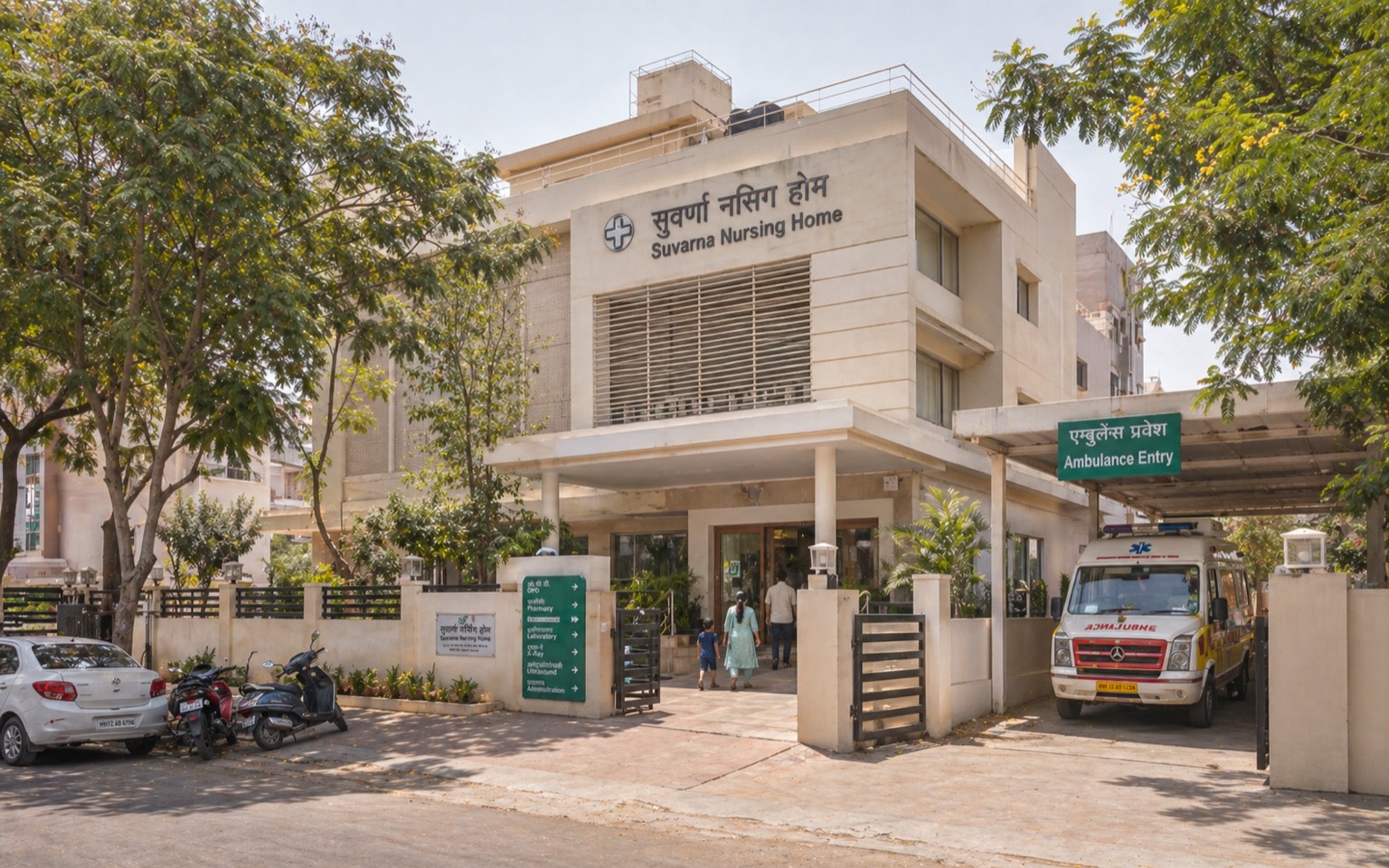
The nursing home — a 10 to 30 bed inpatient facility, typically owner-managed by a doctor or small partnership — is the most common private healthcare facility format in India. Industry estimates place the inventory at well above 50,000 establishments nationally, ranging from a 12-bed obstetric unit in a small town to a 28-bed surgical nursing home in a metropolitan suburb. The format is also the most architecturally constrained: nursing homes are routinely sited on residential plots, in converted bungalows, in apartment buildings, on inadequate setbacks, and with utility infrastructure designed for residential rather than healthcare load.
This guide is the third in the ten-part series and the second facility-type deep-dive. It assumes the reader has read the pillar reference and the hospital deep-dive, and addresses the specific architectural-regulatory problem set of the 10-to-30-bed scale. It is written for architects on commission to design a new nursing home, retrofit an existing nursing home, or convert a residential or commercial property to nursing-home use.
The 10-to-30-bed scale is regulatory-frangible: it is large enough to attract the full statutory schedule (CEA / state NH Act, BMW, AERB if imaging present, drug license, fire NOC) but small enough that owners often under-provision regulatory consultancy and architectural services. The architect's discipline at this scale matters disproportionately — small projects are also small-margin, and a re-design forced by regulatory mismatch is project-fatal.
"The nursing home is the building type that India invented and forgot to study. It is where most of our inpatient care actually happens, and where the regulator is most often disappointed." — Dr. Sanjay Oak, paediatric surgeon and former Vice-Chancellor, MUHS, paraphrased from a 2017 keynote
"In the small hospital, every square metre is a decision. There is no room for the architect's vanity." — Anonymous Indian healthcare architect, private interview, paraphrased
1. The Nursing Home — Legal Status & Definition
The term "nursing home" is not uniformly defined across Indian statutes. Each state act provides its own definition, with implications for which facilities are covered.
| Statute | Defined As | Bed Threshold |
|---|---|---|
| Bombay Nursing Homes Registration Act 1949 (Maharashtra) | "Premises used or intended to be used for the reception and care of persons suffering from any sickness, injury or infirmity" | Any facility receiving and caring for inpatients (no minimum bed) |
| Delhi Nursing Homes Registration Act 1953 | "Premises…used for the reception and treatment of persons suffering from any sickness…and includes a maternity home" | Any inpatient facility |
| Karnataka Private Medical Establishments Act 2007 (KPME) | "Hospital, nursing home, maternity home, dispensary, clinic" — facility-type agnostic | Any healthcare establishment |
| Tamil Nadu CEA 2018 | Defines "clinical establishment" inclusive of nursing homes | Any clinical establishment |
| West Bengal CEA 2017 | Defines "clinical establishment" inclusive of nursing homes | Any clinical establishment |
| Centre CEA 2010 | "Clinical establishment" inclusive of nursing homes | Any clinical establishment |
The architectural takeaway: there is no statutory bed-count below which "nursing home" registration is exempt. A 6-bed maternity nursing home and a 28-bed surgical nursing home are both registrable. The 10-to-30-bed scale is a market reality, not a regulatory category — but it is where most nursing homes operate.
2. The State Nursing Homes Acts — Old Laws Still in Force
Two of the most architecturally consequential nursing-home statutes are mid-twentieth-century laws still in active enforcement, with intermittent state amendments.
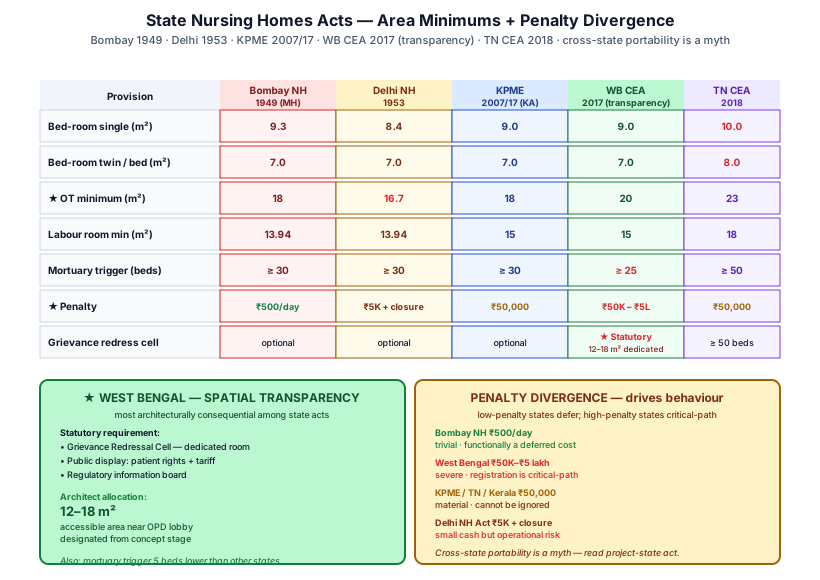
Bombay Nursing Homes Registration Act 1949 (applies to Maharashtra; historically Gujarat)
| Provision | Architectural Implication |
|---|---|
| Minimum bed-room area, single | 9.3 m² |
| Minimum bed-room area, twin | 7 m² per bed |
| Minimum OT area | 18 m² |
| Minimum labour room | 13.94 m² |
| Recovery area | Required; size by bed count |
| Mortuary / cold storage | Required ≥ 30 beds |
| Sanitary | 1 toilet per 6 beds (minimum) + attached toilet per single room |
| Lighting & ventilation | Cross-ventilation, natural light to all bed-rooms |
| Lift | Required if facility above ground floor |
| Fire safety | NBC Part 4 + state fire code |
| Penalty for non-registration | ₹500 per day of contravention (low historical figure; revisions in process) |
Delhi Nursing Homes Registration Act 1953
| Provision | Architectural Implication |
|---|---|
| Minimum bed-room area, single | 8.4 m² |
| Minimum bed-room area, twin | 7 m² per bed |
| Minimum OT area | 16.7 m² |
| Minimum labour room | 13.94 m² |
| Recovery | Optional in original act; required by Delhi NH Rules |
| Mortuary | Required ≥ 30 beds |
| Penalty for non-registration | ₹5,000 + closure |
| Special provision | Separate ambulance entry above 100 beds (per Unified Building Bye-laws 2016) |
West Bengal Clinical Establishments Act 2017 (replaces older WB statutes)
| Provision | Architectural Implication |
|---|---|
| Minimum bed-room area | 9 m² single / 7 m² per bed twin |
| Minimum OT | 20 m² |
| Labour room | 15 m² |
| Mortuary | Required ≥ 25 beds (lower threshold than most states) |
| Public-disclosure | Mandatory tariff display + grievance redress room |
| Grievance redressal cell | Statutory — designated officer + room |
| Penalty | ₹50,000 to ₹5 lakh |
Karnataka KPME (state act, 2007 with 2017 amendment)
| Provision | Architectural Implication |
|---|---|
| Minimum bed-room area | 9 m² single / 7 m² per bed twin |
| Minimum OT | 18 m² |
| Labour room | 15 m² |
| Mortuary | Required ≥ 30 beds |
| Tariff display | Required |
| Penalty | ₹50,000 |
The architect must read the project state's statute. A nursing home design that meets KPME area minimums but is sited in Tamil Nadu fails TN CEA's higher minimums. Cross-state design portability is a myth.
3. Bed Configuration & Schedule of Spaces
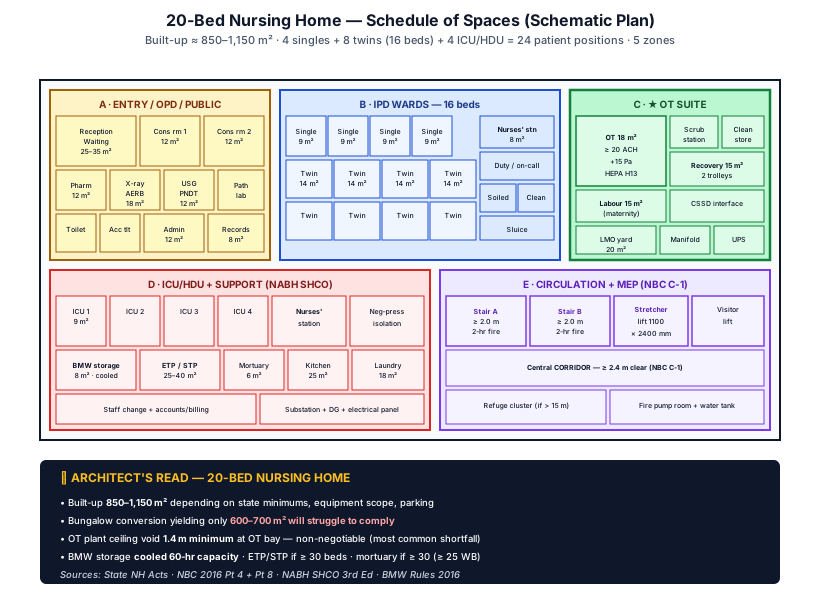
A representative schedule of spaces for a 20-bed nursing home, conforming to the most common state NH Act minimums (9 m² single / 7 m² twin, OT 18 m², labour 15 m²):
| Space | Area | Notes |
|---|---|---|
| Reception, registration, waiting | 25–35 m² | Entry zone |
| OPD consultation rooms (2–3) | 12 m² each | Adjacent to waiting |
| Examination rooms | 9 m² each | Privacy curtain |
| Pharmacy / dispensing | 10–12 m² | Cold-storage chamber + schedule X |
| Pathology — minor | 12–15 m² | Sample reception, minor processing; for major, separate licensure |
| Imaging — X-ray (if any) | 18 m² + console | AERB compliant |
| Imaging — USG (if any) | 12 m² | PNDT registered |
| Single-bed wards (4) | 9 m² each | Attached toilet |
| Twin-bed wards (8 → 16 beds) | 14 m² each | Shared toilet adjacent |
| ICU / HDU (4 beds) | 9 m² per bed × 4 + nurses' station | NABH SHCO compatible |
| OT — major (1) | 18 m² + scrub + recovery | ASHRAE 170 compliant |
| OT clean store / sterile supply | 6 m² | Pass-through to CSSD |
| Labour room | 15 m² | If maternity |
| Recovery / post-anaesthesia | 15 m² | 2 trolleys |
| Nurses' station — IPD floor | 8 m² | Per ward unit |
| Doctors' duty / on-call | 9 m² | Required by NABH |
| Soiled utility | 6 m² | Per ward |
| Clean utility | 6 m² | Per ward |
| BMW storage room | 8 m² | Cooled if > 48-hour |
| ETP / STP plant | 25–40 m² | Per state PCB norms |
| LMO yard (if central O2) | 20 m² yard with setback | PESO |
| Manifold room | 6 m² | Adjacent to LMO yard |
| Mortuary cold storage (1 body) | 6 m² | If > 25 or 30 beds per state |
| Kitchen | 25 m² | Diet preparation |
| Laundry | 18 m² | Soiled-clean flow |
| Medical records | 8 m² | Locked, fire-resistant |
| Administration | 12 m² | Owner / manager |
| Accounts / billing | 9 m² | Adjacent to entry |
| Public toilet — OPD | 9 m² | Accessibility-compliant |
| Staff change | 12 m² | Male / female |
| Stretcher lift | 1100 × 2400 mm cabin | NBC Part 8 |
| Staircases (2) | Per NBC C-1 width | 2.0 m clear |
A 20-bed nursing home thus requires approximately 850–1,150 m² of built-up area depending on state minimums, equipment scope, and parking. A bungalow-to-nursing-home conversion that yields only 600–700 m² will struggle to comply.
4. Fire & Life Safety on Residential Plots — The Hardest Problem
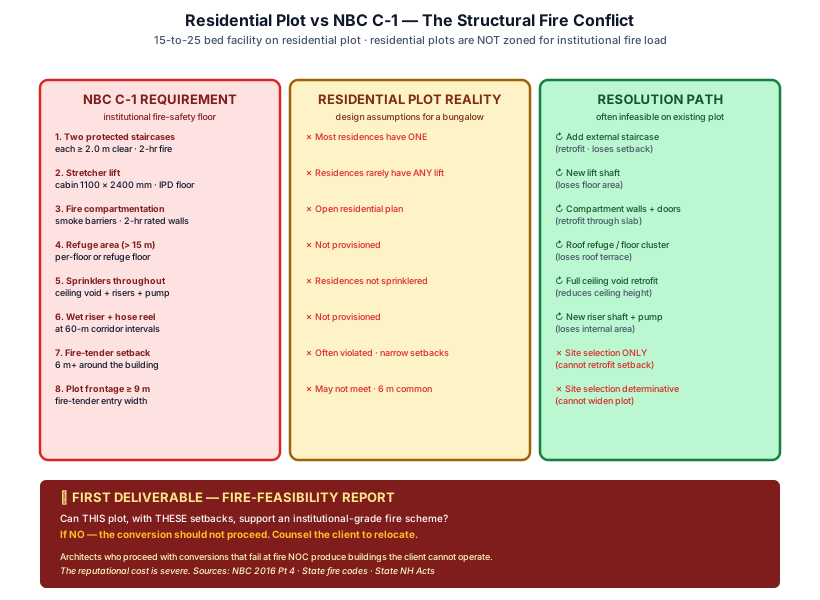
The most commercially common nursing home configuration — a 15 to 25 bed facility on a residential plot in a tier-2 or tier-3 city — confronts a structural conflict: residential plots are not zoned for institutional fire load. The conflict shows up at fire NOC.
| NBC C-1 Requirement | Residential Plot Reality | Resolution Path |
|---|---|---|
| Two protected staircases | Most residences have one | Add external staircase (often retrofit) |
| Stretcher lift | Residences rarely have any lift | Add lift in setback or new shaft |
| Fire compartmentation | Open residential plan | Compartmenting walls and doors at retrofit |
| Refuge area (above 15 m / 5 floors) | Not provisioned | Roof refuge or floor refuge cluster |
| Sprinklers throughout | Residential not sprinklered | Full retrofit ceiling void |
| Wet riser + hose reel | Not provisioned | New riser shaft and pump |
| Setback for fire tender access (6 m+) | Often violated on residential plots | Site selection or relocation |
| Plot frontage ≥ 9 m (NBC fire) | May not meet | Site selection determinative |
The architectural lesson — many bungalow-to-nursing-home conversions are not fire-NOC-feasible. The architect's first deliverable is the fire-feasibility report: can this plot, with these setbacks, support an institutional-grade fire scheme? If the answer is no, the conversion should not proceed; the client should be counselled to relocate. Architects who proceed with conversions that fail at fire NOC produce buildings the client cannot operate — and the architectural reputational cost is severe.
5. The Small OT — Statutory Schedule
A nursing home's OT is the architectural pivot. Even at the small scale, OT compliance is non-trivial.
| OT Element | NH Schedule | Architectural Implication |
|---|---|---|
| OT minimum area | 18 m² (most states); 23 m² (TN) | Bay sizing |
| OT clean-air supply | ≥ 20 ACH (ASHRAE 170 minimum); HEPA modules preferred | Plant ceiling void 1.4 m+ |
| Pressure positive | +15 Pa minimum | Door interlock, damper |
| OT scrub area | 1 station per surgeon | Adjacent bay outside OT |
| Recovery | ≥ 1 trolley per OT (typical) | 8–12 m² adjacent |
| OT clean store | 4–6 m² | Pass-through preferred |
| Sterile supply | 6 m² | If CSSD on-site |
| Floor finish | Conductive vinyl | Static-dissipative |
| Wall and ceiling | Joint-free, washable | Epoxy or panel |
| OT lighting | Shadowless ceiling-mounted, redundant supply | UPS-backed |
| Medical gas outlets | O2 ×2, N2O ×1, Vacuum ×3, Air ×1 | Manifold |
| AGSS | If N2O used | Vent to roof |
The single most common architectural shortfall in nursing-home OTs is plant ceiling void: architects accept 0.9 to 1.1 m, OT contractors require 1.4 m. The shortfall surfaces at HEPA-module installation, six months after construction, requiring slab demolition or floor-to-floor reconfiguration. Plant-ceiling void at 1.4 m minimum at the OT bay is non-negotiable.
6. BMW & Effluent at the Nursing-Home Scale
A 20-bed nursing home generates approximately 8–18 kg of biomedical waste per day in segregated streams.
| BMW Stream | Bin Colour | Nursing Home Storage |
|---|---|---|
| Yellow — anatomical, soiled, expired drugs | Yellow | Cooled storage; 60-hour capacity |
| Red — contaminated plastics, tubing, urine bags | Red | Cooled storage |
| White (translucent puncture-proof) — sharps | White | Sealed container |
| Blue — broken glass, metallic implants | Blue | Cardboard / metal container |
A BMW storage room of 6–10 m², refrigerated to ≤ 5°C, is sufficient for the 20-bed scale. CBWTF tie-up is mandatory; the storage must accommodate 60 hours of generation to allow for missed pickups.
For liquid effluent, most state PCBs require pre-treatment for hospitals and nursing homes ≥ 30 beds (varies). A 20-bed nursing home below this threshold may be exempted from formal ETP but should still install a primary settling tank and disinfection — the regulatory grey zone is treacherous and a future amendment can convert "exempt" to "non-compliant" overnight.
7. Bungalow-to-Nursing-Home Conversion — A Specific Typology
A common Indian healthcare entrepreneurship pattern: a doctor purchases a 4,000–6,000 sqft bungalow, intends to convert it to a 12–18 bed nursing home. The conversion has predictable architectural and regulatory issues.
| Issue | Consequence | Mitigation |
|---|---|---|
| Residential FAR ≠ institutional FAR | Lost development potential or non-compliance | Re-zoning application or site relocation |
| Setbacks designed for 1.5-storey residence | Insufficient for fire tender, ambulance | Fire-feasibility check before purchase |
| Single staircase | NBC C-1 violation | External staircase retrofit |
| Lift absent | Stretcher inaccessible above ground | New lift shaft; loss of floor area |
| Sprinkler infrastructure absent | Major retrofit | Ceiling void + risers |
| Sub-station capacity inadequate | DG and UPS load unsupported | Sub-station capacity upgrade |
| Plumbing — single soil stack | Cross-contamination risk | Re-plumbing with separated stacks |
| HVAC — split AC | OT, ICU non-compliant | Central plant retrofit |
| Building bye-law — change of use | Most municipalities require formal "change of use" sanction | Application; may not be granted in residential zone |
| Neighbourhood objections | Residential neighbours may object to ambulance traffic and BMW | Civic engagement; sometimes determinative |
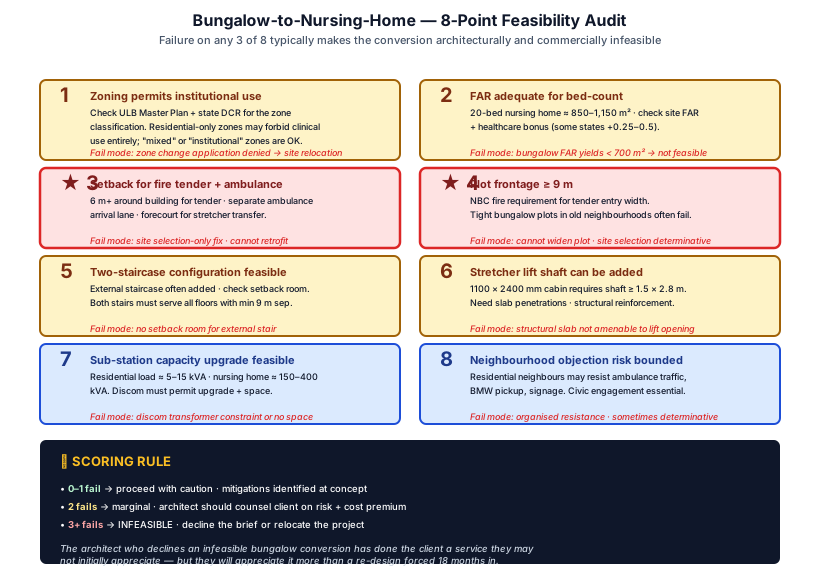
The architect's first action on a bungalow-conversion brief is the 8-point feasibility audit:
1. Zoning permits institutional use (or convertible)
2. FAR adequate for the bed-count and ancillary spaces
3. Setbacks adequate for fire tender + ambulance circulation
4. Plot frontage ≥ 9 m
5. Two-staircase configuration is feasible
6. Stretcher-lift shaft can be added
7. Sub-station capacity upgrade is feasible
8. Neighbourhood objection risk is bounded
Failure on any 3 of the 8 typically makes the conversion architecturally and commercially infeasible. The architect who declines the brief in this case has done a service the client may not initially appreciate.
8. NABH SHCO — The Right Accreditation for Nursing Home Scale
NABH's Small Health Care Organisations (SHCO) standard, 3rd edition, is designed for facilities ≤ 50 beds (and non-bed clinics & labs). It carries lighter documentation than the full hospital standard but retains the architectural essentials.
| SHCO Architectural Requirement | Compliance Detail |
|---|---|
| Bilingual signage | Hindi-English (or state language); tactile near critical points |
| Hand-hygiene stations | Wash-basin frequency in IPD, ICU, OT |
| Negative-pressure isolation room | At least 1 (where applicable) |
| One-way flow — CSSD, kitchen, laundry | As per HIC |
| OT ventilation | ASHRAE 170 minimum compliance |
| Fire safety | NBC C-1 |
| Patient & visitor safety — bedrails, grab-bars | As specified |
| Hazardous material storage | Locked, ventilated |
| Pharmacy infrastructure | Cold chain, narcotic, monitored fridge |
| Medical records | Locked, fire-resistant cabinet |
For a nursing home seeking empanelment in CGHS, AB-PMJAY tier-bonus, ECHS, or insurance — SHCO accreditation is increasingly valuable. The architect who designs to SHCO from concept saves the client a cycle of retrofit when the empanelment opportunity arises.
9. Compliance Calendar for a Nursing Home Project
A representative timeline for a 20-bed nursing home greenfield, smaller than the hospital scale.
| Stage | Approval | Calendar (months from concept) |
|---|---|---|
| Site identification & feasibility | Zoning, FAR, frontage check | 0 |
| Concept design | Pre-application discussion with state CEA / NH authority | 1 |
| Preliminary design | Building permit submission, fire scheme | 2–3 |
| Building permit | ULB sanction | 4–6 |
| AERB layout (if X-ray planned) | Per machine | 5–7 |
| Construction commencement | Contractor mobilisation | 6–7 |
| Construction | — | 6–14 |
| Lift inspector approval | Pre-commissioning | 13–15 |
| Electrical inspector | Pre-energisation | 14–15 |
| Fire NOC final | Pre-operation | 15–16 |
| State PCB CTE | Pre-construction (parallel earlier) | 4–5 |
| State PCB CTO | Pre-operation | 15–17 |
| BMW authorisation | Pre-operation | 15–17 |
| Drug license | Pre-operation | 15–17 |
| AERB licence per machine | Per installation | 15–17 |
| PC-PNDT registration (if USG) | Pre-USG operation | 15–17 |
| State NH / CEA registration | Pre-operation | 15–18 |
| NABH SHCO pre-assessment (optional) | 6 months post-opening | 22–24 |
Total compliance calendar for a 20-bed nursing home: 15–18 months from project initiation to operational opening, with NABH SHCO assessment 4–6 months thereafter.
10. Nursing-Home-Specific Failure Modes
| # | Failure | Prevention |
|---|---|---|
| 1 | Bungalow conversion fire NOC fails | 8-point feasibility audit at site purchase |
| 2 | Setback for fire tender / ambulance violated | Site selection |
| 3 | OT plant ceiling void < 1.2 m | 1.4 m at OT bay non-negotiable |
| 4 | BMW storage uncooled or undersized | Cooled, 60-hour capacity |
| 5 | LMO yard setback violated | PESO setbacks pre-checked |
| 6 | Single stretcher lift on a multi-floor IPD | Stretcher lift designed-in |
| 7 | NABH SHCO signage retrofit | Bilingual + tactile from concept |
| 8 | Mortuary access via OPD lobby | Service-side mortuary |
| 9 | Pharmacy without cold storage | Cold storage from concept |
| 10 | Tariff display / grievance redress in WB missing | Designated zone and signage |
| 11 | Effluent pre-treatment absent in ≥ 30-bed | ETP / STP from preliminary |
| 12 | Smoke compartments not designed | Compartment lines at concept |
References
- ASHRAE (2021) Standard 170-2021: Ventilation of Health Care Facilities. Atlanta: ASHRAE.
- Bureau of Indian Standards (2016) National Building Code of India 2016, Part 4 — Fire and Life Safety. New Delhi: BIS.
- Bureau of Indian Standards (2016) National Building Code of India 2016, Part 8 — Building Services. New Delhi: BIS.
- Central Pollution Control Board (2018) Bio-Medical Waste Management Rules, 2016 (with 2018 amendment). New Delhi: MoEFCC.
- Department of Empowerment of Persons with Disabilities (2021) Harmonised Guidelines and Standards for Universal Accessibility in India 2021. New Delhi: Government of India.
- Government of Karnataka (2007) The Karnataka Private Medical Establishments Act 2007 (with 2017 amendment). Bengaluru.
- Government of Maharashtra (1949) Bombay Nursing Homes Registration Act 1949. Mumbai.
- Government of NCT of Delhi (1953) Delhi Nursing Homes Registration Act 1953. New Delhi.
- Government of Tamil Nadu (2018) Tamil Nadu Clinical Establishments (Regulation) Act 2018. Chennai.
- Government of West Bengal (2017) West Bengal Clinical Establishments (Registration, Regulation and Transparency) Act 2017. Kolkata.
- Joshi, D.C. and Joshi, M. (2018) Hospital Administration. 2nd edn. New Delhi: Jaypee Brothers.
- Kobus, R.L., Skaggs, R.L., Bobrow, M., Thomas, J. and Payette, T.M. (2008) Building Type Basics for Healthcare Facilities. 2nd edn. Hoboken: Wiley.
- Llewelyn-Davies, R. and Macaulay, H.M.C. (1966) Hospital Planning and Administration. Geneva: WHO.
- NABH (2020) Standards for Small Health Care Organisations (SHCO), 3rd Edition. New Delhi: NABH, Quality Council of India.
- Petroleum and Explosives Safety Organisation (2016) Static and Mobile Pressure Vessels (Unfired) Rules 2016. Nagpur: PESO.
- Rao, K.D., Bhatnagar, A. and Berman, P. (2012) 'So many, yet few: Human resources for health in India', Human Resources for Health, 10(1), p. 19.
- Rao, M., Rao, K.D., Kumar, A.K.S., Chatterjee, M. and Sundararaman, T. (2011) 'Human resources for health in India', The Lancet, 377(9765), pp. 587–598.
- Roy, B., Holmes, D. and Chouinard, V. (2018) 'Doing the difficult work: ethical considerations in research with marginalised populations in healthcare', International Journal of Nursing Studies, 80, pp. 64–67.
- Ulrich, R.S., Zimring, C., Zhu, X., DuBose, J., Seo, H.B., Choi, Y.S., Quan, X. and Joseph, A. (2008) 'A review of the research literature on evidence-based healthcare design', HERD, 1(3), pp. 61–125.
- World Health Organization (2008) Essential Environmental Health Standards in Health Care. Geneva: WHO.
Author's Note: The nursing home scale carries an outsized share of India's inpatient burden and an outsized share of its compliance failures. Most of these failures are architecturally pre-empt-able at the brief stage, and most are committed because the architect was not consulted early enough. The author advocates for the early engagement of the architect — at site purchase, not after — as the single intervention with the highest return at this scale. This guide may be read alongside the pillar reference, the hospital deep-dive, and forthcoming guides on AERB, BMW, fire safety, NABH, and CEA-state variations.
Disclaimer: This article is for informational and educational purposes only and does not constitute legal, regulatory, or professional architectural advice. Nursing home compliance depends on the specific state, city, plot, brief, scope, bed strength, and current statutory amendments. Confirm all requirements with the state health authority, state pollution control board, AERB, fire service, drug controller, and other applicable regulators before any binding design or construction commitment. Studio Matrx, its authors, and contributors accept no liability for decisions made on the basis of the information in this guide.
Interactive · Nursing home compliance by bed-count
15-30 beds (mid) · ≥ 700 sqm
Staffing: 2-3 MOs + 6-8 nurses; visiting specialists
Required spaces
- ▸OPD × 3
- ▸LDR room
- ▸Major + minor OT
- ▸IPD wards (15-30 beds)
- ▸ICU / HDU (4-6 beds)
- ▸Diagnostics (X-ray + lab)
- ▸CSSD (mini)
- ▸Pharmacy + drug store
- ▸Mortuary + waste room
Statutory clearances
- ▸Nursing Home Act + state notification
- ▸BMW Rules
- ▸Drug + Pharmacy
- ▸AERB (X-ray)
- ▸Fire NOC (mandatory)
- ▸Pollution Control NOC + STP
- ▸DPDP Act 2023
State-specific reality
Most states use a Nursing Home Act parallel to the central CEA. Maharashtra (BNHRA 1949), Delhi (DNHRA 1953), Karnataka (KPMEA 2007), Tamil Nadu (TNPCEA 2018), Kerala (KCEA 2018) — each with different bed-count thresholds + fee structures.
References: State Nursing Home Acts, CEA 2010 + Rules 2012, IPHS 2022. Larger facilities (> 100 beds) move into multi-spec hospital territory with stricter regulation.
Export this guide
Related Guides — Deep-dive reading
Clinical Establishments Act + State Variations: An Architect's Compliance Map for All States
The Centre Act 2010 and the Twelve States with Their Own Statutes — Karnataka, Maharashtra, Delhi, Tamil Nadu, West Bengal, Telangana, Kerala, UP, Rajasthan, Madhya Pradesh, Chhattisgarh, Gujarat — Side-by-Side Schedules of Minimum Areas, Equipment, Penalties, and Architectural Deliverables
Healthcare ArchitectureHealthcare Architecture in India: The Regulatory Landscape
A Pillar Reference for Architects — Three Regulatory Layers, Approval Matrix by Facility Type, State-by-State Variation, Sequencing, Stakeholder Map, and the Compliance Deliverables Checklist
Healthcare ArchitectureDesigning Hospitals in India (>30 beds): A Statutory Compliance Roadmap
An Architect's Working Reference — NBC Group C-1, Bed-Strength Regulatory Tiers, OT/ICU/CSSD Compliance, Environmental Clearance, SPCB, State CEA, Fire, IPHS for Government Hospitals, and the Hospital-Specific Compliance Calendar
Healthcare ArchitectureRelated Tools — Try Free
Healing View Impact Calculator
Evidence-Based Design dashboard quantifying the recovery impact of nature view + daylight factor on analgesic use, length of stay, and HCAHPS patient-experience uplift. Calibrated against Ulrich 1984 (Science), Park & Mattson 2008, and the CHD EBD evidence base.
EBD CalculatorAcoustic Privacy (STC) Visualizer
Indian healthcare acoustic visualizer — compare wall assemblies and noise sources, see received SPL after STC attenuation, and check FGI 2018 / IS 1950 / NABH speech-privacy compliance with live dual-canvas waveform.
Acoustic ToolCircadian Light Meter
Patient-centric circadian lighting visualizer for Indian healthcare design — time-of-day × intensity → CCT, melanopic lux (EML / mEDI), melatonin suppression, and an alertness curve. Calibrated against WELL v2 L03 Circadian Lighting Design, CIE S 026:2018, Brainard 2001, and Lucas et al. 2014.
Circadian Tool