
Eye, Dental, Dialysis, Blood Bank & Lab Design in India
An Architect's Working Reference — Eye Hospital and Day-Care, Dental Operatory and Sterilisation, Haemodialysis Centre and Water Plant, Blood Bank Workflow, Pathology and Microbiology BSL-2/3 — Specialty-Specific Architectural Detailing
Specialty diagnostic and ambulatory facilities — eye hospitals, dental clinics, haemodialysis centres, blood banks, pathology labs — make up the largest fraction of healthcare construction in India outside of general multi-specialty hospitals. Each typology has its own clinical workflow, regulatory profile, equipment mix, and architectural language that the architect must learn separately. A multi-specialty hospital architect who treats the eye OT or the dialysis hall as "just another room" produces a building that the operator cannot run efficiently or sometimes at all. Specialty design is therefore not a generalist exercise; it requires programme-specific thinking from concept stage.
This guide is the ninth in the design-focused series. It covers five specialty typologies — eye, dental, dialysis, blood bank, and lab — that together account for an estimated 35–45% of new healthcare construction by floor area in India. The companion guide that follows (surgical specialty design) covers cardiac, oncology, IVF, and day-care surgery typologies. The guide assumes the reader has read the pillar regulatory reference, the regulatory deep-dives, and the preceding design articles.
Each specialty section is structured for the architect's working use: clinical workflow first (so the architect understands what happens), then schedule of spaces with sizing, then specific architectural-engineering requirements, then equipment integration notes, then the failure-mode catalogue.
"In specialty healthcare, the operator's success depends on whether the building was designed with the workflow in mind or whether the workflow was forced to fit a generic building. The architect's first task is to learn the workflow." — Dr. Cyrus M. Shroff, ophthalmologist, paraphrased
"A dental clinic is not a small hospital. A dialysis centre is not a small hospital. A blood bank is not a small hospital. They are different building types — each with its own logic." — Anonymous senior healthcare architect, paraphrased
1. Eye Hospital and Ophthalmology Day-Care
Indian eye care has a distinct architecture — driven by high cataract surgery volumes (Aravind Eye Care Hospital model), refraction-led OPD throughput, and sub-specialty integration (retina, glaucoma, paediatric, oculoplasty).
Eye hospital workflow
| Stage | Activity | Architectural Provision |
|---|---|---|
| Registration | Patient arrival, history | Reception, waiting |
| Refraction | Vision testing | Refraction lanes (5–6 m length) |
| Examination | Slit-lamp, intra-ocular pressure | Examination room with darkened windows |
| Diagnostics | OCT, A-scan, B-scan, perimetry, topography | Diagnostic rooms (8–12 m² each) |
| Counselling / decision | Surgery planning | Counselling room |
| Pre-op preparation | Pupil dilation, prep, antibiotic drops | Pre-op room with reclining chairs |
| Surgery (cataract / phaco / retinal) | OT day-care | Day-care OT |
| Recovery | Post-op observation | Recovery chairs / beds |
| Discharge / follow-up | Same-day or short-stay | Discharge area |
Eye hospital schedule of spaces
| Space | Area | Notes |
|---|---|---|
| Reception | 18–25 m² | Computerised registration |
| Waiting (high volume) | 1.4 m²/person; 60–100 m² for 100 patients/day | Queue management |
| Refraction lanes | 5–6 m × 2.5 m each; 4–8 lanes | Floor markings; chart at end |
| Examination — slit-lamp | 9–12 m² each; 4–6 rooms | Darkened glazing |
| OCT / imaging room | 12–15 m² | Equipment-specific |
| Visual field (perimetry) | 9–12 m² each; 2 rooms | Quiet, dim |
| A-scan / B-scan room | 9–12 m² | Patient lying / sitting |
| Pre-op preparation | 18–25 m² | 4–6 reclining chairs |
| Eye OT (cataract / phaco) | 25–30 m² + scrub + recovery | Major OT class B |
| Eye OT (retinal / vitreoretinal) | 30–35 m² | Higher equipment density |
| Recovery / day-care chairs | 1.4 m² per chair; 8–12 chairs | Monitoring, family |
| Counselling | 9–12 m² | Privacy |
| Pharmacy (eye drops, IOL) | 10–15 m² | Cold storage for some drops |
| Optical / spectacle | 15–25 m² | Display + dispensing |
| Doctor's chamber | 9–12 m² each | Multiple |
| Administration | 18–25 m² | — |
Eye OT specifics
| Element | Specification |
|---|---|
| OT class | Class B (orthopaedic-equivalent); 25 ACH; HEPA H13 |
| OT area | 25–30 m² (major); 18–22 m² (minor / day-care) |
| Floor | Conductive vinyl welded |
| Wall | PVC panel; light blue or green calming |
| Lighting | Surgical microscope with co-axial illumination; ceiling LED ambient |
| Phaco machine | Ceiling-mounted boom or trolley |
| Operating microscope | Ceiling-mounted; high-magnification |
| Operating table | Ophthalmic-specific |
| Surgeon position | Seated; head-end of table |
| Anaesthesia | Local typically (topical); occasional general (paediatric); minimal anaesthesia equipment |
| Recovery | Reclining chair; patch + observation |
Aravind / high-volume model
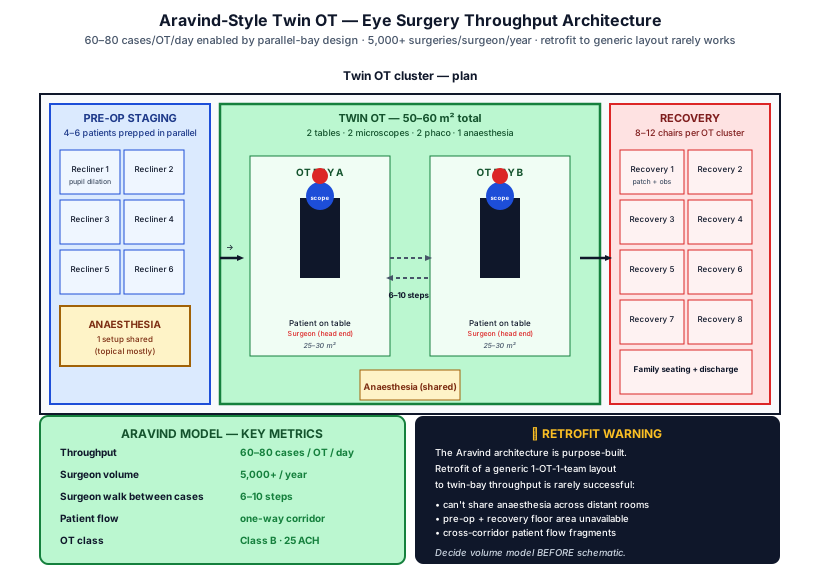
The Aravind Eye Hospital model — 5,000+ surgeries per surgeon per year — is enabled by architectural innovation: parallel OT bays sharing one anaesthesia setup, optimised patient flow, batched preparation. Some Indian eye hospitals adopt this; others remain conventional 1-OT-1-team.
| Aravind-Style Element | Architectural Provision |
|---|---|
| Twin OT (2 tables sharing prep zone) | 50–60 m² total; 2 microscopes, 2 phaco, 1 anaesthesia |
| Pre-op staging | 4–6 patients prepped in parallel |
| Recovery chairs | 8–12 chairs per OT cluster |
| Patient flow | One-way through corridor system |
| Staff workflow | Surgeon walks 6–10 steps between cases |
The Aravind model can deliver 60–80 cases per OT per day. The architectural design is purpose-built; retrofit to a generic OT layout is rarely successful.
2. Dental Clinic and Operatory
Indian dental practice ranges from single-chair clinics (most common) to multi-chair group practices to dental hospitals (with surgical wings). The architectural typology scales with this.
Dental operatory specifications
| Element | Specification |
|---|---|
| Operatory area | 9–12 m² per chair (single); 12–15 m² (multi-station) |
| Chair clearance | 0.9 m on operator side; 0.6 m on assistant side |
| Plumbing | Cuspidor + air/water syringe + suction line at chair |
| Compressed air | Per chair; from central compressor or local |
| Vacuum suction | Per chair; central preferred |
| Electrical | Per chair: 4–6 sockets, X-ray, light, chair motor |
| X-ray (intraoral) | Wall-mounted; AERB shielding 1.0 mm Pb |
| Operator stool | Side-mounted; ergonomic |
| Monitor mount | For digital X-ray, intraoral camera |
| Chair lighting | Operating light overhead; 10,000 lux |
| Floor finish | Welded vinyl; coved skirting |
| Wall finish | Antimicrobial paint or PVC panel |
| Privacy | Curtain or partition between chairs |
| Hand-hygiene | Sensor sink in operatory; alcohol rub |
Dental clinic schedule of spaces
| Space | Area | Single Chair | 4-Chair | 8-Chair |
|---|---|---|---|---|
| Reception | 12–18 m² | ✓ | ✓ | ✓ |
| Waiting | 1.4 m²/person | 6 m² (4 patients) | 18 m² (12) | 30 m² (20) |
| Operatory | 9–12 m² each | 12 | 36 | 72 |
| Sterilisation | 6–10 m² | 6 | 8 | 12 |
| Pano / OPG room | 12 m² | — | ✓ | ✓ |
| Cone-beam CT | 18 m² | — | (option) | ✓ |
| Lab — dental | 12–18 m² | — | ✓ | ✓ |
| Pharmacy / dispensing | 6 m² | — | ✓ | ✓ |
| Office / consultation | 9 m² | ✓ | ✓ | ✓ |
| Toilets | 3 m² | ✓ | ✓ | ✓ |
| Staff change | 6 m² | — | ✓ | ✓ |
| BMW storage | 1.5–3 m² | ✓ | ✓ | ✓ |
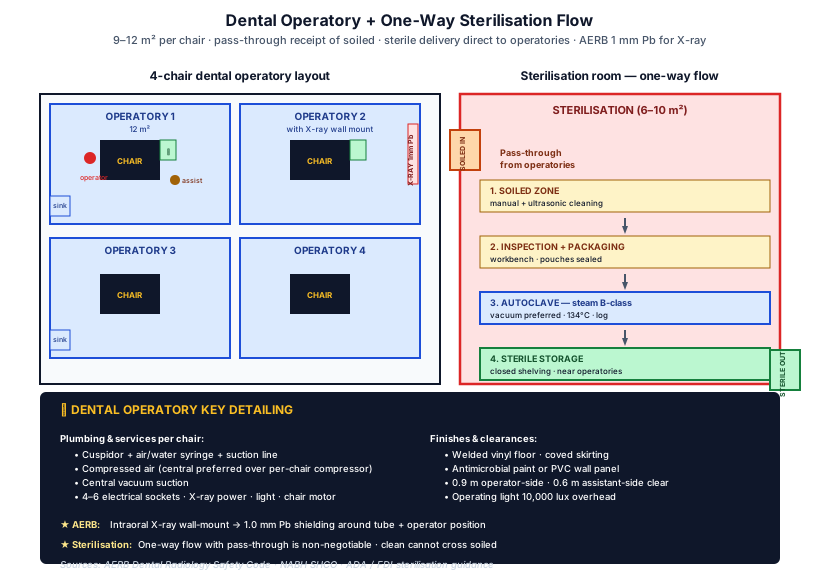
Dental sterilisation flow
| Stage | Architectural Provision |
|---|---|
| Soiled instrument receipt | Pass-through window from operatory |
| Manual / ultrasonic cleaning | Clean wash bay |
| Inspection / packaging | Workbench |
| Autoclave | Steam autoclave; B-class (vacuum) preferred |
| Sterile storage | Closed shelving; near operatories |
| Pass-out to operatories | Direct or via cart |
The dental sterilisation room is approximately 6–10 m² for a 4-chair clinic; 12–15 m² for 8+ chairs.
Dental OT (oral surgery / implants under sedation)
| Element | Specification |
|---|---|
| Area | 18–22 m² |
| Class | Class A or B OT |
| Equipment | Implant motor, X-ray, suction, monitoring |
| Anaesthesia | Local or sedation; full anaesthesia for major |
| Recovery | Adjacent chair / room |
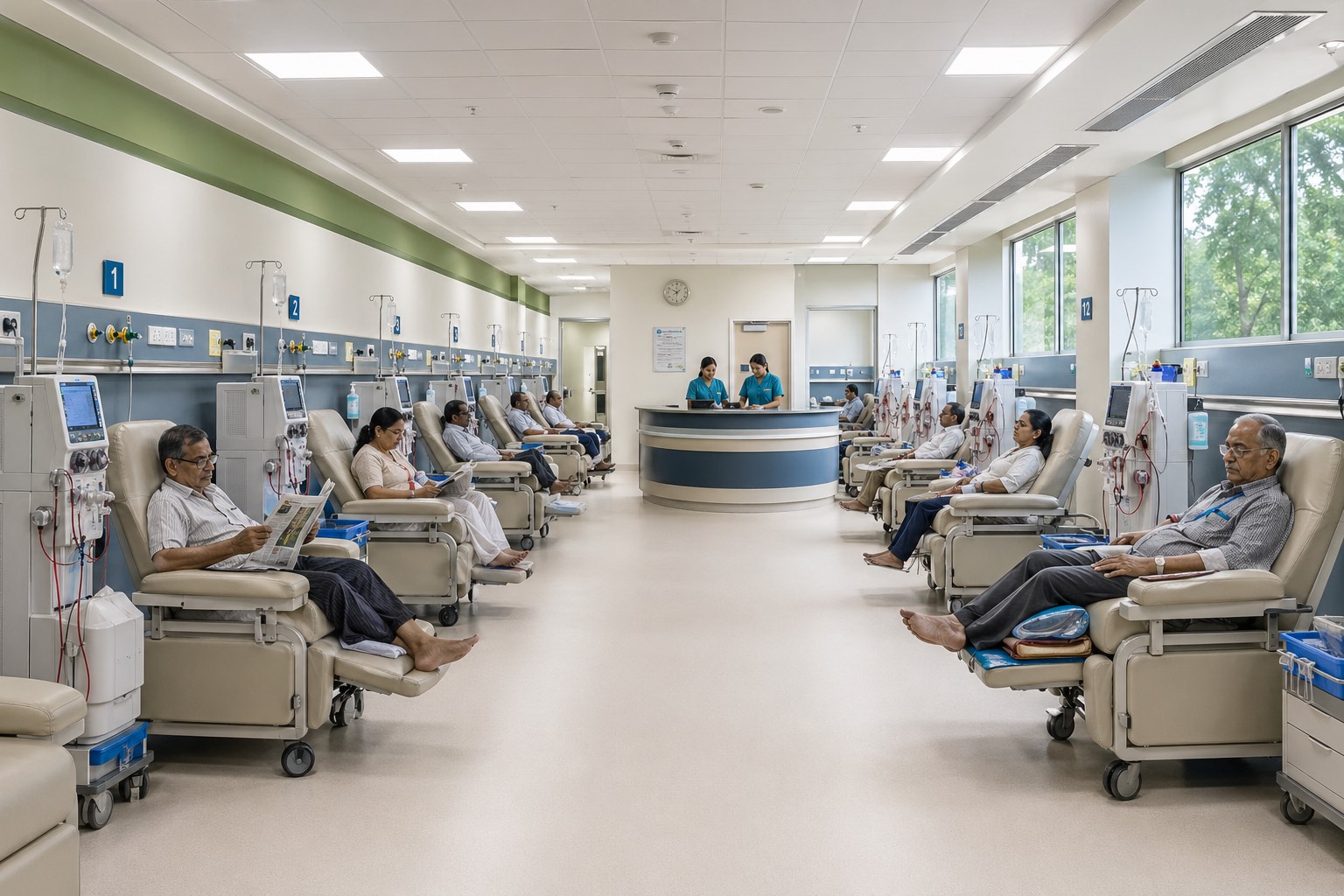
3. Haemodialysis Centre
Haemodialysis centres have grown rapidly in India — both standalone (chain operators like NephroPlus, DCDC) and within tertiary hospitals.
Dialysis centre workflow
| Stage | Activity | Architectural Provision |
|---|---|---|
| Patient arrival | Weight, vitals | Weighing area; nurse station |
| Vascular access | Fistula, catheter prep | Cannulation chair; privacy |
| Dialysis (4 hours typical) | Connected to machine, monitored | Dialysis chair / bed |
| Disconnection | Catheter de-access | Same chair |
| Discharge | Weight, vitals | Discharge desk |
Dialysis chair / bed area specifications
| Element | Specification |
|---|---|
| Floor area per station | 6–9 m² (chair); 10–12 m² (bed) |
| Chair-to-chair clearance | 1.2 m minimum |
| Privacy | Curtain or partition between stations |
| Headwall services | Dialysate inlet + drain; O₂ outlet; vacuum; power; nurse-call |
| Patient monitor | Per chair |
| Hand-hygiene | Sensor sink per 4 chairs minimum |
| Lighting | Ambient 300–500 lux; reading 750 lux per chair |
| Refreshment provision | Water + biscuit tray (renal-diet) |
| Family seating | Optional; one chair per station |
Dialysis centre schedule (24-station typical)
| Space | Area |
|---|---|
| Reception, waiting, registration | 30–40 m² |
| Weighing / triage | 9 m² |
| Dialysis hall — open | 24 stations × 6 m² + circulation = ~ 200–250 m² |
| Isolation cubicle (HBV / HCV / HIV positive) | 9–12 m² + dedicated machine |
| Cannulation room | 12 m² |
| Doctor's office | 12 m² |
| Nurse station | 12–15 m² |
| Pharmacy | 9–12 m² |
| Water treatment plant room | 18–25 m² |
| Equipment / dialyser-reuse | 12–15 m² (if reuse practised) |
| Patient toilets | 6 m² (×2) |
| Staff toilet | 3 m² |
| Patient lounge | 18–25 m² |
| BMW storage | 6–8 m² |
| Storage — supplies | 12 m² |
| Plant — utility | 12–18 m² |
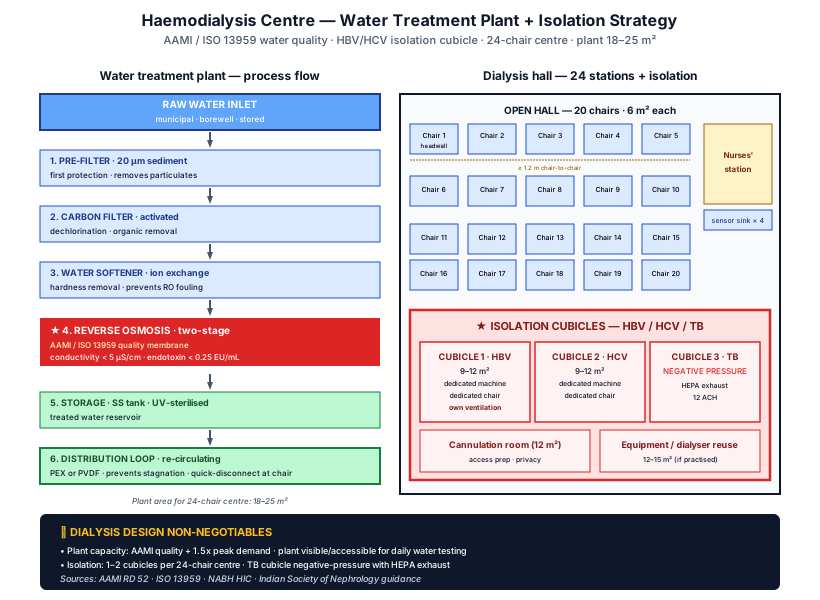
Dialysis water-treatment plant
| Stage | Equipment | Notes |
|---|---|---|
| Pre-filter | 20 μm sediment filter | First protection |
| Carbon filter | Activated carbon | Dechlorination |
| Water softener | Ion exchange resin | Hardness removal |
| Reverse osmosis | Two-stage RO membrane | Purification to AAMI / ISO 13959 |
| Storage tank | Stainless steel; UV-sterilised | Treated water reservoir |
| Distribution loop | PEX or PVDF pipework; continuous re-circulating | Prevents stagnation |
| Quick-disconnect at chair | Sealed tap | Per station |
| Drain | Direct to sewer with disinfection point | Effluent management |
Plant area: 18–25 m² for a 24-chair centre. Plant must be visible / accessible for maintenance and water-quality testing.
Isolation requirements (Hepatitis B / C / HIV)
| Pathogen | Isolation |
|---|---|
| HBV (Hepatitis B) | Dedicated machine + dedicated chair; isolation cubicle preferred |
| HCV (Hepatitis C) | Dedicated machine; isolation cubicle preferred |
| HIV | Universal precautions; dedicated machine optional |
| Active TB | Negative-pressure isolation cubicle; HEPA exhaust |
The isolation cubicle is 9–12 m² with own ventilation and machine. For 24-chair centre, allocate 1–2 isolation cubicles.
4. Blood Bank / Transfusion Medicine Centre
Blood banks are licensed under the Drugs and Cosmetics Act by the Drugs Controller (state) and operate under strict workflow architecture. Standalone blood banks and hospital-based blood banks share the same architectural pattern.
Blood bank workflow
| Stage | Activity | Architectural Provision |
|---|---|---|
| Donor reception | Registration, history | Reception |
| Donor screening | Hb test, vitals | Screening room |
| Donor counselling | Consent | Counselling room |
| Donor bleeding | Whole blood collection | Bleeding bed (couch) |
| Donor refreshment | Post-donation rest | Refreshment area |
| Component preparation | Centrifuge, plasma separation | Component lab |
| Storage | By component | Refrigerator / freezer rooms |
| Issue | Cross-match to recipient | Cross-match lab; issue counter |
| Quality control | Serology, screening tests | Serology lab |
Blood bank schedule
| Space | Area | Notes |
|---|---|---|
| Donor reception | 12–18 m² | Registration, queue |
| Donor screening | 9–12 m² | Hb, vitals, history |
| Donor counselling | 9 m² | Privacy |
| Donor bleeding | 25–35 m² for 4–6 couches | Bleeding bay |
| Refreshment | 15–20 m² | Post-donation rest |
| Component lab | 25–35 m² | Centrifuge, plasma separator |
| Storage — refrigeration | 15–20 m² | 2–6°C; multiple fridges |
| Storage — freezer | 9–12 m² | −30°C; for FFP, cryo |
| Storage — platelets | 9–12 m² | 22°C with agitator |
| Cross-match / serology lab | 25–35 m² | NAT, ELISA, blood grouping |
| Issue counter | 9–12 m² | Patient-facing |
| Quality / records | 12–15 m² | Documentation |
| Office | 12 m² | Medical officer |
| Toilets | 3 m² × 2 | — |
| BMW storage | 6 m² | — |
| Backup power | UPS for fridges | Critical |
Blood bank architectural requirements
| Element | Specification |
|---|---|
| Floor finish | Welded vinyl; jointless; coved skirting |
| Wall finish | Washable; antimicrobial in lab |
| Cold storage room | Walk-in or split fridge units; alarm on temperature deviation |
| UPS for cold storage | Mandatory; refrigerator failure = blood loss |
| Backup generator | Auto-start within 10 sec for cold storage |
| Temperature monitoring | Continuous; BMS-integrated |
| Access control | Restricted; staff card only |
| Donor flow | One-way: reception → bleeding → refreshment |
| Donor toilet | Adjacent to bleeding bay |
| Specimen flow | Cross-match samples received separately from donor flow |
5. Pathology Laboratory and Microbiology
Pathology labs accompany every hospital and exist as standalone diagnostic centres. NABL accreditation is the standard. Architecture differs by lab type.
Pathology lab schedule
| Lab Type | Specifications |
|---|---|
| Sample reception | 12–18 m²; queue, sample register |
| Phlebotomy / sample collection | 9–12 m² per booth; 2–4 booths; chair, screen |
| Hematology (CBC, coagulation) | 18–25 m²; analyser benches |
| Biochemistry (glucose, LFT, KFT, lipids) | 25–35 m²; auto-analyser + manual |
| Immunology / serology | 18–25 m²; ELISA reader, plate washer |
| Hormones | 18–25 m²; chemiluminescence analyser |
| Histopathology | 35–50 m²; grossing, microtome, embedding |
| Cytopathology | 18–25 m²; microscope station |
| Molecular biology / PCR | 18–25 m²; clean / amplification / detection rooms separated |
| Microbiology — culture | 18–25 m²; BSL-2 |
| Microbiology — specialised | 25–35 m²; BSL-3 if TB |
| Quality control | 12 m² |
| Records / reports | 12–18 m² |
| Office | 9–12 m² |
Lab architectural requirements
| Element | Specification |
|---|---|
| Flooring | Chemical-resistant; epoxy or vinyl; coved skirting; floor drain |
| Walls | Washable; chemical-resistant in chemistry/microbiology |
| Ceiling | Sealed; cleanable |
| Bench | Stainless steel or solid-surface; chemical-resistant; sealed |
| Sink | Per bench; eyewash; emergency shower in chemistry |
| Fume hood | Per chemistry / histopathology; vented to roof |
| Biological Safety Cabinet (BSC) | Class II in microbiology; HEPA exhaust |
| Compressed air | Per analyser |
| Vacuum | Per bench |
| Electrical | UPS-backed; multiple sockets per bench |
| Refrigeration | Reagent storage; sample storage |
| Autoclave | For waste sterilisation |
| Lighting | 500–750 lux at bench; daylight bonus |
| HVAC | 6–10 ACH; HEPA in BSL-2/3 |
BSL-2 and BSL-3 microbiology architecture
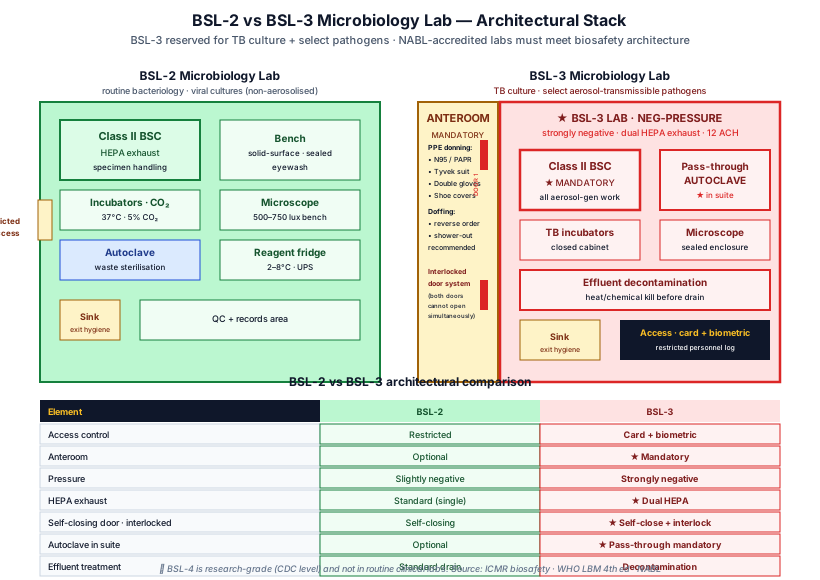
| Element | BSL-2 | BSL-3 |
|---|---|---|
| Access control | Restricted | Card + biometric |
| Anteroom | Optional | Mandatory |
| Pressure | Slightly negative | Strongly negative |
| HEPA exhaust | Standard | Dual HEPA |
| Self-closing door | Yes | Yes + interlocked |
| Hand-wash near exit | Yes | Yes |
| Autoclave in suite | Optional | Mandatory |
| Effluent treatment | Standard | Decontamination |
| Personnel PPE protocol | Lab coat | Full PPE; respirator |
BSL-3 is reserved for TB culture, select pathogens. BSL-4 is research-grade, not in routine clinical labs.
6. Common Specialty Failure Modes
| # | Failure | Specialty | Prevention |
|---|---|---|---|
| 1 | Refraction lane < 5 m | Eye | Verify length at concept |
| 2 | Eye OT plant ceiling void < 1.4 m | Eye | 4.2 m floor-to-floor |
| 3 | Dental X-ray without AERB shielding | Dental | 1.0 mm Pb wall as default |
| 4 | Dental sterilisation single-corridor | Dental | One-way flow with pass-through |
| 5 | Dialysis water plant under-sized | Dialysis | AAMI-compliant + 1.5x capacity |
| 6 | Dialysis isolation cubicle absent | Dialysis | 1–2 per 24-chair centre |
| 7 | Blood bank cold storage not on UPS | Blood bank | UPS + DG auto-transfer |
| 8 | Blood bank one-way donor flow violated | Blood bank | Plan one-way reception → bleeding → refresh |
| 9 | Lab fume hood absent in chemistry | Lab | Per bench |
| 10 | Lab BSC absent in microbiology | Lab | Class II BSC mandatory |
| 11 | BSL-3 without anteroom and dual HEPA | Lab | Full BSL-3 spec |
| 12 | PCR rooms not zone-separated | Molecular | 3-zone (clean / amp / detect) |
| 13 | Eye recovery seating insufficient | Eye | 2 chairs per OT minimum |
| 14 | Dental compressed-air central absent | Dental | Central preferred over per-chair |
| 15 | Dialysis chair clearance < 1.2 m | Dialysis | NABH minimum |
| 16 | Lab effluent into general drain | Lab | Pre-treatment / disinfection |
| 17 | Blood bank specimen receipt mixed with donor flow | Blood bank | Separate sample / donor entries |
| 18 | NABL spatial requirements ignored | Lab | NABL standard at concept |
7. Architect's Specialty Design Toolkit
| # | Step | Output |
|---|---|---|
| 1 | Specialty type confirmed (eye / dental / dialysis / blood bank / lab) | Brief |
| 2 | Workflow mapped patient-by-patient | Workflow diagram |
| 3 | Schedule of spaces per specialty | Sizing schedule |
| 4 | Equipment specification with vendor coordination | Equipment plan |
| 5 | AERB shielding (where X-ray/imaging) | AERB layout |
| 6 | Sterilisation / one-way flow | Sterilisation scheme |
| 7 | Pressure / HEPA / BSL classification | HVAC scheme |
| 8 | UPS for critical equipment | Electrical scheme |
| 9 | Specialty-specific water (dialysis RO) or chemicals | Plumbing scheme |
| 10 | Patient flow + family flow | Circulation overlay |
| 11 | Regulatory (NABH, NABL, drug license, AERB, PESO) | Regulatory matrix |
| 12 | Maintenance access | Service routing |
References
- AAMI / ANSI (2014) AAMI RD 52: Dialysate for Hemodialysis. Arlington: AAMI.
- AERB (2018) Safety Code for Dental Radiology. Mumbai: AERB.
- Drugs and Cosmetics Act, 1940 (with rules).
- Facility Guidelines Institute (2022) Guidelines for Design and Construction of Hospitals. St. Louis: FGI.
- Indian Council of Medical Research (2017) Biosafety Manual for Microbiological Laboratories. New Delhi: ICMR.
- ISO (2017) ISO 13959: Water for Haemodialysis and Related Therapies. Geneva: ISO.
- ISO (2017) ISO 15189: Medical Laboratories — Requirements for Quality and Competence. Geneva: ISO.
- NABH (2019) Standards for Eye Care Hospitals, 4th Edition. New Delhi: NABH.
- NABH (2018) Standards for Dental Clinics & Hospitals. New Delhi: NABH.
- NABH (2019) Standards for Dialysis Provider, 2nd Edition. New Delhi: NABH.
- NABH (2019) Standards for Blood Banks / Blood Centres & Transfusion Services. New Delhi: NABH.
- NABL (2021) Specific Criteria for Accreditation of Medical Testing Laboratories. Gurugram: NABL.
- Natchimuthu, K., Rajaraman, S. and Vijayakumar, A. (2017) 'Innovations in eye care delivery: the Aravind model', Indian Journal of Ophthalmology, 65(9), pp. 766–774.
- Rao, P.V. and Kumar, R.S. (2010) 'Dental clinic design — Indian perspective', Journal of Indian Dental Association, 92(5), pp. 26–32.
- World Health Organization (2008) Essential Environmental Health Standards in Health Care. Geneva: WHO.
- World Health Organization (2010) WHO Manual on Quality Standards for HIV Rapid Testing. Geneva: WHO.
Author's Note: Specialty design is the architectural response to specialty workflow. The guide is intentionally specific — eye hospital, dental clinic, dialysis, blood bank, lab — because the architectural decisions in each are different. The next guide covers surgical specialty design (cardiac, oncology, IVF, day-care surgery); the two together constitute the architect's specialty-typology toolkit. Subsequent guides cover sustainability and the business of healthcare commissions.
Disclaimer: This article is for informational and educational purposes only and does not constitute professional architectural, clinical, or regulatory advice. Specialty design depends on specific equipment, patient population, regulatory framework, and operational context that must be assessed project-by-project. Studio Matrx, its authors, and contributors accept no liability for decisions made on the basis of the information in this guide.
Interactive · Ambulatory specialty spaces
Haemodialysis unit · 9-12 sqm / chair · 8-30 chairs procedure room · 6 support spaces
Chronic + acute hemodialysis; 4-hour sessions, 3× per week per patient.
Procedure room · Dialysis hall
9-12 sqm / chair · 8-30 chairs
Chair / bed combo; bedside dialysis machine; nurse line-of-sight.
Support spaces
RO water plant room
≥ 25 sqmReverse osmosis to AAMI standard; daily quality test
Water-loop distribution
Per layoutPEX-Al-PEX pipe loop with sample ports at each chair
Isolation chair (HBV/HCV/HIV+)
Separate dedicated chairOwn RO loop; PPE; segregated waste
Patient prep + weigh-in
≥ 15 sqmPre-dialysis weight + vitals + AV-fistula assessment
Counsel / treatment-planning
≥ 14 sqmNephrologist + nurse + family
Storage (consumables)
≥ 18 sqmDialysers, lines, concentrate
Patient flow
Arrival + weigh → vitals → chair → 4-hour dialysis → post-weigh → discharge.
Regulatory
- • AAMI water-quality standard
- • BMW Rules (blood / sharps)
- • Drug + Pharmacy (heparin)
- • NABL water testing
Watch-out
RO water purity at 1.5-2.0 µS/cm at every loop is non-negotiable. A single contaminated chair can cause sepsis outbreak.
References: NABH ambulatory standards, NACO + NHM disease-specific facility guidelines, IS 13450 (medical gas), AAMI (water quality for dialysis). Each specialty has dedicated regulatory + accreditation tracks.
Export this guide
Related Guides — Deep-dive reading
CSSD — Central Sterile Services Department Design in India
An Architect's Working Reference — Dirty-to-Clean Unidirectional Flow · Decontamination Zone · Inspection & Packing · Sterilisation (Steam · Plasma · EO · Gamma) · Sterile Storage · OT-CSSD Adjacency Models · NABH 5th Edition & ISO 13485 · The Logistics of Surgical Sterility
Healthcare ArchitectureHospital Back-of-House — Kitchen, Laundry & Mortuary Design in India
An Architect's Working Reference — Therapeutic Diet Kitchen · HACCP-Equivalent Flow · Hospital Laundry with Pass-Through Washer-Extractors · Mortuary with Dignified End-of-Life Architecture · Multi-Faith Provision · Service-Side Adjacency · NABH 5th Edition · The Service Heart of the Hospital
Healthcare ArchitecturePandemic Preparedness & Isolation Hospital Design in India
An Architect's Working Reference — AIIR Negative-Pressure Rooms · Cohort Isolation Wards · Surge-Conversion Architecture · Triage & Screening Layers · COVID-19 Lessons · BSL-3 Sample Rooms · Mortuary Surge Capacity · The Pandemic-Ready Hospital Master Plan
Healthcare ArchitectureRelated Tools — Try Free
Acoustic Privacy (STC) Visualizer
Indian healthcare acoustic visualizer — compare wall assemblies and noise sources, see received SPL after STC attenuation, and check FGI 2018 / IS 1950 / NABH speech-privacy compliance with live dual-canvas waveform.
Acoustic ToolHealing View Impact Calculator
Evidence-Based Design dashboard quantifying the recovery impact of nature view + daylight factor on analgesic use, length of stay, and HCAHPS patient-experience uplift. Calibrated against Ulrich 1984 (Science), Park & Mattson 2008, and the CHD EBD evidence base.
EBD CalculatorCircadian Light Meter
Patient-centric circadian lighting visualizer for Indian healthcare design — time-of-day × intensity → CCT, melanopic lux (EML / mEDI), melatonin suppression, and an alertness curve. Calibrated against WELL v2 L03 Circadian Lighting Design, CIE S 026:2018, Brainard 2001, and Lucas et al. 2014.
Circadian Tool