
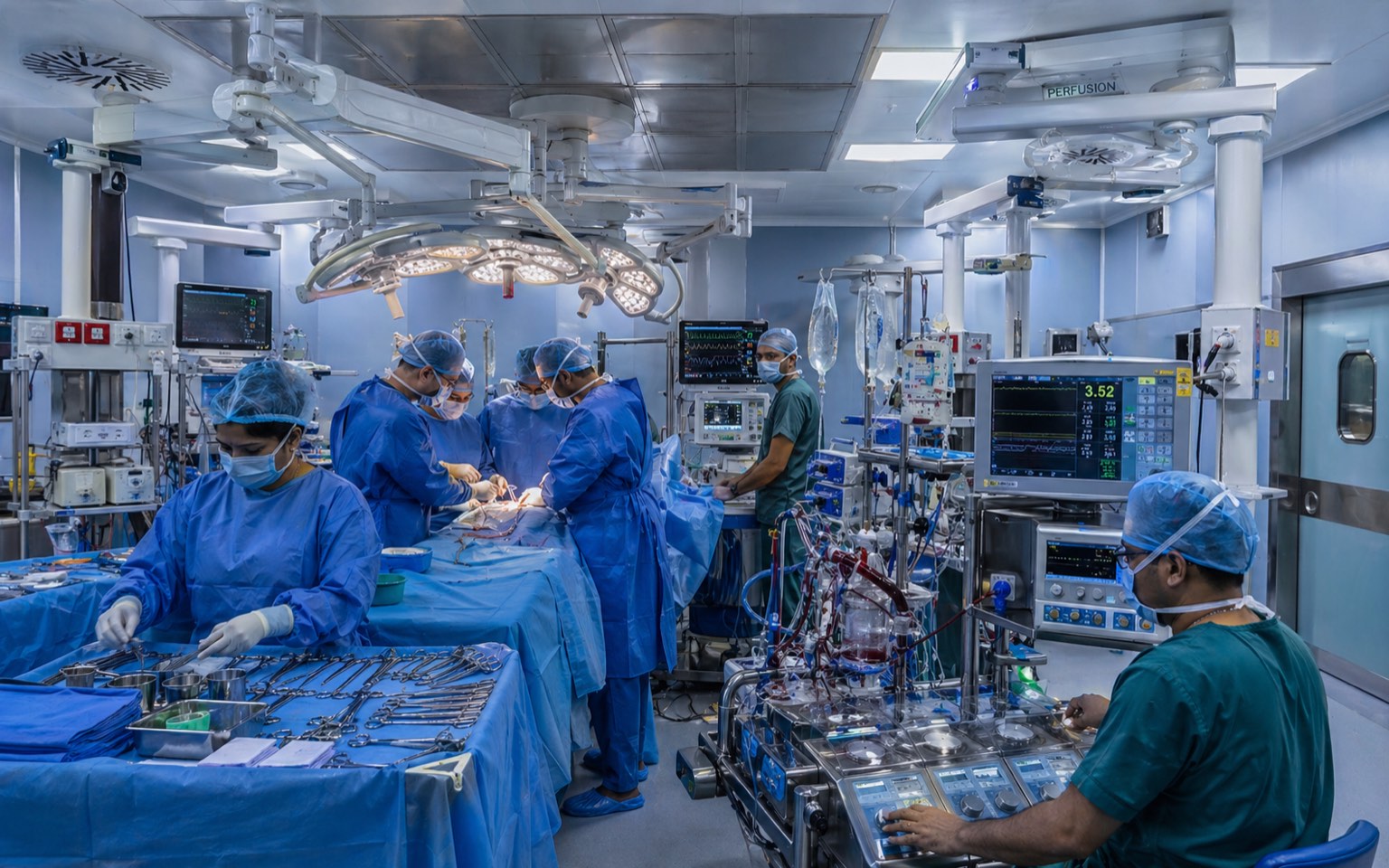
Cardiac, Oncology, IVF & Day-Care Surgery Design in India
An Architect's Working Reference — Cardiac OT and Cathlab, Oncology Day-Care and Chemotherapy Pharmacy, Linac Bunker (Cross-Reference AERB), IVF/ART Grade A/B/C/D Cleanroom Architecture, Day-Care Surgery Tier, Plastic and Robotic Surgery Specifics
Surgical specialty centres are where most tertiary healthcare investment in India is concentrated — cardiac, oncology, fertility, day-care surgery, robotic surgery. These specialties have distinctive workflows, equipment, regulatory profiles, and capital budgets that the architect must internalise from concept stage. Unlike the diagnostic and ambulatory specialties covered in the previous guide, surgical specialties involve general anaesthesia, prolonged monitoring, equipment integration, sterile environments, and (for radiotherapy and IVF) regulatory-controlled cleanroom standards.
This guide is the tenth in the design-focused series and the second of the specialty pair. It assumes the reader has read the regulatory series, particularly the AERB radiology compliance guide, and the design-series articles up to this point — particularly the OT suite design, ICU design, and the preceding diagnostic specialty guide.
Each specialty section is structured for working use: clinical workflow, schedule of spaces, key architectural-engineering specifications, regulatory cross-references, equipment integration, and failure modes. The aim is to give the architect on a specialty commission a complete brief from which detailed design can proceed without extensive re-research.
"Cardiac surgery is the OT discipline that most demands architectural perfection — because everything is high-stakes, and everything is integrated. The patient is alive only because of the building's mechanical reliability for two to four hours." — Dr. Ramakanta Panda, cardiac surgeon, paraphrased from a 2017 healthcare conference
"In oncology, the building is treating the family as much as the patient. The chemo chair is a single experience; the journey through cancer is a sustained one. The architect designs for the journey." — Dr. V. Shanta (1927–2021), oncologist and former Chairperson Cancer Institute Adyar, paraphrased
1. Cardiac Surgery Centre
Cardiac centres in India have grown rapidly through chains (Apollo, Manipal, Narayana Health, Fortis Heart Institute) and standalone heart hospitals. Architecture is among the most demanding in healthcare.
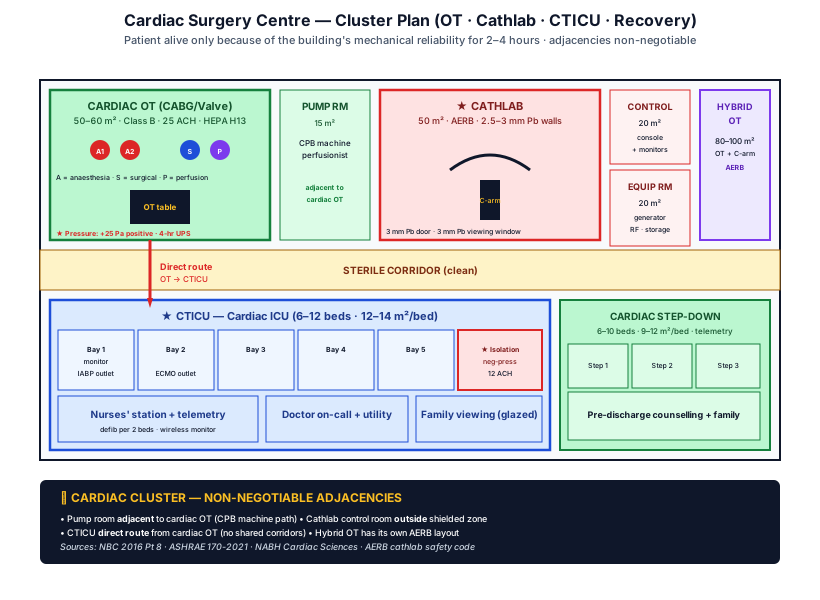
Cardiac centre programmatic spaces
| Space | Area | Notes |
|---|---|---|
| Cardiac OPD | 200–350 m² | Echo, ECG, TMT, holter, OPD consultation |
| Cardiac diagnostic | 200–300 m² | Stress test, holter, echo, EP study |
| Cathlab | 50 m² procedure + 20 m² control + 20 m² equipment + 15 m² recovery | Class A OT level + AERB |
| Hybrid OT | 80–100 m² | OT + cathlab; AERB |
| Cardiac OT (CABG, valve) | 50–60 m² | Class B; HEPA H13; pump room |
| Pump perfusion room | 15 m² | Adjacent to cardiac OT |
| Cardiac ICU (CTICU) | 12–14 m²/bed; 6–12 beds | Specialised cardiac monitoring |
| Cardiac step-down | 9–12 m²/bed; 6–10 beds | Telemetry; pre-discharge |
| Cardiac IPD | Standard hospital | Cardiology IPD |
| Paediatric cardiac unit | NICU + PICU integration | If congenital cardiac surgery |
| ECMO unit | 14–18 m²/bed | Specialised |
| Transplant unit | 16–20 m²/room | If heart transplant |
Cardiac OT specifics
| Element | Specification |
|---|---|
| Area | 50–60 m² (CABG, valve); 60+ m² (transplant) |
| Class | Class B; 25 ACH; HEPA H13; positive pressure |
| Pendants | 2 × anaesthesia + 1 × surgical + 1 × perfusion |
| Ceiling-mounted boom | Multiple; structural load 250–400 kg per pendant |
| Anaesthesia equipment | Pendant-mounted + cart |
| Bypass machine (CPB) | Adjacent in pump room or in OT |
| TEE (transoesophageal echo) | Mobile or integrated |
| Imaging integration | C-arm or fixed for hybrid |
| Floor finish | Conductive vinyl welded; coved |
| Wall finish | PVC panel; antimicrobial |
| Door | Sliding pneumatic; 1.5 m clear |
| Lighting | 100,000 lux ceiling-mounted shadowless; UPS |
| Power | UPS for critical loads (anaesthesia, pump, monitor) |
| Gases | O₂×3, Air×2, N₂O×1, Vac×4, Scavenging×2 |
| Recovery | Direct route to CTICU |
Cathlab specifics
(See also AERB radiology guide for shielding details.)
| Element | Specification |
|---|---|
| Procedure room area | 50 m² |
| Wall barrier | 2.5–3.0 mm Pb |
| Door | 3 mm Pb pneumatic |
| Viewing window | 3 mm Pb leaded glass |
| Control room | 20 m²; equipment console + monitors |
| Equipment room | 20 m²; generator, RF cabinet, image storage |
| Recovery / step-down | 4–6 trolleys; 15 m² |
| Floor finish | Conductive vinyl |
| Wall / ceiling | OT-grade with lead lining |
| HVAC | OT-grade for sterile cathlab; 20 ACH; HEPA |
Cardiac ICU specifics
| Element | Specification |
|---|---|
| Bed area | 12–14 m²/bed |
| Inter-bed clearance | 2.4 m |
| Headwall | Per ICU spec + cardiac monitoring + IABP / ECMO outlet |
| Telemetry | Wireless monitor at every bed |
| Cardiac defibrillator | Per 2 beds |
| ECMO capability | Outlets and space for ECMO unit |
| Echo at bedside | Mobile USG |
| Family viewing | Glazed; controlled access |
| Isolation | At least 1 negative-pressure |
2. Oncology Centre — Medical, Radiation, Surgical
Oncology has three architectural streams: medical (chemotherapy day-care, oncology pharmacy), radiation (linac bunker, brachytherapy, gamma knife), and surgical (oncology OT, surgical IPD).
Oncology day-care chemotherapy
| Space | Area | Notes |
|---|---|---|
| Reception, registration | 25–35 m² | High volume |
| Waiting | 1.4 m²/person; 40–60 m² | Often family-heavy |
| Triage | 12 m² | Vitals, lab review |
| Chair / bed bay | 6–9 m² per chair (open) or 12 m² (single room) | 12–24 chairs typical |
| Isolation cubicle | 14 m² + anteroom | For severely immunocompromised |
| Counselling | 12 m² | Privacy |
| Doctor's office | 12 m² | Multiple |
| Cytotoxic pharmacy | 25–35 m² | BSC class II; spill kit; PPE |
| Storage — refrigerated | 9 m² | For temperature-sensitive |
| Pantry / family | 18–25 m² | Refreshment, family wait |
| Toilets | 3 m² × 2 | — |
| BMW (cytotoxic separate) | 6 m² | Locked |
Cytotoxic pharmacy architecture
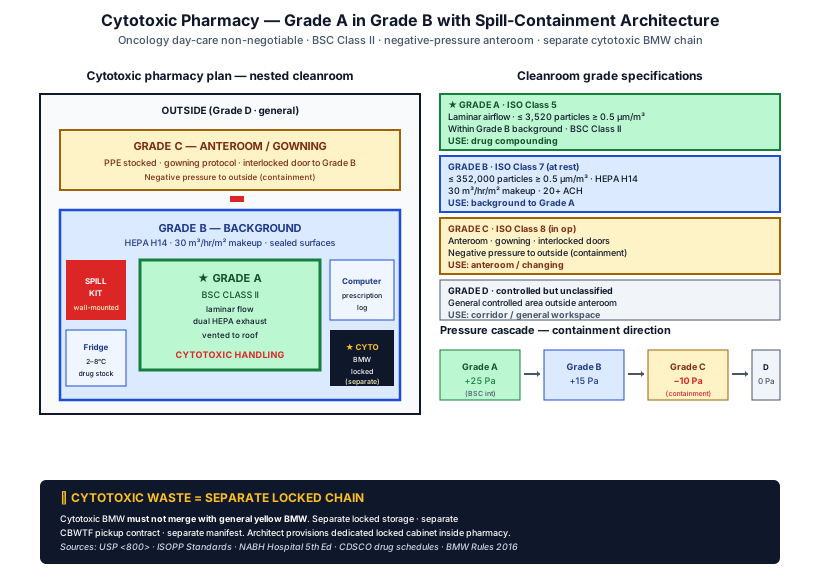
| Element | Specification |
|---|---|
| Area | 18–25 m² minimum |
| Cleanroom class | Grade A (laminar flow) within Grade B/C background |
| Class II BSC | Vented exhaust; dual HEPA |
| Anteroom | Mandatory; gowning |
| Floor finish | Welded vinyl; cove |
| Wall / ceiling | Sealed, washable |
| Negative pressure to anteroom | Containment |
| Ventilation | HEPA + dedicated exhaust |
| Spill kit | Wall-mounted; visible |
| Personal protective equipment | Stocked at anteroom |
| Refrigerated storage | For drugs |
| Documentation | Computer system, locked |
Linear accelerator (linac) bunker
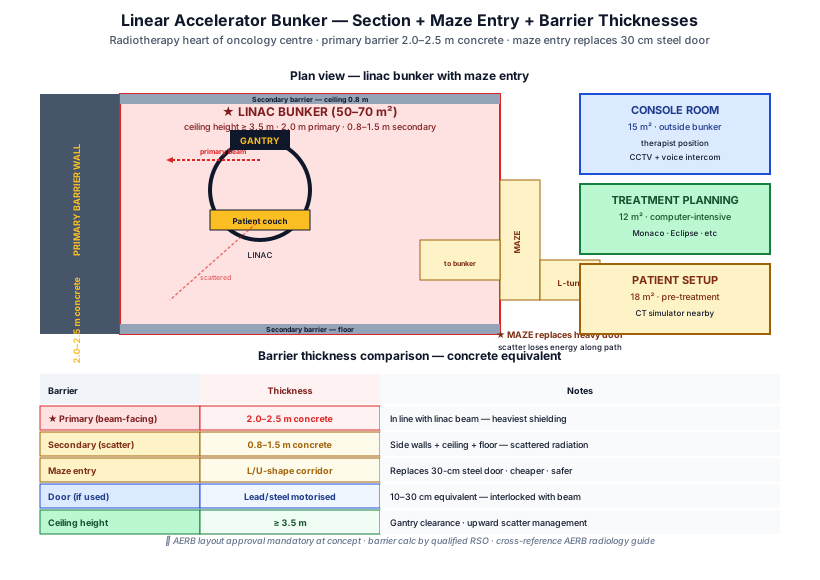
(See AERB radiology guide for full bunker shielding specification.)
| Element | Specification |
|---|---|
| Bunker area | 50–70 m² |
| Bunker height | ≥ 3.5 m |
| Primary barrier walls | 2.0–2.5 m thick concrete (or shielding equivalent) |
| Secondary barrier walls | 0.8–1.5 m concrete |
| Maze entry | Long L- or U-shaped corridor |
| Door | Heavy lead/steel motorised; or maze without door |
| Console room | 15 m² outside bunker |
| Treatment planning system room | 12 m² |
| Patient preparation / setup | 18 m² |
| Anaesthesia (paediatric, head-and-neck) | Adjacent |
| Recovery / waiting | 12 m² |
Brachytherapy room
| Element | Specification |
|---|---|
| Treatment room | 20–30 m² |
| Wall barrier | 50–200 mm Pb equivalent (HDR Ir-192) |
| Source storage safe | Lead-lined; logged access |
| Operator position | Behind shield; remote afterloader |
| Patient stay | Some implants overnight; shielded suite |
Gamma knife centre
| Element | Specification |
|---|---|
| Gamma knife room | 30 m² |
| Lead and concrete shielding | Per AERB |
| Patient frame application room | Adjacent |
| Treatment planning | Computer-intensive room |
| Recovery | Adjacent |
Surgical oncology OT
Standard OT class B with specialty equipment for tumour resection, free-flap, robotic-assisted. See OT design guide.
3. IVF / Assisted Reproductive Technology (ART) Clinic
IVF clinics in India operate under the ART (Regulation) Act 2021 and ICMR National Guidelines (2017). Architecture is among the most regulated.
IVF clinic schedule of spaces
| Space | Area | Notes |
|---|---|---|
| Reception / registration | 15–20 m² | Often discreet |
| Counselling room | 12–15 m² | Couple + counsellor |
| OPD / consultation | 12–15 m² each; 2–4 rooms | Privacy |
| Ovum pickup OT | 25–30 m² | Class B OT; AERB ultrasound shielding |
| Embryo transfer OT | 18–25 m² | Class B |
| Recovery | 12–18 m² | 2–4 trolleys |
| Embryology lab | 25–35 m² | Grade A/B classified zones |
| Andrology / semen analysis | 12–15 m² | Adjacent to embryology |
| Cryopreservation room | 12–18 m² | LN₂ tanks; ventilated |
| Donor screening / management | 12 m² | Where donor programme |
| Pharmacy | 9–12 m² | Specialised drugs (gonadotropins) |
| Doctor's office | 12 m² | Multiple |
| Toilets | 3 m² × 2 | — |
| BMW | 4 m² | — |
Embryology lab — Grade A/B/C/D cleanroom architecture
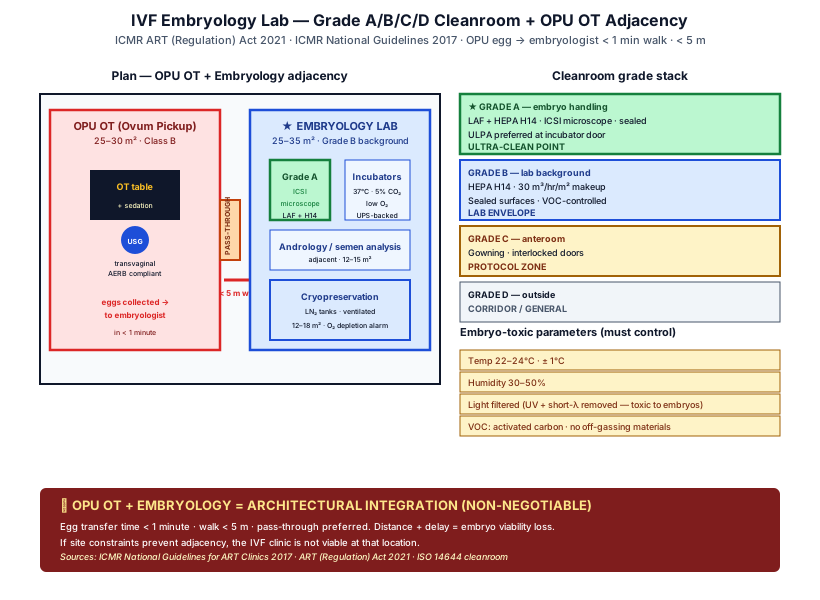
The embryology lab is the most architecturally regulated space in IVF.
| Zone | Cleanroom Class | Specification |
|---|---|---|
| Embryo handling (microscope, ICSI) | Grade A | Laminar flow within Grade B; HEPA H14 |
| Embryology lab (background) | Grade B | 30 m³/hr/m² makeup; HEPA H14 |
| Anteroom / changing | Grade C | Gowning |
| Outside lab | Grade D | General controlled |
Embryology lab architectural details
| Element | Specification |
|---|---|
| Area | 25–35 m² |
| Floor | Welded vinyl; jointless; coved 100 mm |
| Walls | PVC panel or epoxy; smooth, sealed |
| Ceiling | Sealed; washable; modular metal preferred |
| Door | Self-closing; sealed gasket; interlocked anteroom |
| Anteroom | Mandatory; gowning; pressure-positive |
| Lighting | Filtered to remove UV and short-wavelength (toxic to embryos) |
| Temperature | Stable 22–24°C; ± 1°C |
| Humidity | 30–50% |
| Air quality | HEPA H14; ULPA preferred at incubator |
| VOC control | Activated carbon filtration; no off-gassing materials |
| Equipment | Class II BSC, ICSI microscope, incubators, cryopreservation tanks, centrifuges |
Ovum pickup OT
| Element | Specification |
|---|---|
| Area | 25–30 m² |
| Class | Class B |
| Ultrasound | Transvaginal; AERB compliant |
| Anaesthesia | Sedation; full anaesthesia capability |
| Adjacent embryology | Direct passage / pass-through to lab |
| Recovery | Adjacent |
The OPU OT and embryology lab must be physically adjacent; egg transfer to embryologist must be < 1 minute, < 5 m walk. Architectural integration is non-negotiable.
4. Day-Care Surgery Centre
Day-care surgery centres handle procedures with same-day discharge — cataract, hernia, hydrocele, varicocele, dental implant, minor plastic, endoscopy. These are common standalone facilities and integrated within hospitals.
Day-care surgery schedule
| Space | Area |
|---|---|
| Reception, registration | 15–20 m² |
| Waiting | 25–35 m² (high family) |
| OPD consultation | 12 m² × 2–4 |
| Pre-op preparation | 18–25 m²; 4–6 chairs |
| OT (major day-care) | 25–30 m²; class B |
| OT (minor) | 18–22 m²; class A |
| Recovery / PACU | 25–35 m²; 6–8 trolleys |
| Step-down recovery | 18–25 m²; 6–8 chairs |
| Discharge desk | 9–12 m² |
| Pharmacy | 9 m² |
| Doctor's office | 12 m² |
| Staff change | 9 m² |
| Toilets | 3 m² × 3 |
| BMW | 4 m² |
Day-care surgery typologies
| Type | OT Specification | Recovery |
|---|---|---|
| Cataract | 22–25 m²; phaco machine; microscope | 1 chair × 1–2 hr |
| Hernia / hydrocele | 22–25 m²; standard | 1 trolley × 4–6 hr |
| Endoscopy / colonoscopy | Procedure room 25 m²; reprocessor | Recovery chair |
| Dental implant (multiple) | 22–25 m² OT or operatory | Chair |
| Plastic / cosmetic minor | 22–25 m² | Chair / trolley |
| Cardiac cath day-care | 50 m² cathlab; 20 m² control | Recovery 4 hr |
| Dialysis vascular access | 22–25 m² OT | Chair |
| Eye day-care surgery | 18–22 m² | Chair × 1 hr |
ICMR ART (Regulation) Act 2021 architectural compliance
| Element | Specification |
|---|---|
| Registration with state | Mandatory |
| OPU OT separate | Required |
| Embryology lab Grade A/B | Required |
| Donor screening | Required |
| Counselling room | Required |
| Patient consent infrastructure | Required |
| Documentation | Required |
5. Cosmetic and Plastic Surgery Centre
Cosmetic and plastic surgery centres in India have grown rapidly. Architectural typology blends day-care and tertiary OT.
| Element | Specification |
|---|---|
| OT — minor cosmetic | 22–25 m²; class A or B |
| OT — major cosmetic / reconstructive | 25–35 m²; class B; pendants |
| Recovery | Quiet; private; family-friendly |
| Procedural treatment | Botox, filler, laser — 12–15 m² each |
| Photography studio | 12 m² with neutral background, stable lighting |
| Consultation room | 12 m² with computer for imaging |
| Pre-op marking room | 9 m² |
| Discharge counselling | 9 m² with privacy |
| Discreet entry / exit | Cosmetic patients prefer privacy |
6. Robotic Surgery Integration
Robotic surgery (da Vinci, Versius) requires architectural-engineering accommodations.
| Element | Specification |
|---|---|
| OT area | 50–60 m² |
| Ceiling height | 3.5 m minimum |
| Structural | Support for robot arm (~ 1500 kg) |
| Power | Dedicated UPS for robot |
| Cooling | Higher cooling for robot electronics |
| Boom-mounted equipment | Visualisation, controls |
| Maintenance access | Robot arm service zone |
| Vendor coordination | Manufacturer-specific specifications |
7. Common Surgical Specialty Failure Modes
| # | Failure | Specialty | Prevention |
|---|---|---|---|
| 1 | Cardiac OT undersized (< 50 m²) | Cardiac | 50–60 m² minimum |
| 2 | Cathlab without AERB layout approval | Cardiac | AERB at concept |
| 3 | CTICU not adjacent to cardiac OT | Cardiac | Direct route |
| 4 | Cytotoxic pharmacy without BSC class II | Oncology | BSC mandatory |
| 5 | Cytotoxic chain merged with general yellow BMW | Oncology | Separate locked storage |
| 6 | Linac bunker at ground floor without earth-berm | Oncology | Bunker design + AERB |
| 7 | Embryology lab without Grade A/B classification | IVF | Cleanroom standard |
| 8 | OPU OT not adjacent to embryology | IVF | < 5 m walk; pass-through |
| 9 | IVF lab UV-emitting lighting | IVF | Filtered lighting |
| 10 | Day-care OT shared with main hospital OT | Day-care | Separate cluster |
| 11 | Day-care recovery undersized (< 1 trolley per case) | Day-care | 2 trolleys per OT |
| 12 | Robotic OT structural inadequate | Robotic | Robot-arm structural design |
| 13 | Cathlab not directly adjacent to ICU | Cardiac | Same floor; direct route |
| 14 | Plastic surgery centre without discreet entry | Cosmetic | Separate entry |
8. Architect's Surgical Specialty Toolkit
| # | Step | Output |
|---|---|---|
| 1 | Specialty type confirmed | Brief |
| 2 | Workflow map per specialty | Workflow |
| 3 | OT count and type | OT plan |
| 4 | Specialty-specific HVAC (cleanroom for IVF; OT-grade for cathlab) | HVAC scheme |
| 5 | AERB shielding (cathlab, linac, brachy, gamma knife) | AERB layout |
| 6 | Cleanroom classification (IVF Grade A/B, cytotoxic pharmacy Grade A) | Cleanroom scheme |
| 7 | Equipment integration (robot, ECMO, perfusion, CPB) | Equipment plan |
| 8 | Recovery / step-down sizing | Recovery scheme |
| 9 | Family-presence provision | Family lounge |
| 10 | Discreet entry (cosmetic) | Entry separation |
| 11 | UPS / DG sizing for critical | Electrical scheme |
| 12 | Regulatory compliance map | Regulatory matrix |
References
- AERB (2017) Radiation Safety Manual for Radiotherapy. Mumbai: AERB.
- AERB (2018) Atomic Energy (Radiation Protection) Rules — Consolidated. Mumbai: AERB.
- ART (Regulation) Act 2021 — Government of India.
- ASHRAE (2021) Standard 170-2021: Ventilation of Health Care Facilities. Atlanta: ASHRAE.
- Banoub, J.M. (2021) 'Operating room design: cardiac surgery requirements', Journal of Cardiothoracic Surgery, 16(2), pp. 45–52.
- ESHRE (2008) Revised Guidelines for Good Practice in IVF Laboratories. Grimbergen: European Society of Human Reproduction and Embryology.
- Facility Guidelines Institute (2022) Guidelines for Design and Construction of Hospitals. St. Louis: FGI.
- Indian Council of Medical Research (2017) National Guidelines for Accreditation, Supervision and Regulation of ART Clinics in India. New Delhi: ICMR.
- ISO (2015) ISO 14644-1:2015 Cleanrooms and associated controlled environments. Geneva: ISO.
- Jasovic-Gasic, M. and Jasovic, V. (2016) 'Architectural design of oncology centres', European Journal of Cancer Care, 25(4), pp. 511–521.
- Joshi, D.C. and Joshi, M. (2018) Hospital Administration. 2nd edn. New Delhi: Jaypee Brothers.
- NABH (2020) Standards for Fertility / ART Clinics. New Delhi: NABH.
- NCRP (2005) Report 151: Structural Shielding Design and Evaluation for Megavoltage X- and Gamma-Ray Radiotherapy Facilities. Bethesda: NCRP.
- Pharmaceutical Inspection Co-operation Scheme (PIC/S) (2014) Guide to Good Manufacturing Practice for Medicinal Products — Annex 1. Geneva: PIC/S.
- Reddy, S.M., Rao, K.D. and Sundararaman, T. (2012) 'Cancer care infrastructure in India: gaps and recommendations', Indian Journal of Cancer, 49(1), pp. 6–11.
- Vermeulen, J., Gehin, A.B., Wijesinghe, R. and Smith, T.A. (2016) 'Cleanroom standards for IVF labs', Reproductive BioMedicine Online, 32(5), pp. 471–480.
Author's Note: Surgical specialty design is the most architecturally consequential application of healthcare architecture in India. Each specialty has its own clinical, regulatory, and equipment language that the architect must learn. The two specialty guides together (diagnostic + surgical) cover the major typologies the architect will encounter in practice. The remaining two guides in the series cover sustainability and the business of healthcare commissions.
Disclaimer: This article is for informational and educational purposes only and does not constitute professional architectural, clinical, or regulatory advice. Specialty design depends on specific equipment, patient population, regulatory framework, and operational context that must be assessed project-by-project. Studio Matrx, its authors, and contributors accept no liability for decisions made on the basis of the information in this guide.
Interactive · Surgical-specialty OT deep dive
Robotic surgery suite · 65-80 sqm (robot needs space + reach) · 25 ACH
DaVinci / Versius / Hugo system; minimal-invasive across multiple specialties.
Specialty equipment + spatial impact
- DaVinci patient cart + master console
8-10 sqm extra clear floor near patient
- Vision tower + monitors
Ceiling pendant or boom — height clearance 2.7 m+
- Surgeon console alcove
Far side of OT (3-4 m from patient); needs ergonomic seating
- Backup laparoscopic stack
On wheels; available if robot fails mid-case
Adjacency requirements
- ICU + HDU≤ 50 m
- Imaging (CT for setup verification)Same floor
- Sterile processing (robotic accessories)Dedicated robotic-instrument trays
Critical design moves
- ▸Console alcove with privacy partition (low light)
- ▸Cable management routes between console + cart
- ▸Extra emergency power circuits — robot has critical software
- ▸Sound + video recording infrastructure for training
Pitfall
Robot occupies space EVEN when undocked. Don't shrink the OT to standard size — minimum 65 sqm for one robot.
References: ASHRAE 170-2017, NABH 5th ed., specialty society guidelines (ISHLT for transplant, SAGES for robotic, ABA for burns). Always pair specialty OT design with the operating surgical team.
Export this guide
Related Guides — Deep-dive reading
Cancer Hospital & Oncology Centre Design in India
An Architect's Working Reference — LINAC Bunkers, Brachytherapy Suites, AERB Type-1 Compliance, Chemotherapy Day-Care, BMT & Isolation, Tumour Board Rooms, Palliative & Hospice Integration, and the Indian Tertiary Cancer Centre Brief
Healthcare ArchitectureOT Suite Design in India — Planning, Services, Detailing
From Single OT to 12-OT Campus — Zone Classification, ASHRAE 170 + NABH Plant Design, Pendants and Booms and Lighting, Scrub/Induction/Recovery Geometry, CSSD Interface, Floor and Wall Finishes, and the OT Architectural Toolkit
Healthcare ArchitectureAERB Compliance for Radiology & Imaging Rooms: Architect's Working Reference
Atomic Energy Regulatory Board Codes for Diagnostic Radiology, Mammography, CT, Cathlab, MRI, Nuclear Medicine, and Radiotherapy — Barrier Calculation Principles, Lead-Equivalent Specification, Door & Viewing Window Design, RSO Appointment, Layout Approval Process, and Per-Room Architectural Detail
Healthcare ArchitectureRelated Tools — Try Free
Acoustic Privacy (STC) Visualizer
Indian healthcare acoustic visualizer — compare wall assemblies and noise sources, see received SPL after STC attenuation, and check FGI 2018 / IS 1950 / NABH speech-privacy compliance with live dual-canvas waveform.
Acoustic ToolCircadian Light Meter
Patient-centric circadian lighting visualizer for Indian healthcare design — time-of-day × intensity → CCT, melanopic lux (EML / mEDI), melatonin suppression, and an alertness curve. Calibrated against WELL v2 L03 Circadian Lighting Design, CIE S 026:2018, Brainard 2001, and Lucas et al. 2014.
Circadian ToolMaterial Schedule Generator
Generate a room-wise finish schedule — walls, floors, ceilings, trim, and joinery by location.
Material Schedule