
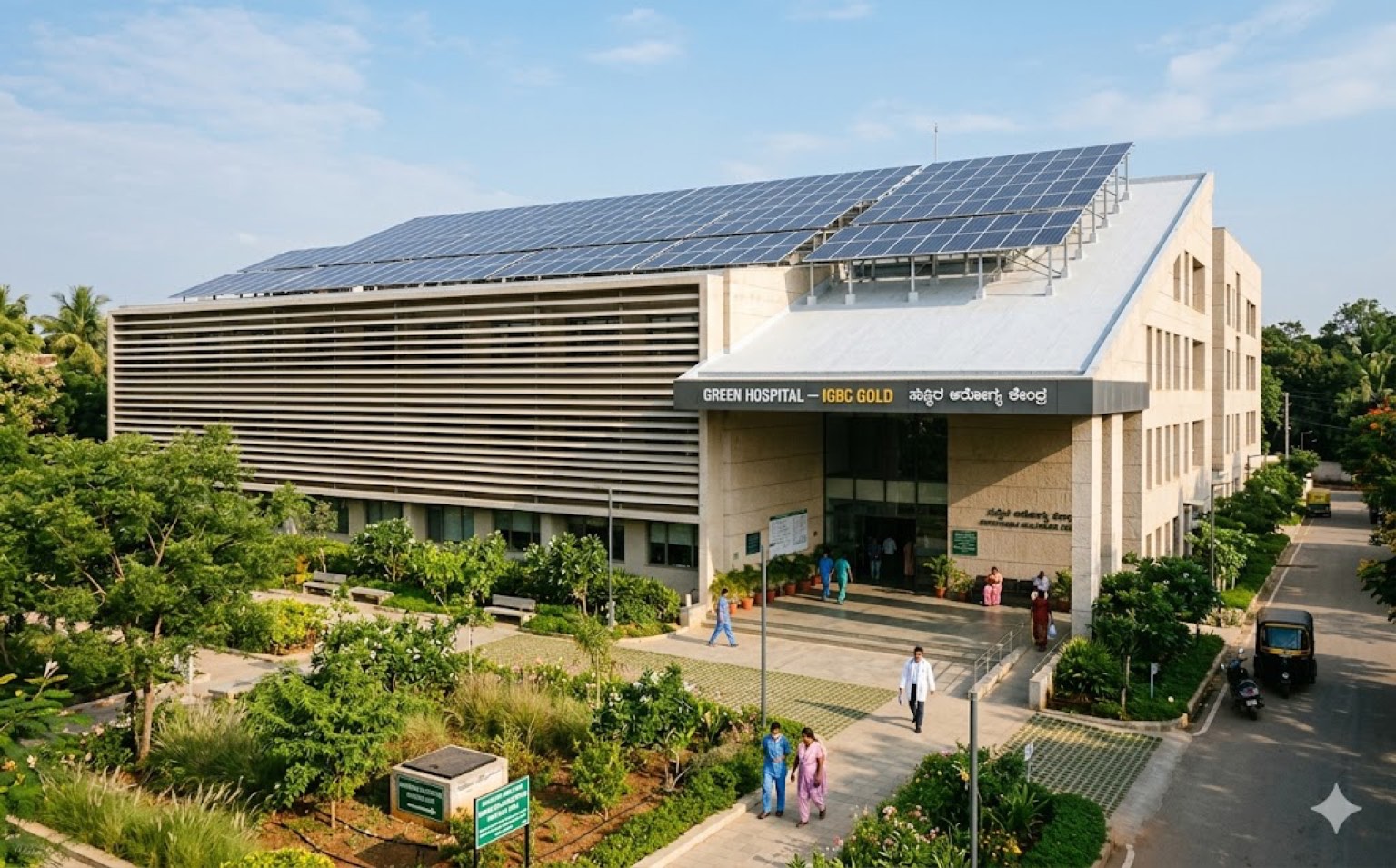
Sustainable Healthcare Buildings — IGBC, GRIHA, LEED, ECBC
An Architect's Working Reference — Indian Green Healthcare Rating Frameworks, Energy Benchmarking (kWh/bed/yr), Water Benchmarking, Embodied Carbon, ECBC Compliance, Operational Decarbonisation, Renewable Energy, WELL Certification, and the Sustainable Healthcare Toolkit
Healthcare buildings consume approximately 2–4 times the energy per square metre of typical office buildings, due to 24×7 operation, conditioned air requirements, sterilisation steam, hot-water demand, and intensive medical equipment. They also generate measurable environmental impact through bio-medical waste, pharmaceutical effluent, and embodied carbon in materials. As Indian healthcare expands at 12–15% per year, sustainable healthcare design has shifted from optional aspiration to operational necessity — driven by capex-cost cooling and electrical loads, opex-cost energy bills, regulator pressure on water and effluent, and patient expectations of green-rated facilities.
This guide is the eleventh in the design-focused series. It assumes the reader has read the pillar regulatory reference, the regulatory deep-dives, and the preceding design articles. The guide covers the four major sustainability rating frameworks that apply to Indian healthcare; provides energy and water benchmarking; addresses embodied-carbon decisions; and ends with the architect's working toolkit for sustainable healthcare.
Sustainability in Indian healthcare is not primarily about achieving a rating certificate. It is about reducing operational cost, improving resilience to grid and water unreliability, lowering embodied carbon, and (where possible) tracking toward net-zero operations. The rating frameworks (IGBC, GRIHA, LEED, WELL) are useful structures for organising the work, but the underlying decisions — passive design, envelope performance, HVAC efficiency, water recycling, renewable energy — matter regardless of certification.
"A green hospital is not the same as a luxurious hospital. It is, increasingly, the only hospital that can afford to operate. Energy and water are not free." — Pradeep Sachdeva, architect, paraphrased from IGBC conference 2019
"The most sustainable healthcare investment is the one that reduces carbon today and prepares the building for net-zero tomorrow. The buildings we are commissioning now will outlive several rounds of regulatory tightening." — Dr. Roopa Malhotra, sustainability researcher, paraphrased
1. The Four Major Rating Frameworks
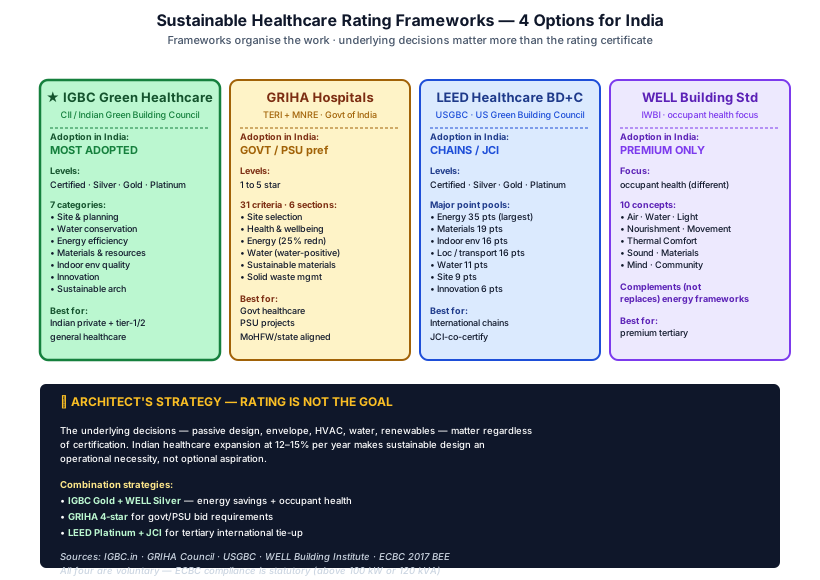
| Framework | Origin | Indian Healthcare Application |
|---|---|---|
| IGBC Green Healthcare | Indian Green Building Council (IGBC), CII | Most adopted in India for healthcare |
| GRIHA Hospitals | TERI / MNRE — Government of India | Government and PSU healthcare projects |
| LEED Healthcare BD+C | USGBC (US Green Building Council) | International private hospital chains |
| WELL Building Standard | International WELL Building Institute | Premium healthcare; focus on occupant health |
IGBC Green Healthcare credit categories
| Category | Credits |
|---|---|
| Sustainable architecture & design | Site, water, energy, materials, indoor environment |
| Site selection & planning | Brownfield preference, transit access, heat-island reduction |
| Water conservation | Reduced water use, on-site treatment, reuse |
| Energy efficiency | Envelope, HVAC, lighting, renewables |
| Building materials & resources | Recycled, regional, certified materials |
| Indoor environmental quality | Daylight, ventilation, low-VOC, acoustics |
| Innovation & development | Project-specific innovations |
Rating levels: Certified, Silver, Gold, Platinum.
GRIHA criteria
GRIHA uses 31 criteria across 6 sections. Hospital adaptation includes climate-responsive envelope, 25% reduction in energy use, water-positive operation, BMW management.
LEED Healthcare BD+C v4
| Category | Points |
|---|---|
| Integrative process | 1 |
| Location & transportation | 16 |
| Sustainable sites | 9 |
| Water efficiency | 11 |
| Energy & atmosphere | 35 |
| Materials & resources | 19 |
| Indoor environmental quality | 16 |
| Innovation | 6 |
| Regional priority | 4 |
Levels: Certified, Silver, Gold, Platinum.
WELL Building Standard
WELL focuses on occupant health and well-being — different from energy-focused frameworks. Categories: Air, Water, Nourishment, Light, Movement, Thermal Comfort, Sound, Materials, Mind, Community.
2. Energy Benchmarking — kWh per Bed per Year
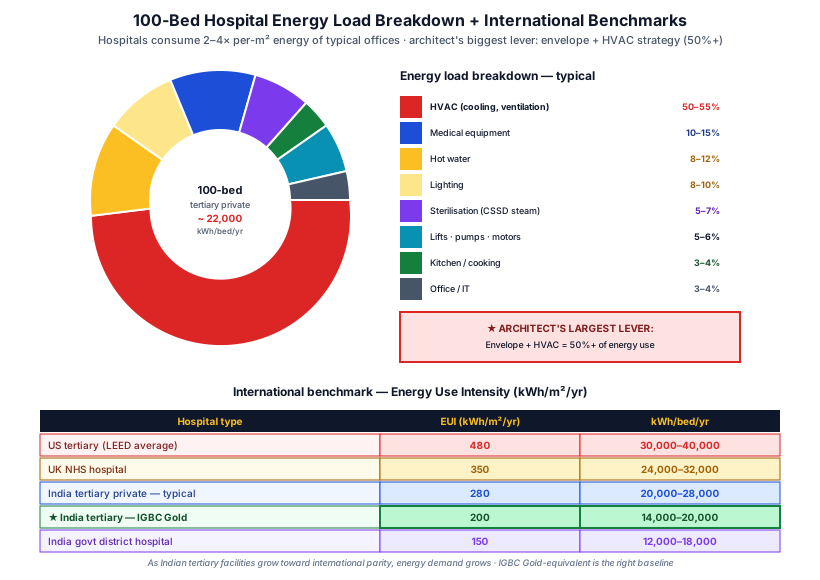
International benchmarks for hospital energy:
| Region / Type | Typical EUI (kWh/m²/yr) | kWh/bed/yr |
|---|---|---|
| US tertiary hospital (LEED average) | 480 | 30,000–40,000 |
| UK NHS hospital | 350 | 24,000–32,000 |
| Indian tertiary private — typical | 280 | 20,000–28,000 |
| Indian tertiary private — IGBC Gold | 200 | 14,000–20,000 |
| Indian tier-2 private | 200 | 18,000–24,000 |
| Indian government district hospital | 150 | 12,000–18,000 |
Indian hospitals run on lower benchmarks than international, partly due to less central HVAC, less imaging, and less operational intensity. As Indian tertiary facilities grow toward international parity, energy demand grows.
Energy load breakdown for typical 100-bed hospital
| End-use | % of Total | Architectural Influence |
|---|---|---|
| HVAC (cooling, ventilation) | 50–55% | Envelope, climate adaptation |
| Hot water | 8–12% | Solar thermal, heat pump |
| Lighting | 8–10% | LED, daylight |
| Medical equipment | 10–15% | Energy-efficient procurement |
| Sterilisation (CSSD steam) | 5–7% | Boiler efficiency, heat recovery |
| Cooking, kitchen | 3–4% | Induction, exhaust |
| Lifts, motors, pumps | 5–6% | VFDs, regenerative drives |
| Office / IT | 3–4% | Efficient equipment |
The architect's largest sustainability lever is the envelope and HVAC strategy — together 50%+ of energy.
3. Passive Design Strategies for Indian Climate
The cheapest energy is the energy not used. Passive design is climate-specific.
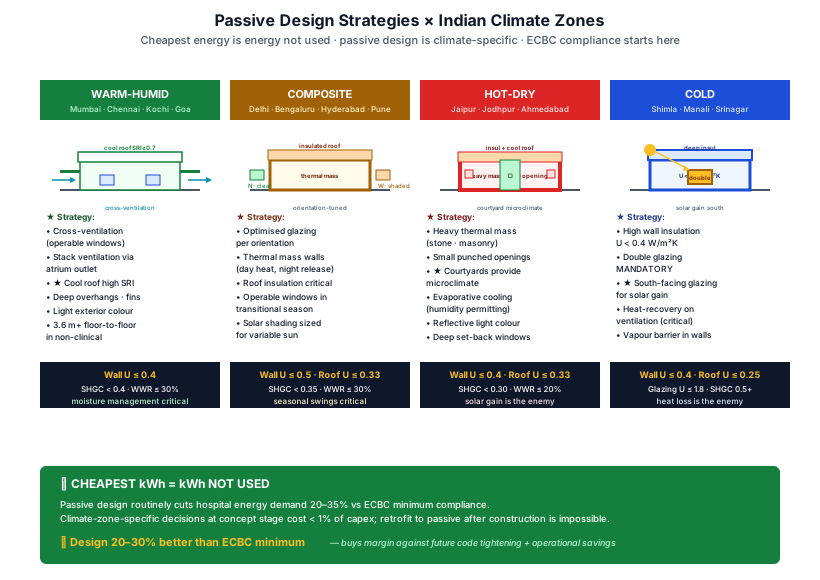
Warm-humid (Mumbai, Goa, Chennai, Kochi)
| Strategy | Application |
|---|---|
| Cross-ventilation in non-clinical | Operable windows in lobby, corridors, family lounges |
| Stack ventilation | Atrium with outlet at top |
| Cool roof | High-reflectivity roof; lowers heat gain |
| Shaded glazing | Deep overhangs, fins |
| Light coloured exterior | Reduces solar absorption |
| Higher floor-to-floor for cross-ventilation | 3.6 m+ in non-clinical |
Composite (Delhi, Bengaluru, Hyderabad)
| Strategy | Application |
|---|---|
| Optimised glazing per orientation | South + east heated; west + north shaded |
| Thermal mass | Heavy walls absorb day heat, release night |
| Insulation in roof | Critical in summer |
| Operable windows in transitional season | Spring, autumn natural ventilation |
| Solar shading | Sized for Bengaluru's variable sun |
Hot-dry (Jaipur, Ahmedabad)
| Strategy | Application |
|---|---|
| Heavy thermal mass | Stone, masonry walls |
| Small punched openings | Reduces solar gain |
| Courtyards | Provide microclimate |
| Evaporative cooling | Where humidity allows |
Cold (Shimla, Manali)
| Strategy | Application |
|---|---|
| High insulation | Wall U-value < 0.4 W/m²K |
| Double glazing | Mandatory |
| Solar gain | South-facing glazing |
| Heat recovery on ventilation | Critical |
4. Building Envelope and ECBC Compliance
ECBC 2017 (Energy Conservation Building Code) is the binding national framework for energy. Healthcare buildings ≥ 100 kW load fall under ECBC.
| Envelope Element | ECBC Compliance Requirement (warm-humid) |
|---|---|
| Wall U-value | ≤ 0.4 W/m²K (general); ≤ 0.55 (with insulation) |
| Roof U-value | ≤ 0.33 W/m²K |
| Glazing — VLT | 35–55% (visible light) |
| Glazing — SHGC | < 0.4 (reduces solar heat gain) |
| Glazing — U-value | ≤ 1.4 W/m²K (insulating) |
| Window-to-wall ratio (WWR) | ≤ 30% (recommended); ≤ 50% (allowable with shading) |
| Cool roof reflectance | ≥ 0.7 (Solar Reflectance Index) |
| Continuous insulation | Required; thermal-bridge analysis |
| Air-tightness | < 5 air changes/hr at 50 Pa |
| Skylight (daylighting) | Optional; SHGC ≤ 0.5 |
Wall and roof construction detailing
| Construction | Performance |
|---|---|
| Brick + plaster | U ≈ 1.0 W/m²K (uninsulated) — non-compliant |
| Brick + EPS insulation 50 mm + plaster | U ≈ 0.5 W/m²K — meets composite |
| AAC block + plaster | U ≈ 0.6 W/m²K — meets warm-humid |
| Light steel + insulation | U variable; sized per design |
| Concrete + EPS / mineral wool | U sized per insulation thickness |
| Roof — concrete + 75 mm EPS + waterproofing | U ≈ 0.3 W/m²K |
| Roof — concrete + green roof | U variable; 0.4 W/m²K typical |
The architect's deliverable is an envelope performance schedule showing each construction's U-value and SHGC against ECBC requirements.
5. HVAC Efficiency for Healthcare
| Efficiency Strategy | Saving Potential |
|---|---|
| Variable-speed (VFD) on chiller / pumps / fans | 20–40% |
| Heat recovery wheels (DOAS) | 15–25% |
| Variable air volume (VAV) where appropriate | 10–20% |
| Demand-controlled ventilation (DCV) — non-clinical only | 10–15% |
| Free cooling in temperate climate | 5–15% |
| High-efficiency chiller (kW/TR < 0.6) | 15–25% |
| Heat recovery from chiller condensate to hot water | 20–30% on hot water |
| Air-cooled vs water-cooled trade-off | Climate-dependent |
| Right-sized equipment | Proper sizing avoids partial-load inefficiency |
| Continuous commissioning | 5–10% via tuning |
6. Lighting and Daylighting
| Strategy | Application |
|---|---|
| LED throughout | 40–60% saving over fluorescent |
| Lighting power density (LPD) | Per ECBC: ≤ 9 W/m² (general clinical); ≤ 14 W/m² (OT) |
| Daylight harvesting | Sensor-controlled dimming near windows |
| Occupancy sensors | Non-clinical zones |
| Task lighting | Lower ambient; higher task |
| Circadian / dimmable | Patient-room comfort |
| Patient-controlled lighting | Higher satisfaction; per IPD room |
7. Water — Benchmark and Strategy
| Water Stream | Reduction Strategy |
|---|---|
| Patient bathing | Low-flow fixtures (6 L/min showerheads) |
| Toilet flushing | Dual-flush 3/6 L; sensor where appropriate |
| Cooling tower | Drift eliminator; closed-loop where possible |
| HVAC make-up | Recovery from condensate |
| Laundry | Heat recovery; reuse of rinse water |
| Kitchen | Greywater capture (where regulated permits) |
| Landscape | Drip irrigation; native species; treated STP water |
| Toilet flushing reuse | STP-treated water; recommended |
Water benchmarking
| Hospital Type | Typical (litres/bed/day) | Best-Practice (IGBC Gold) |
|---|---|---|
| Tertiary private | 600–800 | 350–500 |
| Mid-tier private | 500–700 | 300–450 |
| Government district | 400–600 | 250–400 |
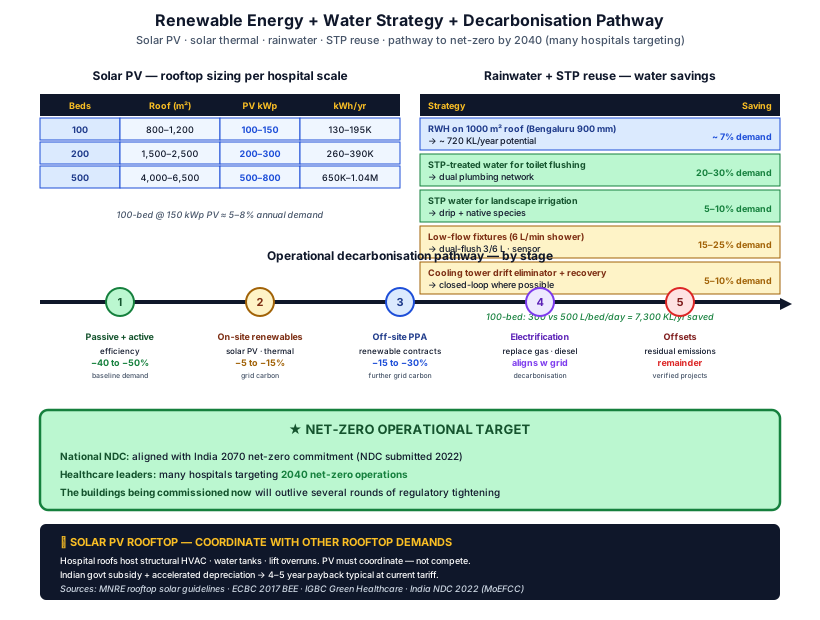
A 100-bed hospital saving 200 L/bed/day (300 → 500) saves 7,300 KL/yr — significant in water-scarce locations.
Rainwater harvesting
| Element | Specification |
|---|---|
| Roof catchment | 80% effective area |
| First flush diverter | 1–2 mm of rainfall diverted |
| Filtration | Sand, gravel, charcoal |
| Storage | Underground tank, sized per regional rainfall |
| Recharge well | If groundwater recharge is mandate |
| Reuse | Toilet flushing, landscape, cooling-tower make-up |
For Bangalore (annual 900 mm rainfall) on 1000 m² roof: ~ 720 KL/year potential, offsetting ~ 7% of hospital water demand.
8. Renewable Energy
| Source | Hospital Application | Notes |
|---|---|---|
| Solar PV (rooftop) | Lighting, computers, non-critical | Indian govt subsidy; 4–5 yr payback typical |
| Solar PV (off-grid in remote) | Backup + primary | High capex; reliability driver |
| Solar thermal (water heating) | Hot water for baths, kitchen | 30–50% of hot water demand |
| Solar thermal (cooling) | Absorption chillers | Niche; high capex |
| Biogas (kitchen waste) | Cooking gas; small scale | Where waste volume justifies |
| Wind | Limited; site-specific | Coastal / hill sites |
| Geothermal | Pre-heat / pre-cool ventilation | Niche; high capex |
| Co-generation (CHP) | Heat + power; large hospitals | Mid-size and above |
Solar PV on Indian hospitals
| Hospital Size | Typical Rooftop Area | PV Capacity | Annual Generation |
|---|---|---|---|
| 100-bed | 800–1,200 m² | 100–150 kWp | 130,000–195,000 kWh |
| 200-bed | 1,500–2,500 m² | 200–300 kWp | 260,000–390,000 kWh |
| 500-bed | 4,000–6,500 m² | 500–800 kWp | 650,000–1,040,000 kWh |
For a 100-bed hospital with 150 kWp PV, ~5–8% of annual energy demand can be met. Hospital roofs typically host structural HVAC, water tanks, and lift overruns; PV must coordinate with these.
9. Embodied Carbon
Embodied carbon is the carbon emitted in extracting, manufacturing, transporting, and installing building materials. For Indian healthcare, embodied carbon is often 30–40% of lifetime carbon of the building.
High-embodied-carbon decisions
| Decision | High Embodied Carbon | Lower Carbon Alternative |
|---|---|---|
| Structure | Concrete + steel | Brick + concrete (smaller spans) or recycled steel |
| Cladding | Aluminium curtain wall | Local stone or brick |
| Insulation | EPS / XPS | Mineral wool, cellulose, hemp (warm climates) |
| Glazing | Imported low-E | Local clear + external shading |
| Finishes | Imported tiles, marble | Local terrazzo, Indian stone |
| MEP | Long-distance imports | Domestic supply where possible |
The architect's deliverable: an embodied-carbon estimate in the design report, with reduction strategies. For tertiary projects, an LCA (life-cycle assessment) increasingly forms part of the LEED Platinum or IGBC Platinum submission.
10. Operational Decarbonisation Pathway
| Stage | Strategy |
|---|---|
| Energy efficiency (passive + active) | Reduces baseline demand by 40–50% |
| On-site renewables | Reduces grid carbon by 5–15% |
| Off-site renewable PPA | Reduces grid carbon further |
| Electrification (replace gas, diesel) | Aligns with grid decarbonisation |
| Electric vehicle charging | Aligns with patient transport |
| Carbon offsets | For residual emissions |
| Net-zero operational target | Aligned with national NDC by 2070; many hospitals targeting 2040 |
11. Common Sustainability Implementation Gaps
| # | Gap | Mitigation |
|---|---|---|
| 1 | Envelope U-value designed at minimum, not optimum | Design 20–30% better than ECBC |
| 2 | Glazing without solar control | External shading; SHGC < 0.4 |
| 3 | HVAC oversized for capex | Right-sizing; VFD |
| 4 | LED retrofit not specified | LED throughout from day one |
| 5 | Solar PV planned but not installed | Include in commissioning |
| 6 | Rainwater harvesting absent | Mandate by state; design at concept |
| 7 | STP water reuse for flushing absent | Plumbing dual-network |
| 8 | High-VOC paint specified | Low-VOC, antimicrobial |
| 9 | Imported materials over local | Regional preference |
| 10 | No commissioning plan | 5–10% energy saving from commissioning |
| 11 | No occupant feedback / POE | Continuous improvement basis |
| 12 | No energy benchmarking | Annual EUI tracking |
| 13 | DG run continuously instead of grid | Grid-priority operation |
| 14 | Cooling tower water without drift eliminator | Mandatory in IGBC/GRIHA |
| 15 | No WELL features (occupant health) | Increasingly expected in tertiary |
12. Architect's Sustainable Healthcare Toolkit
| # | Step | Output |
|---|---|---|
| 1 | Sustainability target — IGBC Silver/Gold/Platinum or LEED equivalent | Sustainability brief |
| 2 | Climate adaptation strategy | Passive design |
| 3 | Envelope performance — U-value, SHGC, WWR | Envelope schedule |
| 4 | HVAC efficiency strategy — VFD, heat recovery, VAV | HVAC scheme |
| 5 | Lighting — LED, daylight harvesting, sensors | Lighting scheme |
| 6 | Water — low-flow fixtures, rainwater, STP reuse | Water scheme |
| 7 | Solar PV sized to roof potential | PV plan |
| 8 | Solar thermal for hot water | Solar thermal plan |
| 9 | Embodied carbon assessment | LCA report |
| 10 | Materials — local, low-VOC, certified | Material spec |
| 11 | IGBC / GRIHA / LEED submission | Documentation |
| 12 | Commissioning + post-occupancy | Operational plan |
| 13 | Annual EUI benchmarking | Tracking system |
| 14 | Net-zero pathway (where feasible) | Future-proofing |
References
- Bureau of Energy Efficiency (2017) Energy Conservation Building Code 2017. New Delhi: Ministry of Power.
- Bureau of Indian Standards (2016) National Building Code of India 2016, Part 11 — Approach to Sustainability. New Delhi: BIS.
- IGBC (2014) IGBC Green Healthcare Rating System. Hyderabad: Indian Green Building Council, CII.
- IGBC (2018) IGBC Green Building Rating System: New Buildings v3.0. Hyderabad: IGBC.
- GRIHA Council (2014) GRIHA for Hospitals. New Delhi: TERI / MNRE.
- Government of India (2015) Nationally Determined Contribution under the Paris Agreement. New Delhi: MoEFCC.
- Lockwood, C. (2016) 'The case for green hospitals', HERD, 9(2), pp. 9–14.
- Manu, S., Shukla, Y., Rawal, R., Thomas, L.E. and de Dear, R. (2016) 'India Model for Adaptive Comfort (IMAC)', Building and Environment, 98, pp. 55–70.
- McLennan, J.F. (2008) The Living Building Challenge. Bainbridge Island: International Living Future Institute.
- Ministry of New and Renewable Energy (MNRE) (2022) Solar Energy in Healthcare. New Delhi: MNRE.
- Pati, D., Park, C.-S. and Augenbroe, G. (2010) 'Roles of building performance simulation in healthcare facility design', HERD, 4(1), pp. 86–102.
- Pelletier, K.R. (2010) 'Healing buildings — Healing the planet', Reviews on Environmental Health, 25(4), pp. 313–324.
- Roaf, S., Crichton, D. and Nicol, F. (2009) Adapting Buildings and Cities for Climate Change. 2nd edn. Oxford: Architectural Press.
- USGBC (2014) LEED v4 for Building Design and Construction — Healthcare. Washington: USGBC.
- WELL Building Institute (2020) WELL Building Standard v2. New York: IWBI.
- World Green Building Council (2019) Health and Wellbeing in Homes. London: WGBC.
Author's Note: Sustainable healthcare design is no longer a special-case discipline; it is the baseline expectation for new healthcare construction in India. The frameworks (IGBC, GRIHA, LEED, WELL) are useful for organising the work, but the underlying decisions — passive design, envelope, HVAC efficiency, water recycling, renewables — matter regardless of certification. The architect's role is to make the case for sustainability at the brief stage and translate it into specifications. The final guide in this series covers the business of healthcare commissions — fees, BOQ, project management, client relationships.
Disclaimer: This article is for informational and educational purposes only and does not constitute professional architectural, sustainability, or financial advice. Sustainability decisions depend on specific project parameters and rating-framework dynamics that must be assessed project-by-project. Studio Matrx, its authors, and contributors accept no liability for decisions made on the basis of the information in this guide.
Interactive · IGBC Green Healthcare scorer
26 / 100 points · Below certified
Site planning
8/16
Energy efficiency
4/28
Water conservation
4/16
Materials & resources
4/16
Indoor environment
6/16
Innovation
0/6
Site planning (16 pts available)
Energy efficiency (28 pts available)
Water conservation (16 pts available)
Materials & resources (16 pts available)
Indoor environment (16 pts available)
Innovation (6 pts available)
Certification thresholds
Certified
51-60 pts
Silver
61-70 pts
Gold
71-80 pts
Platinum
81+ pts
IGBC Green Healthcare rating (similar to LEED for Healthcare). Real point values vary by version; this widget uses the IGBC New-Hospital pilot scoring framework as a teaching reference.
Export this guide
Related Guides — Deep-dive reading
Designing a Naturally Energy-Efficient Indian Home
Comfort first, gadgets last — passive design, orientation, insulation, ventilation and the climate wisdom that cuts Indian energy bills
SustainabilityEnergy-Efficient Facades in India: How the Building Skin Cuts Your Cooling, Heating & Lighting Bills
How a building facade drives cooling, heating and lighting energy in India, the three levers of solar-heat-gain control, insulation and daylighting, U-value, SHGC, VLT and WWR in plain terms, ECBC and Eco-Niwas expectations, and real Indian green buildings.
Building FacadesGRIHA & IGBC Water-Efficient Bathroom India: How Bathrooms Earn Green-Building Credits
A professional's reference to how the bathroom earns points under India's two national green-building rating systems — IGBC (Green Homes / Green New Buildings) and GRIHA — through water-efficient fixtures, low-flow flush and flow-rate caps, metering, greywater and rainwater reuse, and low-VOC indoor-environment credits, and how to target them.
BathroomsRelated Tools — Try Free
Cross-Ventilation Analyzer
Estimate airflow and air changes per hour (ACH) from room size, window areas, layout, and local wind — with NBC 2016 Part 8 compliance check.
Ventilation CalculatorRainwater Tank Sizer
How big should your rainwater tank be? Computes annual harvest, recommended tank capacity in litres, water-bill savings, and payback — for 10 Indian cities.
RWH CalculatorBrise-Soleil Visualizer
Interactive horizontal-louvre cut-off angle calculator — sun altitude, louvre depth, and spacing inputs with a live shadow preview. Computes θ = arctan(spacing/depth) for façade shading, ECBC envelope compliance, hospital daylight design, and tropical sun-control detailing.
Sun Shading Tool