
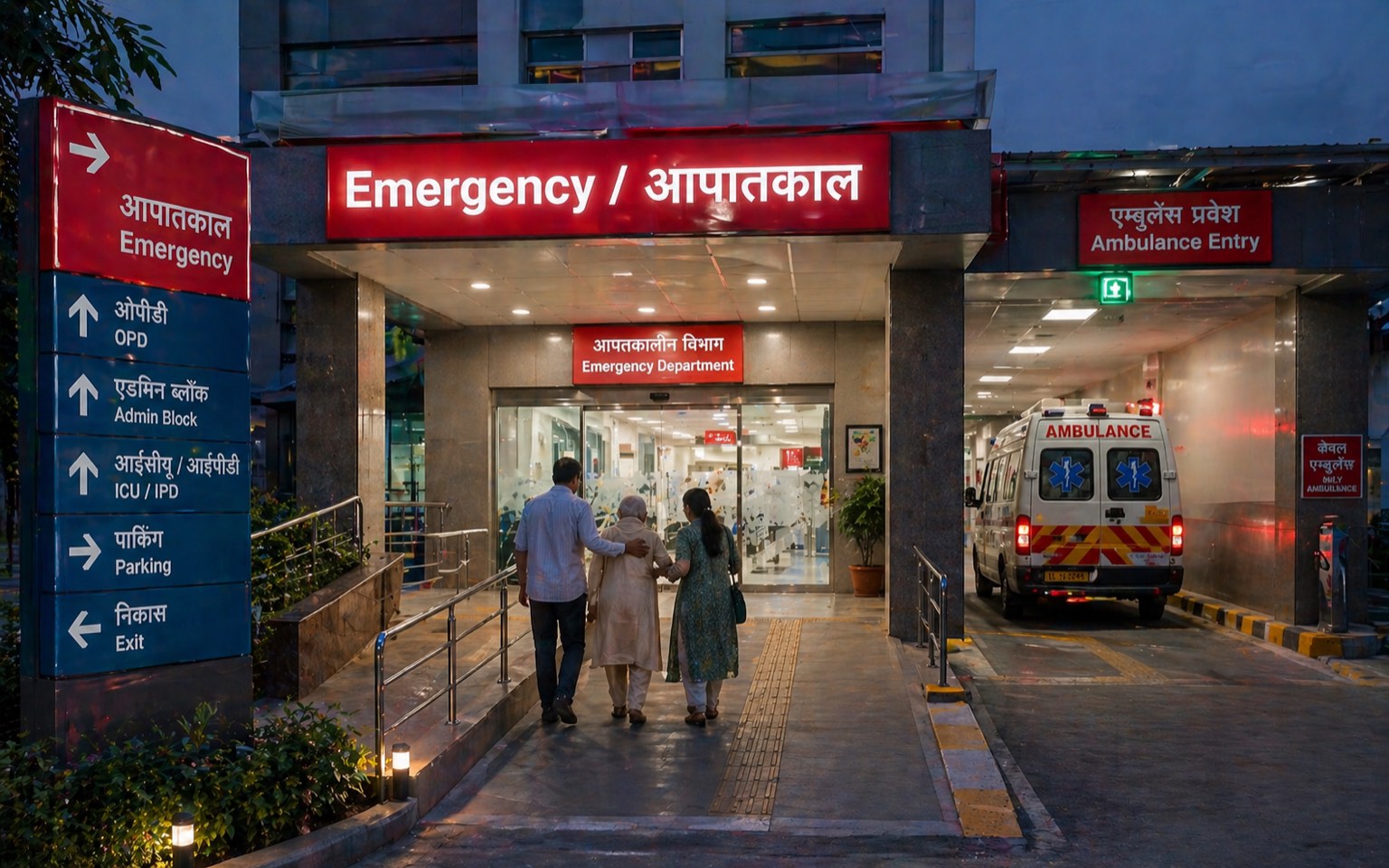
Emergency Department & Healthcare Wayfinding in India
An Architect's Working Reference — ED Triage Flow, Ambulance/Walk-in/Clinical Separation, Resuscitation Bay, Trauma Stream, Bilingual Wayfinding, Tactile and Braille, Colour-Coded Zoning, Indian-Context Signage, and the ED + Wayfinding Architectural Toolkit
The emergency department and the hospital's wayfinding system are two architectural problems that share a common premise: the patient or visitor is in distress, time-pressured, and frequently first-time. Both must be designed for the worst-case user — the trauma patient arriving by ambulance unconscious, the rural family arriving with a non-English-speaking elderly relative, the visitor looking for a ward at midnight while crying. The architectural standard is not "the average patient can find their way"; it is "the most stressed user, with the lowest literacy, in the worst light, can find their way safely."
This guide is the fourth in the design-focused series. It assumes the reader has read the pillar regulatory reference, the regulatory deep-dives, and the preceding design-series articles on clinical adjacencies, OT suite design, and ICU/NICU/PICU design. The guide is structured in two halves — emergency department design first, then wayfinding — because in practice they are designed together: the ED's signage, lighting, and visibility integrate with the building's wayfinding system from the entry forecourt onward.
"In an emergency department, the architecture is not background. It is the first responder. Before the doctor arrives, the building has already done much of the triage." — Dr. Peter Cameron, emergency physician, paraphrased from a 2015 Australian Emergency Medicine Foundation lecture
"You design wayfinding for the patient who has not slept, who does not read English, who is in pain, and who is alone. If they can find their way, everyone else also can." — Anonymous senior healthcare architect, paraphrased from a private interview
1. The Emergency Department — A Distinct Architectural Problem
The ED is unlike other clinical departments. Its operational profile demands specific architectural responses.
| ED Operational Feature | Architectural Implication |
|---|---|
| 24×7 operation; peak unpredictable | Distributed staffing space; flexible bed allocation |
| Mixed acuity: trauma to non-urgent | Streaming by severity; physical separation |
| Family accompaniment culture (India) | Larger waiting; visitor amenities |
| Imaging-dependent triage | ED–imaging direct adjacency |
| Trauma cases — life-saving in first hour | Resuscitation bay near entry; OT/ICU direct route |
| Non-ambulatory arrival | Stretcher-compatible doors and corridors |
| Verbal / language barriers | Multi-lingual signage; pictograms |
| Mass-casualty surge capability | Decanting space; convertible areas |
| Forensic / police interface | Police room; chain of custody for samples |
| Public-health surveillance | Notifiable disease reporting infrastructure |
| Aggressive / agitated patients | Security; safe rooms; restraint protocols |
A 100-bed hospital's ED typically processes 100–200 patients per day; a 500-bed tertiary, 400–800. The architectural footprint scales with this throughput.
2. The Triage System — ESI, Manchester, and Indian Adaptations
International EDs operate under one of three triage frameworks; Indian EDs typically adopt or adapt one.
| Framework | Origin | Categories | Used In |
|---|---|---|---|
| ESI (Emergency Severity Index) | USA (5-level) | 1: Resuscitation · 2: Emergent · 3: Urgent · 4: Less urgent · 5: Non-urgent | US, increasingly Indian tertiary |
| MTS (Manchester Triage System) | UK (5-level) | 1: Immediate · 2: Very urgent · 3: Urgent · 4: Standard · 5: Non-urgent | UK, EU, parts of India |
| CTAS (Canadian) | Canada (5-level) | I–V | Canada |
| AIIMS Triage | India-adapted | Red/Yellow/Green colour-coded | AIIMS, several govt hospitals |
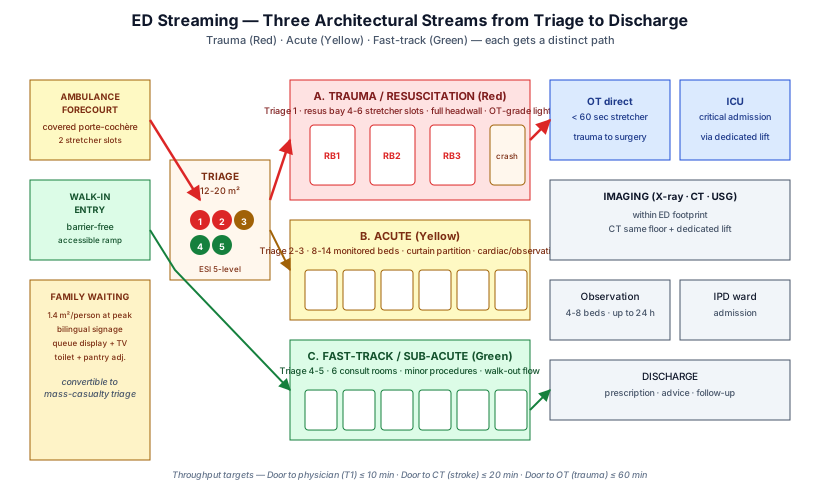
Architectural translation of triage: the ED plan must allow physical separation by triage level. A red (level 1) patient goes directly to resuscitation; a yellow (level 2/3) to acute beds; a green (level 4/5) to fast-track. The architect provides distinct paths for each.
3. ED Streaming — Three or Four Architectural Streams
Modern ED design provides physically distinct streams that minimise cross-traffic and maximise throughput.
| Stream | Acuity | Architectural Provision |
|---|---|---|
| Trauma / Resuscitation | Triage 1 (red) | Resuscitation bay 4–6 stretcher slots; OT/ICU direct route; imaging direct |
| Acute | Triage 2–3 (yellow) | Acute bed module 8–14 beds; monitored; cardiac/observation |
| Sub-acute / Fast-track | Triage 4–5 (green) | Walk-in beds; consultation rooms; minor procedures |
| Observation / Holding | Decision-pending | 4–8 beds; up to 24-hour stay |
| Paediatric stream (if separate) | All ages | Distinct entry; child-friendly waiting |
| Obstetric stream (if separate) | Pregnant women | Direct route to labour/delivery; preserves dignity |
| Psychiatric / Behavioural | Mental health emergency | Safe rooms with reduced ligature; observation |
A 100-bed hospital's ED typically operates with trauma + acute + fast-track streams (3-stream); a tertiary 500-bed adds paediatric, obstetric, and psychiatric streams (6-stream).
4. ED Physical Layout — Architectural Specifications
| Element | Specification |
|---|---|
| Total ED area | 100-bed hospital: 250–350 m²; 200-bed: 400–550 m²; 500-bed: 700–900 m² |
| Ambulance entry / forecourt | Covered porte-cochère; minimum 2 ambulance stretcher slots; turning circle 4.5 m radius; weather-protected |
| Walk-in entry | Separate from ambulance; barrier-free; accessible ramp |
| Triage area | 12–20 m²; positioned at entry; visual control of waiting; nurses' station with screen |
| Waiting area | 1.4 m²/person at peak; bilingual signage; TV/queue display; pantry; toilet adjacent |
| Resuscitation bay | 25–35 m² (single bay); 4 bays for tertiary; full headwall; ceiling lights; defibrillator |
| Acute beds | 9–12 m²/bed; curtain or partition; headwall; monitor mount |
| Fast-track / consultation | 9–12 m²/room; couch + chair; less monitoring |
| Observation beds | 9–12 m²/bed; reclining chairs or beds; 24-hour stay capable |
| Procedures room | 12–18 m²; minor surgery, suturing, plaster |
| ED OT (optional) | 18–25 m²; minor surgical capability; lower spec than main OT |
| Imaging — adjacent | X-ray/USG within ED footprint; CT 1-floor adjacent; dedicated lift |
| Lab — adjacent | Sample reception within ED; STAT processing |
| Pharmacy — emergency | 9 m²; STAT dispensing; 24×7; locked narcotic |
| Mortuary access | Direct route from ED to mortuary, service-side |
| Police / forensic room | 9–12 m²; for medico-legal cases; chain of custody |
| Family room / counselling | 9–12 m²; for breaking bad news |
| Staff areas | Doctor's room, nurses' lounge, change, pantry |
| Decontamination room | 9–12 m²; for chemical / biological exposure (tertiary) |
| Mass-casualty triage area | Convertible; lobby/waiting becomes triage |
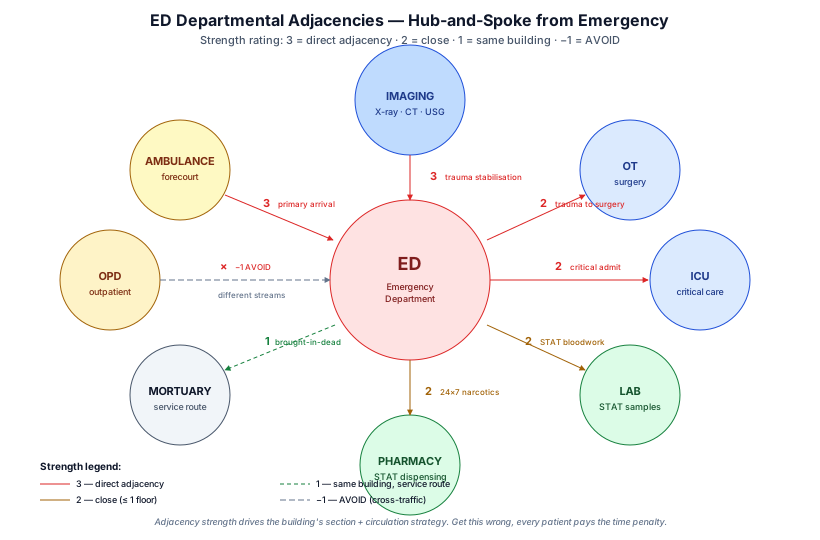
Key adjacency rules for ED:
| Adjacency | Strength | Reason |
|---|---|---|
| ED ↔ Imaging (X-ray/CT) | 3 (direct) | Trauma stabilisation |
| ED ↔ OT | 2 (close) | Trauma to surgery within minutes |
| ED ↔ ICU | 2 (close) | Critical patient transfer |
| ED ↔ Lab | 2 (close) | STAT samples |
| ED ↔ Pharmacy | 2 (close) | Emergency dispensing |
| ED ↔ Mortuary | 1 (same building, service route) | Brought-in-dead, traumatic deaths |
| ED ↔ OPD | −1 (avoid) | Different patient streams |
5. The Resuscitation Bay — ED Architectural Heart
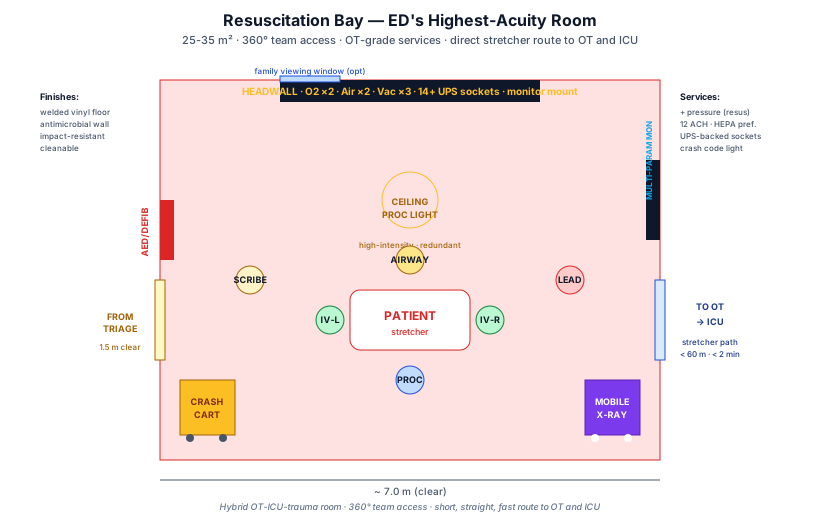
| Resuscitation Bay Element | Specification |
|---|---|
| Area | 25–35 m² for single bay; 14–18 m² per bay if multi-bay |
| Headwall | O2 ×2, Air ×2, Vacuum ×3, suction; UPS-backed power 14+ outlets |
| Ceiling-mounted procedure light | Yes; high-intensity, redundant |
| Defibrillator | Wall-mounted; AED + manual |
| Crash cart | Mobile within bay |
| Imaging integration | Mobile X-ray immediately accessible; mobile USG; some EDs have C-arm |
| Patient monitor | Multi-parameter at headwall |
| Floor finish | Welded vinyl; impact-resistant; cleanable |
| Wall finish | Antimicrobial; impact-resistant |
| Door | Wide (1.5 m clear); for stretcher and team |
| Family viewing | Glazed window optional; with privacy screen |
| Staff access | From multiple sides for resuscitation team |
| Direct route to OT / ICU | Stretcher path < 60 m, < 2 minutes |
The resuscitation bay is the highest-acuity room in the hospital. Architecturally it is a hybrid OT-ICU-trauma room. Specification matches the major OT in services (gases, lighting, structural for ceiling equipment), with the additional requirement of multi-side access for the resuscitation team.
6. ED Throughput — The Architectural Performance Metric
Modern ED design has a quantifiable performance metric: throughput. A well-designed ED targets:
| Metric | Target |
|---|---|
| Door-to-physician time (triage 1) | ≤ 10 minutes |
| Door-to-CT time (suspected stroke) | ≤ 20 minutes |
| Door-to-OT time (trauma) | ≤ 60 minutes |
| Door-to-discharge / admission decision | ≤ 4 hours |
| Mean ED length-of-stay (admitted) | ≤ 6 hours |
| Mean ED length-of-stay (discharged) | ≤ 3 hours |
The architecture either supports or sabotages these metrics. Time consumed walking from triage to imaging is time consumed regardless of clinical efficiency. The architect's plan optimises for these movements.
7. Wayfinding — The Architectural Discipline
Wayfinding is the cognitive process by which a person finds their way through a building. Hospital wayfinding is the most consequential wayfinding context — high stakes, high stress, low patient familiarity, often poor literacy or low English proficiency, frequent visual / cognitive impairment.
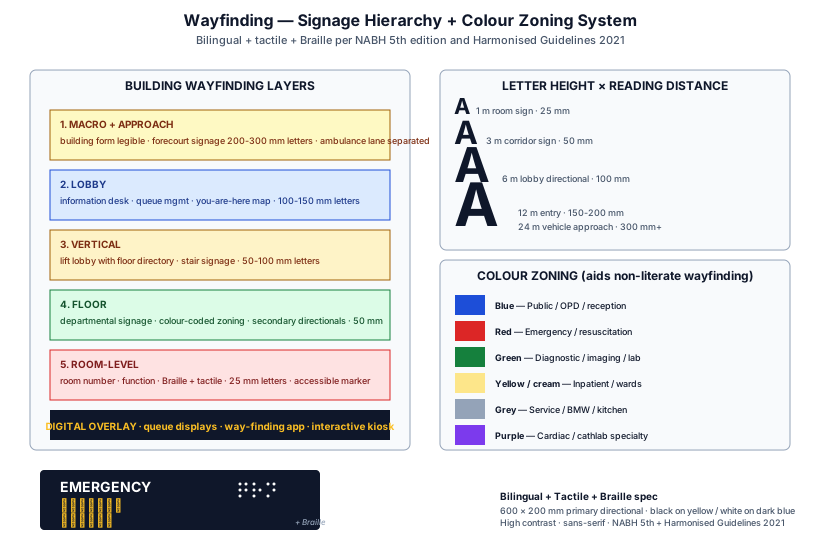
| Wayfinding Layer | Architectural Mechanism |
|---|---|
| Macro | Building form makes its function legible — entries clearly visible from street |
| Approach | Forecourt, signage, ambulance lane separated, reception clearly marked |
| Lobby | Information desk, queue management, primary directional signage, accessible reception |
| Vertical | Lift lobby with floor directory, stair signage |
| Floor | Departmental signage, colour-coded zoning, secondary directionals |
| Room-level | Room number, function, name, accessibility marker |
| Tactile / Braille | At critical decision points, vertical circulation, room signs |
| Digital | Queue displays, way-finding apps, interactive directories |
The wayfinding system is designed as a single coherent strategy from concept stage. Retrofit wayfinding is invariably inconsistent and is flagged at NABH assessment.
8. The Bilingual + Tactile + Braille System
Indian healthcare wayfinding is bilingual at minimum (state language + English) and trilingual where Hindi adds (state language + Hindi + English). Tactile and Braille are statutory under the Harmonised Guidelines 2021 and NABH 5th edition.
Signage hierarchy
| Sign Type | Specification | Location |
|---|---|---|
| Primary directional | 600 × 200 mm minimum; bilingual / trilingual; high contrast (black on yellow / white on dark blue); height 2.0–2.4 m | Entry, lobby, junctions, lift lobbies |
| Secondary directional | 400 × 150 mm; bilingual; height 1.8–2.2 m | Floor corridors, cross-corridors |
| Departmental sign | 500 × 250 mm; bilingual + pictogram | Department entry |
| Room signage | 200 × 150 mm; bilingual + Braille + tactile | Each room door |
| Accessibility sign | International symbol of accessibility + language | Accessible toilets, lifts, parking |
| Safety / warning | Yellow on black; bilingual | Hazard zones, fire exits |
| You-are-here map | Floor-by-floor; multi-lingual; Braille at base | Lobby, lift lobby |
| Emergency exit | NBC-compliant; illuminated; bilingual | Per fire scheme |
Letter heights (NABH + Harmonised Guidelines)
| Reading Distance | Minimum Letter Height |
|---|---|
| 1 m (room sign) | 25 mm |
| 3 m (corridor sign) | 50 mm |
| 6 m (lobby directional) | 100 mm |
| 12 m (entry / external) | 150–200 mm |
| 24 m (vehicle approach) | 300 mm+ |
Colour coding
A consistent colour-zone system aids non-literate wayfinding:
| Zone | Colour | Application |
|---|---|---|
| Public / OPD | Blue | Reception, OPD waiting, registration |
| Emergency | Red | ED entry, resuscitation, urgency |
| Diagnostic | Green | Imaging, lab, pathology |
| Inpatient | Warm yellow / cream | Wards, IPD floors |
| Service | Grey | Service corridor, BMW, kitchen |
| Specialty (cardiac) | Purple | Cardiac IPD, cathlab (optional) |
| Paediatric | Bright multi-colour | Children's areas |
9. Pictograms and Indian-Context Wayfinding
Pictograms cross language barriers. The architect's signage system includes a pictogram library — combined with text labels for those who can read.
| Pictogram | Common Use |
|---|---|
| Stretcher with cross | Emergency / Casualty |
| Stethoscope | Consultation / OPD |
| Magnifying glass on slide | Lab / pathology |
| X-ray bones | Radiology / imaging |
| Pill bottle | Pharmacy |
| Plate / cutlery | Cafeteria / dining |
| Bed | IPD / ward |
| Heart | Cardiac specialty |
| Baby | NICU / paediatric / obstetric |
| Wheelchair | Accessibility / accessible toilet |
| Praying hands | Prayer room |
| Flame on cross | Mortuary (sensitive — use respectfully) |
| Phone | Reception / information |
| Restroom symbols | Toilets (gendered + accessible) |
Indian-context additions:
- Religious-symbol respect: mortuary signage avoids overt religious symbols; uses neutral icon
- Bilingual gender symbols in toilets — the international male/female icon supplemented with state language
- Paediatric warmth — playful colour palette; cartoon-style icons appropriate for children
- Multi-faith prayer room signage — universal "prayer/meditation" icon, multi-language text
10. The Universal-Design Wayfinding Stack
A hospital that meets full Harmonised Guidelines 2021 wayfinding compliance has the following at every critical decision point:
1. Visual — high-contrast text, large letters, bilingual
2. Tactile — raised letters at room signs (1.5 mm)
3. Braille — at room signs and lift buttons
4. Audio — voice announcement at lifts ("Floor 3 — Cardiology")
5. Pictogram — universal icon
6. Colour — zone colour
7. Floor markings — tactile guidance path from entry to lift, lift to wards
8. Lighting — illuminated signage at low-light areas; emergency illuminated exit
9. Wayfinding app (optional) — QR-based smartphone navigation
A signage strategy that includes only 1, 5, and 6 is the most common Indian implementation; full universal-design stack 1-9 is rare but is the NABH 5th edition + Harmonised 2021 expectation for new tertiary projects.
11. Common ED + Wayfinding Failure Modes
| # | Failure | Prevention |
|---|---|---|
| 1 | Single ED entry — ambulance and walk-in mixed | Separate ambulance entry; covered porte-cochère |
| 2 | Resuscitation bay not at ED entry | Resuscitation directly off ambulance |
| 3 | ED imaging on different floor | Imaging within ED footprint |
| 4 | OT route through public corridor | OT-direct route from resuscitation |
| 5 | ED waiting at < 1.4 m²/person | Per peak occupancy |
| 6 | No fast-track stream | Triage 4-5 stream physically separated |
| 7 | Police / forensic room absent | 9–12 m² for medico-legal |
| 8 | Family bad-news room absent | 9–12 m² counselling |
| 9 | No mass-casualty surge plan | Convertible space identified |
| 10 | Wayfinding signage retrofit | System designed at concept stage |
| 11 | Signage monolingual (English only) | Bilingual / trilingual + pictogram |
| 12 | Letter heights too small | Per reading distance |
| 13 | No tactile / Braille at critical points | Statutory under Harmonised 2021 |
| 14 | No colour-zone system | Zone colours assigned at concept |
| 15 | Mortuary signage with religious symbols | Neutral icon |
| 16 | No floor map / you-are-here | At lobby and lift lobby per floor |
| 17 | Lighting inadequate for signage at night | Illuminated signage in critical paths |
| 18 | Multi-faith prayer space missing | Required ≥ 100 beds |
12. The Architect's ED + Wayfinding Toolkit
| # | Step | Output |
|---|---|---|
| 1 | ED throughput target — patients/day, peak hour | ED brief |
| 2 | Triage framework (ESI / MTS / AIIMS) | Triage scheme |
| 3 | Stream count (3 / 4 / 6) | Stream layout |
| 4 | Ambulance entry + walk-in entry separation | Forecourt design |
| 5 | Resuscitation bay placement | Plan |
| 6 | ED–imaging–OT–ICU direct routes | Adjacency confirmed |
| 7 | Bed allocation across streams | Bed schedule |
| 8 | Family + police + counselling rooms | Auxiliary spaces |
| 9 | Wayfinding strategy from concept | Signage scheme |
| 10 | Bilingual + pictogram + tactile + Braille | Universal-design signage |
| 11 | Colour-zone system | Zone scheme |
| 12 | Letter heights, sign placement, illumination | Signage schedule |
| 13 | Floor maps + lift-lobby directories | Wayfinding deliverable |
| 14 | Mortuary access — service-side | Plan |
References
- Beebe, R. and Funk, D.L. (2001) 'Fundamentals of emergency department design', Journal of Emergency Medicine, 21(4), pp. 391–397.
- Cameron, P., Schull, M. and Cooke, M. (2011) 'A framework for measuring quality in the emergency department', Emergency Medicine Journal, 28(9), pp. 735–740.
- Christ, M., Grossmann, F., Winter, D., Bingisser, R. and Platz, E. (2010) 'Modern triage in the emergency department', Deutsches Ärzteblatt International, 107(50), pp. 892–898.
- Department of Empowerment of Persons with Disabilities (2021) Harmonised Guidelines and Standards for Universal Accessibility in India 2021. New Delhi: Government of India.
- Facility Guidelines Institute (2022) Guidelines for Design and Construction of Hospitals. St. Louis: FGI.
- Jensen, K. and Crane, J. (2008) 'Emergency department design: a guide to common pitfalls', American College of Emergency Physicians.
- Joseph, A. and Rashid, M. (2007) 'The architecture of safety: hospital design', Current Opinion in Critical Care, 13(6), pp. 714–719.
- Joshi, D.C. and Joshi, M. (2018) Hospital Administration. 2nd edn. New Delhi: Jaypee Brothers.
- Kobus, R.L., Skaggs, R.L., Bobrow, M., Thomas, J. and Payette, T.M. (2008) Building Type Basics for Healthcare Facilities. 2nd edn. Hoboken: Wiley.
- Mackway-Jones, K., Marsden, J. and Windle, J. (2014) Emergency Triage: Manchester Triage Group. 3rd edn. Chichester: Wiley-Blackwell.
- NABH (2020) Standards for Hospitals, 5th Edition. New Delhi: NABH.
- Passini, R. (1996) 'Wayfinding design: logic, application and some thoughts on universality', Design Studies, 17(3), pp. 319–331.
- Rashid, M. (2014) 'Two decades (1993–2012) of adult intensive care unit design: A comparative study of the physical design features of the best practice examples', Critical Care Nursing Quarterly, 37(1), pp. 3–32.
- Salmi, P. (2007) Wayfinding Design: Hidden Barriers to Universal Access. New York: Whitney Library of Design.
- Schaufelberger, K., Bramberg, E.B., Salzmann-Erikson, M. and Hultin, M. (2016) 'Hospital wayfinding: a systematic review', Patient Safety in Surgery, 10(1), p. 17.
- Ulrich, R.S., Zimring, C., Zhu, X., DuBose, J., Seo, H.B., Choi, Y.S., Quan, X. and Joseph, A. (2008) 'A review of the research literature on evidence-based healthcare design', HERD, 1(3), pp. 61–125.
- Welch, S.J. (2012) 'Twenty years of patient satisfaction research applied to the emergency department', American Journal of Medical Quality, 27(1), pp. 64–72.
Author's Note: ED design and wayfinding design are intimately linked — the ED is the most-stressed entry point of the hospital, and its wayfinding must work at the worst-case level of patient distress and language barrier. The Indian context adds the joint-family arrival pattern, the language plurality, and the lower-literacy reality of much of the patient base. The architect's deliverable is therefore not an "Indian-adapted Western ED" but an Indian-context-native ED that is internationally informed. Subsequent guides in this series will go deeper on EBD principles, biophilic strategy, HVAC, and specialty typologies.
Disclaimer: This article is for informational and educational purposes only and does not constitute professional architectural or clinical advice. ED and wayfinding design depend on the specific clinical scope, patient population, regulatory framework, and operational context that must be assessed project-by-project by qualified architects, healthcare planners, and emergency physicians. Studio Matrx, its authors, and contributors accept no liability for decisions made on the basis of the information in this guide.
Interactive · Emergency department patient flow
Yellow zone (acute) · 38% of ED volume · Door-to-doctor ≤ 30 min · disposition ≤ 4 hr
Urgent but stable — chest pain (non-STEMI), moderate trauma, asthma exacerbation, abdominal pain.
Yellow zone (acute) pathway · 5 stages
- 1
Triage station
0-15 minESI / MTS triage by senior nurse
- 2
Registration
5-10 minConcurrent with triage where possible
- 3
Acute treatment bay
30-90 minCardiac monitor + IV + investigations
- 4
Diagnostics + observation
60-180 minLab + imaging + senior review
- 5
Admit / discharge / refer
30-60 minIPD admission or specialty referral
Wayfinding nudge
The red lane MUST bypass triage + registration — direct ambulance bay to resus, with registration backfilled later. Visual cues + signage critical.
Architectural implications
Separate ambulance vs walk-in entries; CT within 25 m of resus; fast-track on the perimeter (independent flow); senior nurse triage station controls the fork in the road.
Volume splits (50/38/12) reflect typical Indian tier-1 ED footfall; tertiary trauma centres see red-zone share rise to 18-22%. Time targets align with ICEM / AAEM benchmarks.
Export this guide
Related Guides — Deep-dive reading
Maternity & Women's Hospital Design in India
An Architect's Working Reference — LDR/LDRP Models, Obstetric & Neonatal Adjacencies, MTP Act & PC-PNDT Compliance, Postpartum Ward Typology, LaQshya & MusQan Quality Frameworks, State CEA Labour-Room Schedules, and the Women's-Health Service Stack
Healthcare ArchitectureExit Signage in India (2026): Guiding Everyone to the Nearest Way Out
How illuminated and photoluminescent exit signs, the language-neutral running-man pictogram and directional arrows lead any visitor to the nearest safe exit - fast, even in smoke or a power cut.
SecurityNursing Home Design (10–30 beds) in India: A Compliance Guide
An Architect's Working Reference — State Nursing Homes Acts (Bombay, Delhi, WB), Centre & State CEA Application at Small-Hospital Scale, Scaled-Down Infrastructure, Fire Constraints on Residential Plots, Bungalow-to-Nursing-Home Conversions, and the Compliance Calendar
Healthcare ArchitectureRelated Tools — Try Free
Acoustic Privacy (STC) Visualizer
Indian healthcare acoustic visualizer — compare wall assemblies and noise sources, see received SPL after STC attenuation, and check FGI 2018 / IS 1950 / NABH speech-privacy compliance with live dual-canvas waveform.
Acoustic ToolCircadian Light Meter
Patient-centric circadian lighting visualizer for Indian healthcare design — time-of-day × intensity → CCT, melanopic lux (EML / mEDI), melatonin suppression, and an alertness curve. Calibrated against WELL v2 L03 Circadian Lighting Design, CIE S 026:2018, Brainard 2001, and Lucas et al. 2014.
Circadian ToolHealing View Impact Calculator
Evidence-Based Design dashboard quantifying the recovery impact of nature view + daylight factor on analgesic use, length of stay, and HCAHPS patient-experience uplift. Calibrated against Ulrich 1984 (Science), Park & Mattson 2008, and the CHD EBD evidence base.
EBD Calculator