
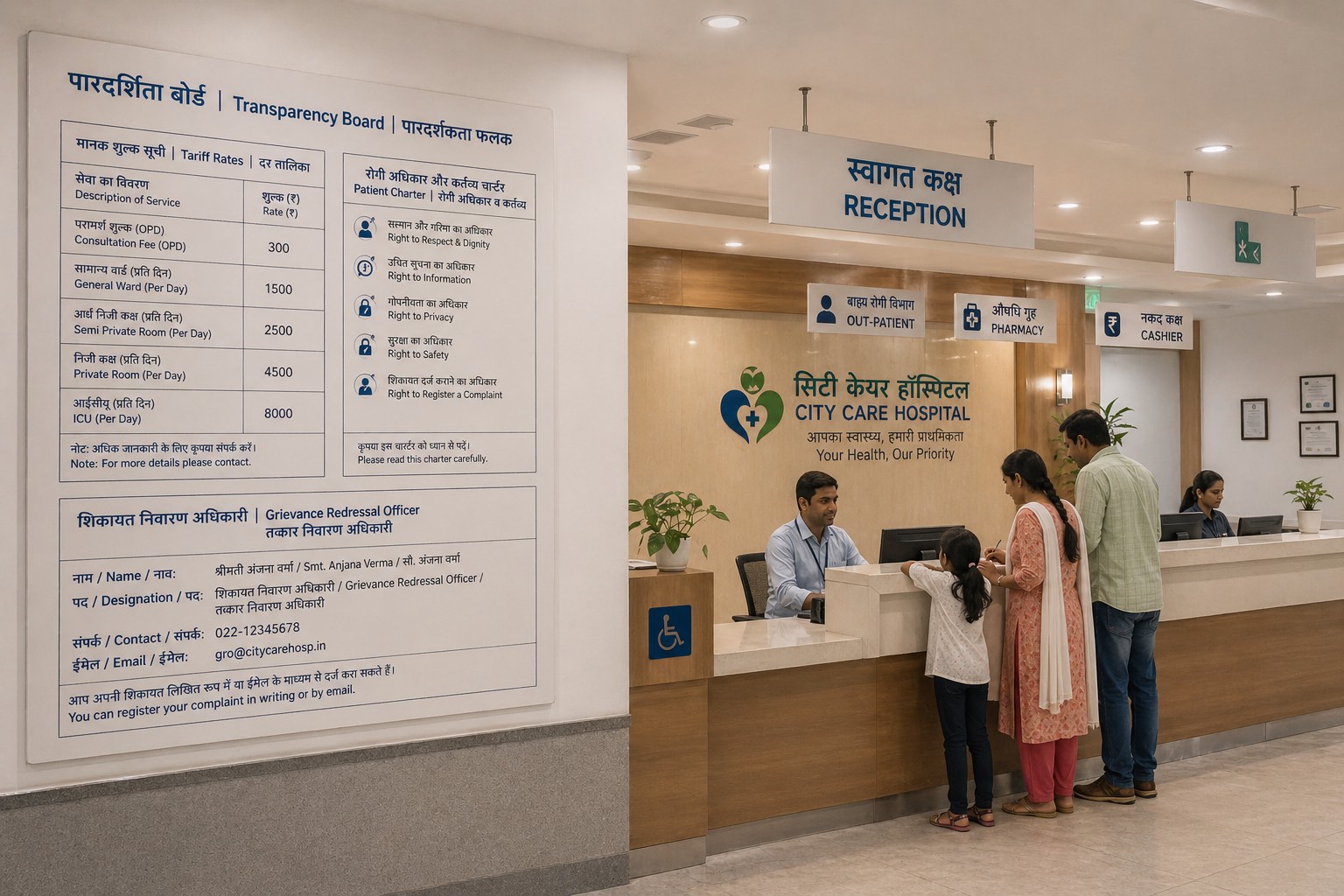
Clinical Establishments Act + State Variations: An Architect's Compliance Map for All States
The Centre Act 2010 and the Twelve States with Their Own Statutes — Karnataka, Maharashtra, Delhi, Tamil Nadu, West Bengal, Telangana, Kerala, UP, Rajasthan, Madhya Pradesh, Chhattisgarh, Gujarat — Side-by-Side Schedules of Minimum Areas, Equipment, Penalties, and Architectural Deliverables
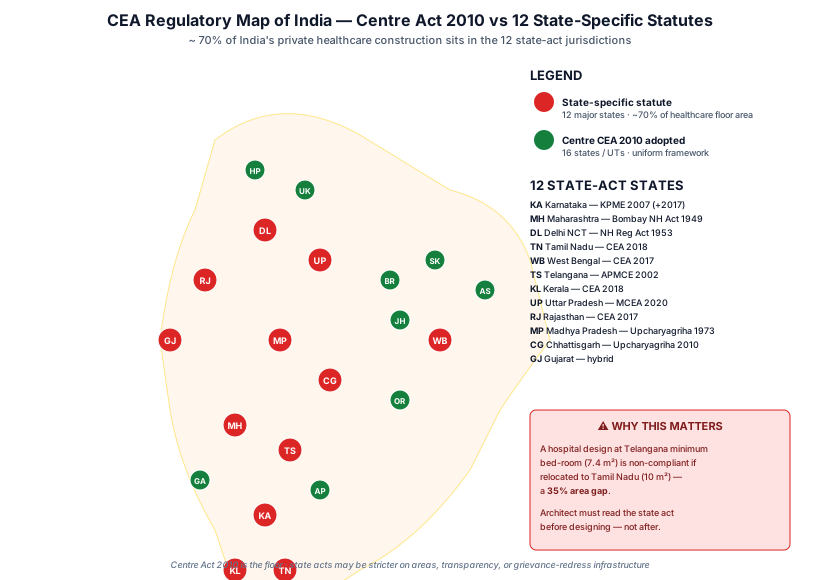
Healthcare licensing in India is constitutionally a state subject. The Centre's Clinical Establishments (Registration & Regulation) Act 2010 was intended as a unifying framework, but state-by-state adoption has been uneven. Twelve major states — accounting for an estimated 70% of India's private healthcare construction by floor area — operate under their own statutes, several of which pre-date the Centre Act by decades and several of which have been notified or revised after it. The architect who designs to "Centre CEA standards" without checking the state act produces buildings that may meet the Centre baseline but fail state-specific minimum-area schedules, transparency provisions, or grievance-redressal infrastructure requirements.
This guide is the sixth in the ten-part series and the second regulatory deep-dive. It assumes the reader has read the pillar reference, the facility-type guides, and the NBC Group C-1 reference. It provides what no single document currently provides: a state-by-state side-by-side comparison of CEA / state-act schedules at the level of detail the architect needs.
The comparative tables are arranged by topic — minimum bed-room areas, OT areas, labour rooms, mortuary thresholds, transparency provisions, penalties — so the architect can read the row that applies to a project state and compare it against neighbouring jurisdictions. The guide also covers the application process and the architect's deliverables for each state.
"In India, every state is a different country for the architect of a hospital. The architect who does not learn this learns it the hard way." — Anonymous senior healthcare-architecture practitioner, paraphrased
"The Clinical Establishments Act is the most important Indian healthcare law that most architects have never read. We need to fix that." — Dr. K.K. Aggarwal (1958–2020), former President, Indian Medical Association, paraphrased from a 2017 IMA continuing-education talk
1. The Centre Act 2010 — What It Actually Says
The Clinical Establishments (Registration & Regulation) Act 2010 (Centre) provides:
| Provision | Substance |
|---|---|
| Mandatory registration | Every clinical establishment must register with the state authority |
| Minimum standards | Categories A, B, C, D by facility scope; minimum area, equipment, staff norms |
| State adaptation | States adopt and modify rules within Centre framework |
| Display obligations | Tariff display, registration certificate, contact details |
| Penalty framework | Up to ₹50,000 for non-registration; higher for repeat |
| Appellate authority | District-level tribunal |
| Inspection | Health authority inspection and re-inspection |
The Centre Act has been adopted by 16 states / UTs as of 2026: Andhra Pradesh, Arunachal Pradesh, Assam, Bihar, Goa, Haryana (partial), Himachal Pradesh, J&K, Ladakh, Jharkhand, Manipur, Meghalaya, Mizoram, Nagaland, Odisha, Puducherry, Punjab (partial), Sikkim, Tripura, and Uttarakhand. The remaining 12 large states operate under state-specific statutes.
2. Karnataka — KPME (2007 with 2017 Amendment)
The Karnataka Private Medical Establishments Act 2007, amended significantly in 2017, is among the most architecturally consequential state acts.
| Provision | KPME Specification |
|---|---|
| Coverage | All private clinical establishments — hospital, nursing home, clinic, polyclinic, lab, diagnostic |
| Minimum bed-room area, single | 9 m² |
| Minimum bed-room area, twin | 7 m² per bed |
| Minimum OT area | 18 m² |
| Minimum labour room area | 15 m² |
| Recovery / post-anaesthesia | Required ≥ 30 beds |
| ICU | Required if surgery offered ≥ 30 beds |
| Mortuary | Required ≥ 30 beds |
| Pharmacy | Required if dispensing |
| Tariff display | Mandatory; bilingual (Kannada + English) |
| Patient charter display | Mandatory |
| Grievance redressal | Designated officer; complaint register |
| Inspection | Annual + complaint-based |
| Renewal | Every 3 years |
| Penalty | ₹50,000 for non-registration; ₹25,000 per day continuing |
| Appellate | Karnataka State Health Tribunal |
| Special provision | Bilingual Kannada-English signage; transparency board with rates |
Architect's deliverables for KPME: schedule of bed-rooms (single & twin) with area against KPME minima; OT and labour room dimensioned drawings; mortuary if ≥ 30 beds; tariff display board location; grievance redress officer's room (typically near OPD); bilingual signage strategy.
3. Maharashtra — Bombay Nursing Homes Registration Act 1949
Maharashtra continues to operate under the Bombay Nursing Homes Registration Act 1949, with state-level rules and amendments. A new Maharashtra Clinical Establishments Bill has been in process for several years; until enacted, the 1949 act governs.
| Provision | Bombay NH Act Specification |
|---|---|
| Coverage | Premises used for reception and care of sick, injured, infirm |
| Minimum bed-room area, single | 9.3 m² |
| Minimum bed-room area, twin | 7 m² per bed |
| Minimum OT area | 18 m² |
| Minimum labour room | 13.94 m² |
| Recovery | Required ≥ 30 beds |
| Mortuary | Required ≥ 30 beds |
| Pharmacy | Required if dispensing |
| Tariff display | Mandatory |
| Special provision (Mumbai DCPR 2034) | Hospital permitted in residential zones with conditions; TDR-loading possible |
| Penalty | ₹500 per day of contravention (low; revisions in process) |
| Renewal | Annual |
| Appellate | District Tribunal |
Architect's deliverables for Maharashtra: Bombay NH Act schedule of areas; Mumbai DCPR Reg. 33(21) compliance for special-building consideration in Mumbai; hospital area in residential zone justification if applicable; tariff display.
4. Delhi (NCT) — Delhi Nursing Homes Registration Act 1953
The Delhi Nursing Homes Registration Act 1953 is the oldest state nursing-home statute still in active use. The Delhi Nursing Homes Rules 1953 (and subsequent rules) detail the architectural requirements. Revisions to a Delhi CEA are under consideration.
| Provision | Delhi NH Act / Rules |
|---|---|
| Coverage | Premises used for reception and treatment of sick; includes maternity homes |
| Minimum bed-room area, single | 8.4 m² |
| Minimum bed-room area, twin | 7 m² per bed |
| Minimum OT area | 16.7 m² |
| Minimum labour room | 13.94 m² |
| Recovery | Required by Delhi NH Rules |
| Mortuary | Required ≥ 30 beds |
| Pharmacy | Required if dispensing |
| Tariff display | Mandatory |
| Separate ambulance entry | Mandatory ≥ 100 beds (Unified Building Bye-laws Delhi 2016) |
| Penalty | ₹5,000 + closure |
| Renewal | Periodic |
| Appellate | Delhi District Tribunal |
Architect's deliverables for Delhi: Delhi NH schedule of areas; separate ambulance entry from concept stage if ≥ 100 beds; UBBL 2016 compliance for hospital in Delhi.
5. Tamil Nadu — TN CEA 2018
The Tamil Nadu Clinical Establishments (Regulation) Act 2018 is among the most recently enacted state acts and has notably higher minimum-area requirements than other states.
| Provision | TN CEA 2018 |
|---|---|
| Coverage | All clinical establishments — public and private; allopathic and AYUSH |
| Minimum bed-room area, single | 10 m² |
| Minimum bed-room area, twin | 8 m² per bed |
| Minimum OT area | 23 m² |
| Minimum labour room | 18 m² |
| Recovery | Required |
| ICU | Required if acute care or surgery |
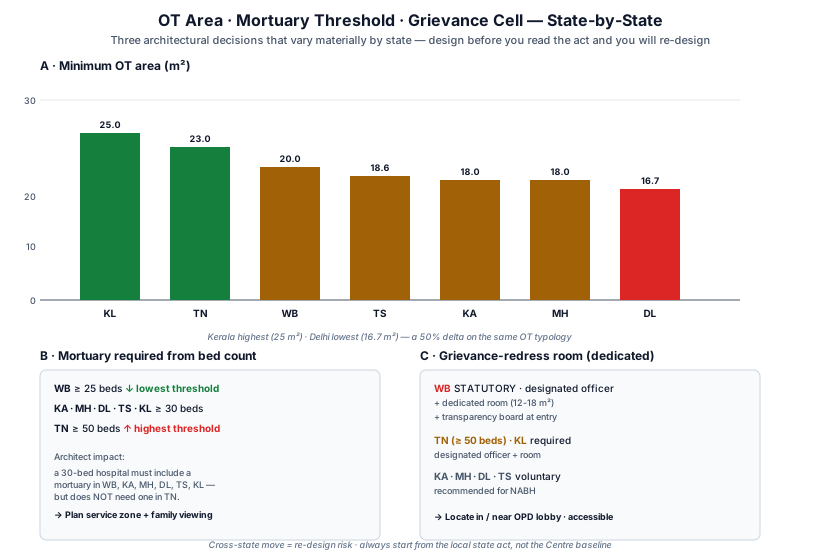
| Mortuary | Required ≥ 50 beds (higher threshold) |
| Pharmacy | Required if dispensing |
| Patient charter | Mandatory + tariff display |
| Grievance redressal | Required ≥ 50 beds |
| Bilingual signage | Tamil + English |
| Penalty | ₹50,000 for non-registration |
| Renewal | Every 3 years |
| Appellate | TN State Health Tribunal |
Architect's deliverables for Tamil Nadu: TN CEA schedule of areas (notably higher); patient-charter wall in OPD; grievance redressal room ≥ 50 beds; bilingual Tamil-English signage system.
6. West Bengal — WB CEA 2017 (Most Transparency-Focused)
The West Bengal Clinical Establishments (Registration, Regulation and Transparency) Act 2017 is the most transparency-focused state act, with statutory grievance-redressal infrastructure requirements that have direct architectural implications.
| Provision | WB CEA 2017 |
|---|---|
| Coverage | All clinical establishments |
| Minimum bed-room area, single | 9 m² |
| Minimum bed-room area, twin | 7 m² per bed |
| Minimum OT area | 20 m² |
| Minimum labour room | 15 m² |
| Mortuary | Required ≥ 25 beds (lowest threshold among states) |
| Grievance redressal cell | Statutory — designated officer + dedicated room |
| Tariff display | Mandatory + grievance officer's contact |
| Patient rights board | Mandatory display |
| Pricing transparency | Pre-treatment estimate mandatory |
| Special powers | Health regulator can fix prices for emergency care |
| Penalty | ₹50,000 to ₹5 lakh + closure |
| Inspection | Surprise inspections |
| Appellate | WB State Tribunal |
Architect's deliverables for West Bengal: WB CEA schedule of areas; mortuary if ≥ 25 beds; dedicated grievance-redressal room (12–18 m²) in accessible location near OPD; transparency-board location at entrance; bilingual Bengali-English signage; pre-treatment estimate display infrastructure.
7. Telangana — APMCE Act 2002
The Andhra Pradesh / Telangana Allopathic Private Medical Care Establishments (Registration & Regulation) Act 2002 (continuing in Telangana post-bifurcation) has notably lower minimum-area requirements compared to other states.
| Provision | Telangana APMCE Specification |
|---|---|
| Coverage | Allopathic private medical care establishments |
| Minimum bed-room area, single | 7.4 m² |
| Minimum bed-room area, twin | 6.5 m² per bed |
| Minimum OT area | 18.6 m² |
| Minimum labour room | 14 m² |
| Recovery | Required |
| Mortuary | Required ≥ 30 beds |
| Pharmacy | Required if dispensing |
| Tariff display | Mandatory |
| Penalty | ₹2,000 (low) |
| Renewal | Every 3 years |
| Appellate | TS State Tribunal |
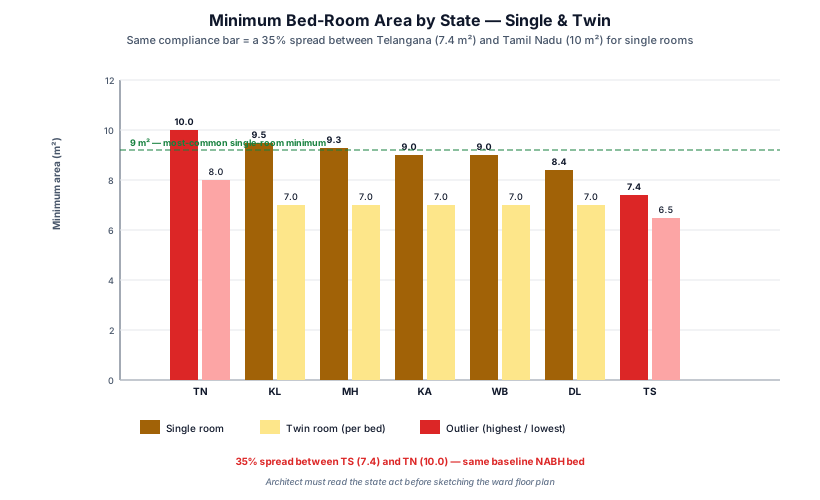
Architect's deliverables for Telangana: APMCE schedule of areas; bilingual Telugu-English signage. Note: a hospital design at Telangana minimum area is non-compliant if relocated to TN (a 35% area gap on bed-rooms).
8. Kerala — Kerala CEA 2018
The Kerala Clinical Establishments (Registration & Regulation) Act 2018 is among the most comprehensive state acts.
| Provision | Kerala CEA 2018 |
|---|---|
| Coverage | All clinical establishments |
| Minimum bed-room area, single | 9.5 m² |
| Minimum bed-room area, twin | 7 m² per bed |
| Minimum OT area | 25 m² (one of the highest) |
| Minimum labour room | 18 m² |
| Recovery | Required |
| ICU | Detailed schedule for tertiary |
| Mortuary | Required ≥ 30 beds |
| Pharmacy | Required if dispensing |
| Tariff display | Mandatory bilingual Malayalam + English |
| Grievance redressal | Required |
| Patient charter | Mandatory display |
| Penalty | ₹50,000 |
| Renewal | Every 3 years |
| Appellate | Kerala State Tribunal |
Architect's deliverables for Kerala: Kerala CEA schedule of areas (high OT minimum); grievance-redressal room; bilingual Malayalam-English signage.
9. Uttar Pradesh — UP MCEA 2020
The Uttar Pradesh Medical Care Establishments (Registration & Regulation) Act 2020 replaced earlier UP nursing-home regulations.
| Provision | UP MCEA 2020 |
|---|---|
| Coverage | All medical care establishments |
| Minimum bed-room area, single | 9 m² |
| Minimum bed-room area, twin | 7 m² per bed |
| Minimum OT area | 20 m² |
| Minimum labour room | 15 m² |
| Recovery | Required ≥ 30 beds |
| Mortuary | Required ≥ 30 beds |
| Pharmacy | Required if dispensing |
| Tariff display + IPD rate card | Mandatory |
| Penalty | ₹50,000 |
| Renewal | Every 5 years |
| Appellate | UP State Tribunal |
Architect's deliverables for UP: UP MCEA schedule of areas; tariff and IPD rate card display; bilingual Hindi-English signage.
10. Rajasthan — Rajasthan CEA 2017
The Rajasthan Clinical Establishments (Registration & Regulation) Act 2017.
| Provision | Rajasthan CEA 2017 |
|---|---|
| Coverage | All clinical establishments |
| Minimum bed-room area, single | 9 m² |
| Minimum bed-room area, twin | 7 m² per bed |
| Minimum OT area | 20 m² |
| Minimum labour room | 15 m² |
| Mortuary | Required ≥ 30 beds |
| Tariff display | Mandatory |
| Patient charter | Mandatory |
| Penalty | ₹50,000 |
| Renewal | Every 3 years |
Architect's deliverables for Rajasthan: Rajasthan CEA schedule of areas; bilingual Hindi-English signage.
11. Madhya Pradesh, Chhattisgarh, and Gujarat — State Acts in Detail
| Provision | MP NH Act 1973 (revised) | Chhattisgarh Upcharyagriha 2010 | Gujarat (hybrid — Bombay NH + state bill in process) |
|---|---|---|---|
| Coverage | Nursing homes, hospitals | Healthcare establishments | Currently Bombay NH Act applies |
| Min bed-room area, single | 9 m² | 9 m² | 9.3 m² (Bombay) |
| Min bed-room area, twin | 7 m² per bed | 7 m² per bed | 7 m² per bed |
| Min OT area | 18 m² | 18 m² | 18 m² |
| Min labour room | 14 m² | 14 m² | 13.94 m² |
| Mortuary | ≥ 30 beds | ≥ 30 beds | ≥ 30 beds |
| Tariff display | Mandatory | Mandatory | Mandatory |
| Penalty | ₹50,000 | ₹50,000 | ₹500/day (Bombay) |
| Renewal | Every 3 years | Every 3 years | Annual |
Gujarat note: until the Gujarat Clinical Establishments Bill is enacted, Bombay NH Act effectively applies. Architects designing in Gujarat should track the Bill's progress and design with conservative minima (the higher of Bombay NH or anticipated Gujarat schedule).
12. Comparative Master Table — Key Architectural Provisions
A condensed master table for architects working across multiple states.
| State | Bed Single (m²) | Bed Twin (m²/bed) | OT (m²) | Labour (m²) | Mortuary Threshold | Grievance Room Statutory | Penalty |
|---|---|---|---|---|---|---|---|
| Centre CEA 2010 | 8 | 6.5 | 18 | 14 | ≥ 30 beds | No | ₹50,000 |
| Karnataka KPME | 9 | 7 | 18 | 15 | ≥ 30 beds | Officer + Register | ₹50,000 |
| Maharashtra Bombay NH | 9.3 | 7 | 18 | 13.94 | ≥ 30 beds | No | ₹500/day |
| Delhi NH 1953 | 8.4 | 7 | 16.7 | 13.94 | ≥ 30 beds | No | ₹5,000 + closure |
| Tamil Nadu CEA 2018 | 10 | 8 | 23 | 18 | ≥ 50 beds | Yes ≥ 50 beds | ₹50,000 |
| West Bengal CEA 2017 | 9 | 7 | 20 | 15 | ≥ 25 beds | Yes — statutory room | ₹50,000–₹5L |
| Telangana APMCE 2002 | 7.4 | 6.5 | 18.6 | 14 | ≥ 30 beds | No | ₹2,000 |
| Kerala CEA 2018 | 9.5 | 7 | 25 | 18 | ≥ 30 beds | Yes | ₹50,000 |
| UP MCEA 2020 | 9 | 7 | 20 | 15 | ≥ 30 beds | No | ₹50,000 |
| Rajasthan CEA 2017 | 9 | 7 | 20 | 15 | ≥ 30 beds | No | ₹50,000 |
| MP NH Act 1973 | 9 | 7 | 18 | 14 | ≥ 30 beds | No | ₹50,000 |
| Chhattisgarh 2010 | 9 | 7 | 18 | 14 | ≥ 30 beds | No | ₹50,000 |
| Gujarat (Bombay NH) | 9.3 | 7 | 18 | 13.94 | ≥ 30 beds | No | ₹500/day |
Cross-state design implications:
- A facility designed at the Telangana 7.4 m² minimum is non-compliant in TN, Kerala, KPME, MH, MP, RJ, UP, WB, CG, and GJ.
- A facility designed at the Centre Act 8 m² minimum is non-compliant in 11 of 12 state-specific jurisdictions.
- The architect should design at the state minimum + 10% buffer to avoid borderline non-compliance during inspection rounding.
13. Application Process — A Common Sequence with State Adjustments
While each state has its own forms and timelines, the application sequence is broadly common.
| Step | Action | Typical Calendar |
|---|---|---|
| 1 | Pre-application meeting with state health authority | Before concept |
| 2 | Submission of application — Form A (Centre) / state-specific form | At preliminary design |
| 3 | Submission fee | At application |
| 4 | Document upload — building plan, ownership, registration of practitioners, equipment list | At application |
| 5 | Provisional registration (some states) | 30–60 days |
| 6 | Site inspection by state authority | 60–120 days |
| 7 | Compliance correction (if any) | 30–60 days |
| 8 | Permanent registration | 120–180 days from application |
| 9 | Display of registration certificate | Pre-operation |
| 10 | Renewal | Every 1–5 years per state |
Architect's role: preparing the building-plan annexure and area-schedule against the state act's minimum schedule is the architect's deliverable. The state authority's inspection focuses on physical compliance — the architect's drawings must match the constructed reality, since post-construction modifications void the registration.
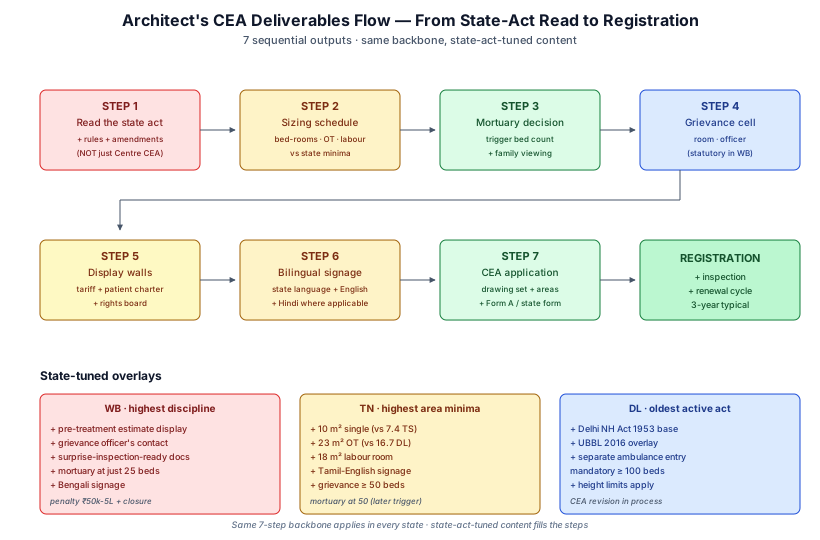
14. The Architect's Compliance Deliverables Matrix — All 12 States
A condensed matrix of what the architect produces, organised by deliverable rather than by state.
| Deliverable | All States | KPME | Bombay NH | Delhi NH | TN CEA | WB CEA | Telangana | Kerala | UP | RJ | MP/CG/GJ |
|---|---|---|---|---|---|---|---|---|---|---|---|
| Schedule of areas vs minimum | Required | KPME schedule | Bombay schedule | Delhi schedule | TN schedule (high) | WB schedule | APMCE schedule | Kerala schedule (high) | UP schedule | RJ schedule | State schedule |
| Bilingual signage | Required | Kannada+English | Marathi+English | Hindi+English | Tamil+English | Bengali+English | Telugu+English | Malayalam+English | Hindi+English | Hindi+English | Hindi/Marathi+English |
| Tariff display | Required | Yes | Yes | Yes | Yes + charter | Yes + grievance contact | Yes | Yes + charter | Yes + IPD rates | Yes + charter | Yes |
| Patient charter wall | Often | Optional | Optional | Optional | Mandatory | Mandatory | Optional | Mandatory | Mandatory | Mandatory | Optional |
| Grievance redressal room | Conditional | Optional | Optional | Optional | ≥ 50 beds | Mandatory | Optional | Mandatory | Optional | Optional | Optional |
| Mortuary | Threshold-based | ≥ 30 | ≥ 30 | ≥ 30 | ≥ 50 | ≥ 25 | ≥ 30 | ≥ 30 | ≥ 30 | ≥ 30 | ≥ 30 |
| Pre-treatment estimate display | Conditional | — | — | — | — | Yes — statutory | — | — | — | — | — |
| Separate ambulance entry | Conditional | — | — | ≥ 100 beds | — | — | — | — | — | — | — |
15. Failure Modes Specific to Multi-State Practice
| # | Failure | Prevention |
|---|---|---|
| 1 | Designing to Centre CEA 2010 minimum without checking state act | Always read state act first |
| 2 | Reusing TN-compliant design in Telangana (or vice versa) without re-area | State-specific area schedule |
| 3 | Missing WB grievance-redressal room | Designate at concept |
| 4 | Missing TN grievance redress room (≥ 50 beds) | Designate for hospitals ≥ 50 beds |
| 5 | Missing pre-treatment estimate display in WB | Statutory in WB |
| 6 | Missing separate ambulance entry in Delhi (≥ 100 beds) | UBBL 2016 |
| 7 | Bilingual signage in wrong language pair | Confirm state language |
| 8 | Mortuary threshold mis-counted in WB (≥ 25, lower than other states) | WB threshold |
| 9 | Patient charter wall not bilingual | Wall design includes both languages |
| 10 | Penalty risk under-counted in WB / TN (₹5L / ₹50K) | Compliance discipline |
References
- Government of India (2010) The Clinical Establishments (Registration and Regulation) Act 2010. New Delhi: MoHFW.
- Government of Karnataka (2007 / 2017) The Karnataka Private Medical Establishments Act 2007 (with Amendment Act 2017). Bengaluru: Karnataka Health & Family Welfare Department.
- Government of Maharashtra (1949) Bombay Nursing Homes Registration Act 1949 with Maharashtra Rules. Mumbai: Maharashtra Public Health Department.
- Government of NCT of Delhi (1953) Delhi Nursing Homes Registration Act 1953 with Delhi Nursing Homes Rules. New Delhi: Delhi Health & Family Welfare Department.
- Government of Tamil Nadu (2018) The Tamil Nadu Clinical Establishments (Regulation) Act 2018. Chennai: TN Health & Family Welfare Department.
- Government of West Bengal (2017) The West Bengal Clinical Establishments (Registration, Regulation and Transparency) Act 2017. Kolkata: WB Health & Family Welfare Department.
- Government of Telangana (2002) The Andhra Pradesh / Telangana Allopathic Private Medical Care Establishments (Registration & Regulation) Act 2002. Hyderabad.
- Government of Kerala (2018) The Kerala Clinical Establishments (Registration and Regulation) Act 2018. Thiruvananthapuram: Kerala Health & Family Welfare Department.
- Government of Uttar Pradesh (2020) The Uttar Pradesh Medical Care Establishments (Registration & Regulation) Act 2020. Lucknow.
- Government of Rajasthan (2017) The Rajasthan Clinical Establishments (Registration and Regulation) Act 2017. Jaipur.
- Government of Madhya Pradesh (1973, revised) Madhya Pradesh Upcharyagriha Tatha Rajya Chikitsalaya Adhiniyam. Bhopal.
- Government of Chhattisgarh (2010) Chhattisgarh Upcharyagriha Tatha Rogopchar Sambandhi Sthapnaye Adhiniyam. Raipur.
- Government of Delhi (2016) Unified Building Bye-laws Delhi 2016. New Delhi.
- Government of Maharashtra (2034) Development Control and Promotion Regulations 2034 (Mumbai). Mumbai.
- Garg, S. and Singh, R. (2017) 'Clinical Establishments Act 2010: implementation challenges in India', Indian Journal of Public Health, 61(3), pp. 162–166.
- Nandraj, S. (2012) 'Unregulated and unaccountable: how the private health sector in India fares', Economic and Political Weekly, 47(4), pp. 12–17.
- Patel, V. et al. (2015) 'Assuring health coverage for all in India', The Lancet, 386(10011), pp. 2422–2435.
- Reddy, K.S. (2015) Healers or Predators? Healthcare Corruption in India. New Delhi: Oxford University Press.
Author's Note: State acts evolve. The Maharashtra CEA bill is at various stages; Gujarat's bill is under process; UP enacted MCEA 2020; Rajasthan in 2017; Kerala in 2018. The architect designing for a multi-state portfolio should track state-level revisions every 6 months. The 2026 status presented in this guide is accurate as of the publication date but should be verified against current state notifications before any binding design commitment. The author has elected to focus this guide on the 12 states that operate under their own statutes; the 16+ states that have adopted the Centre Act follow the Centre framework with state-specific adjustments minor enough to be addressed within the Centre framework reading.
Disclaimer: This article is for informational and educational purposes only and does not constitute legal, regulatory, or professional architectural advice. State acts, rules, fees, and penalties are subject to revision; verify current status with the state health department before any binding design or construction commitment. Studio Matrx, its authors, and contributors accept no liability for decisions made on the basis of the information in this guide.
Interactive · Clinical Establishments Act — state variations
Karnataka · State Act applies
Notified CEA
12
states
State Act applies
7
states
Partial
0
states
Not notified
1
states
Pick a state
Karnataka · State Act applies
Applicable Act: Karnataka Private Medical Establishments Act 2007 (KPMEA)
KPMEA predates CEA; covers OPD + IPD + diagnostics.
Registration fee
₹1,000-50,000 tiered
Coverage threshold
All medical establishments
Why this matters
CEA implementation varies dramatically. Maharashtra + Karnataka + Tamil Nadu + Kerala + West Bengal use state-specific Acts that often have stricter provisions (price-display, grievance redressal) than central CEA. Always check the operating state's primary Act.
References: Clinical Establishments (Registration & Regulation) Act 2010 + state notifications, state-specific Nursing Home Acts. Status as of 2025 — periodic state-level changes are common.
Export this guide
Related Guides — Deep-dive reading
Nursing Home Design (10–30 beds) in India: A Compliance Guide
An Architect's Working Reference — State Nursing Homes Acts (Bombay, Delhi, WB), Centre & State CEA Application at Small-Hospital Scale, Scaled-Down Infrastructure, Fire Constraints on Residential Plots, Bungalow-to-Nursing-Home Conversions, and the Compliance Calendar
Healthcare ArchitectureHealthcare Architecture in India: The Regulatory Landscape
A Pillar Reference for Architects — Three Regulatory Layers, Approval Matrix by Facility Type, State-by-State Variation, Sequencing, Stakeholder Map, and the Compliance Deliverables Checklist
Healthcare ArchitectureDesigning Hospitals in India (>30 beds): A Statutory Compliance Roadmap
An Architect's Working Reference — NBC Group C-1, Bed-Strength Regulatory Tiers, OT/ICU/CSSD Compliance, Environmental Clearance, SPCB, State CEA, Fire, IPHS for Government Hospitals, and the Hospital-Specific Compliance Calendar
Healthcare ArchitectureRelated Tools — Try Free
Homestay Licence Finder
Pick your state for the homestay registration picture — room caps, residence rules and fees — plus the three compliance layers every host needs.
Licence FinderCircadian Light Meter
Patient-centric circadian lighting visualizer for Indian healthcare design — time-of-day × intensity → CCT, melanopic lux (EML / mEDI), melatonin suppression, and an alertness curve. Calibrated against WELL v2 L03 Circadian Lighting Design, CIE S 026:2018, Brainard 2001, and Lucas et al. 2014.
Circadian ToolProperty Tax Calculator — 10 Indian Cities
Estimate annual municipal property tax across BBMP / MCD / MCGM / GHMC / GCC / KMC / PMC / AMC / TMC / PCMC — with self-occupied, tenanted, and age-rebate adjustments.
Property Tax